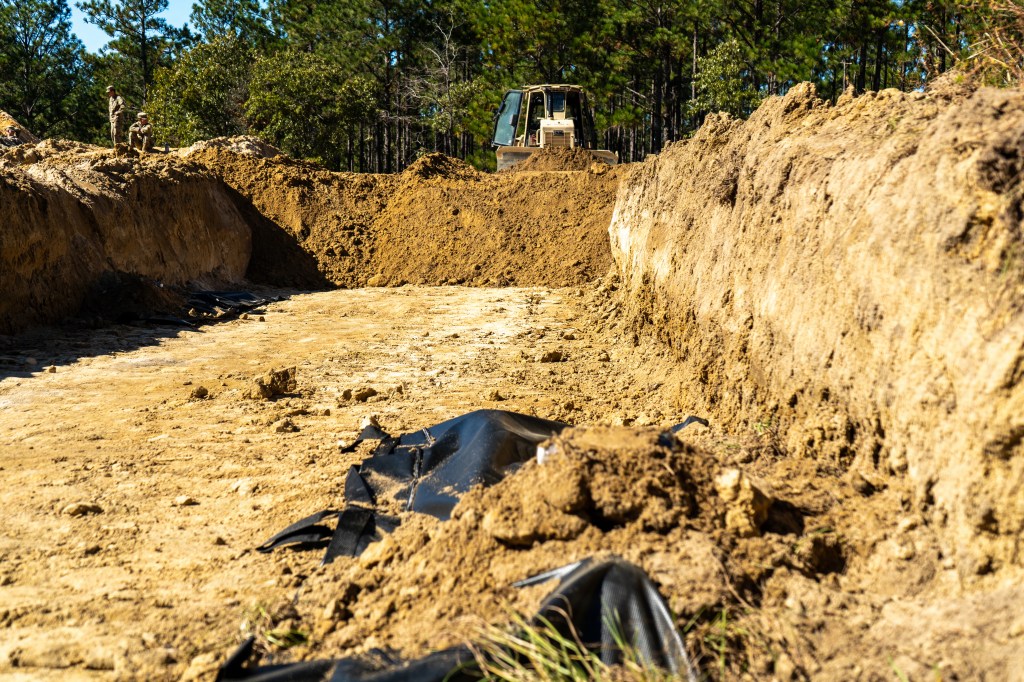
In preparation for potential future conflicts where rapid evacuation of fallen soldiers might not be feasible, the Army is honing its skills in battlefield burials. Recent exercises in North Carolina have focused on efficiently creating temporary graves while ensuring that the remains can be identified and returned to families post-conflict.
As detailed in a recent release, the Army’s exercise included engineers, chaplains, preventive medicine, and fatality management teams working together to prepare for large-scale temporary interments, reminiscent of practices not seen since the Korean War era.
For over two decades, conflicts in Iraq and Afghanistan benefited from U.S. air superiority, enabling swift repatriation of remains. However, future large-scale combat operations (LSCO) might not allow for such capabilities, necessitating new strategies.
Operation Dragon Covenant’s Objectives
Phase II of Operation Dragon Covenant tested the Army’s ability to conduct temporary burial operations and preserve remains on a large scale. Soldiers used their equipment to excavate burial trenches, ensuring mock remains—composed of skeletal models and water containers—remained intact for future forensic teams to recover and repatriate.
Sgt. 1st Class Delbert Ruede, senior fatality management leader for the 3rd Corps Sustainment Command (CSC), emphasized the exercise’s significance: “This exercise allowed us to take a critical look at how we respect, honor, and systematically manage our fallen in a high-intensity conflict…What we are doing here is taking a scientific, field-tested approach so that we can maintain positive control and respectfully care for our fallen.”
Temporary Interment Protocols and Challenges
U.S. joint service guidance allows temporary graves in mass casualty situations where remains cannot be safely moved. The Army’s doctrine specifies that temporary interment plots should have five parallel trenches, each accommodating 100 bodies, with the capability of covering up to 2,400 bodies within 24 hours using continuous operation.
Recent exercises revealed that standard trench dimensions did not align with current equipment capabilities, prompting revisions in Army doctrine to better reflect modern machinery. The Geneva Conventions mandate that even enemy combatants’ bodies be documented, with identifying information collected, and cremation remains a rare exception.
Religious Considerations in Battlefield Burials
In addition to logistical challenges, the exercise highlighted the need for sensitive handling of religious protocols. Lt. Col. Ruska, chaplain for the 3rd CSC, noted the impracticality of pausing operations for individualized ceremonies in high-intensity combat zones. Thus, religious specialists consulted various faith groups to develop protocols ensuring dignified treatment of remains.
“By consecrating the site before remains are placed in the ground reassures families that their loved ones are treated with reverence, dignity and honor despite the inability to provide a memorial ceremony in a contested combat environment,” Ruska stated.
Looking Ahead
The exercise will advance into Phase III of Dragon Covenant in Spring 2027, integrating additional elements such as security, medical facilities, and mortuary affairs collection points, to further refine the Army’s preparedness for future conflicts.