In the waning days of World War II, the U.S. Navy faced an alarming threat. German U-boats might have been poised to launch missile attacks on the East Coast, targeting New York City. Despite the War Department’s doubts, the Navy took the threat seriously and initiated Operation Teardrop.
Launching the Hunt for German U-boats
The operation began amid rumors that German submarines were armed with V-1 rockets aimed at American cities. This intelligence came from two captured spies, William Colepaugh and Erich Gimpel, who had been apprehended after landing in Maine from U-1230. The Navy, unlike other military branches, considered these warnings credible enough to act.
In late 1944, Vice Admiral Jonas Ingram, commanding the Atlantic Fleet, publicly warned of possible missile attacks. This warning came despite skepticism from the War Department. Meanwhile, German propaganda fueled fears, with Minister of Armaments Albert Speer claiming that missiles would hit New York by February 1, 1945.
German Submarines on the Move
As part of Gruppe Seewolf, a group of nine Type IX submarines set sail from Norway in March 1945. Their mission was to disrupt Allied shipping along the American coast and draw anti-submarine forces away from Europe. However, thanks to intercepted communications, Allied forces were well-prepared for their arrival.
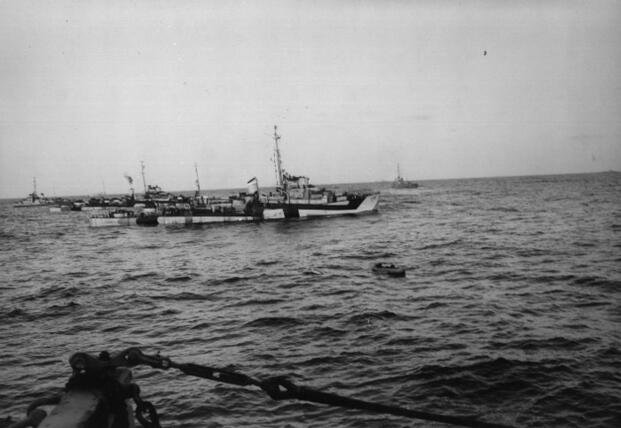
The U.S. Navy’s response, named Operation Teardrop, involved deploying two large barrier forces across the North Atlantic. These forces consisted of escort carriers and numerous destroyer escorts, ready to intercept any submarines approaching the American coastline.
A Costly Victory
On April 24, 1945, the destroyer escort USS Frederick C. Davis made contact with a German submarine, U-546. The submarine struck first, launching an acoustic torpedo that sank the Frederick C. Davis. This marked the last American warship lost in the Atlantic during the war.
Despite this loss, nearby American ships managed to destroy U-546, capturing 33 survivors, including the submarine’s commander, Paul Just. These survivors were expected to confirm whether the submarines carried missiles, leading to intense interrogations.
Intense Interrogations and Their Consequences
The captured crew of U-546 faced severe interrogation tactics, which later drew criticism from naval historian Philip Lundeberg, himself a survivor of the Frederick C. Davis. Desperate to confirm the missile threat, interrogators employed harsh methods, hoping to extract vital information quickly.
However, the interrogation revealed that the German submarines did not carry missile equipment. The fears of a missile attack turned out to be unfounded, with much of the intelligence based on rumors and propaganda.
Postwar Discoveries and Developments
After the war, it became clear that Germany had experimented with submarine-launched weapons, but none had been operationally deployed. The captured spies had likely repeated unverified rumors, and Speer’s broadcast was pure propaganda.
Despite the flawed intelligence, the operation showcased the importance of signals intelligence, as intercepts allowed precise tracking of submarine movements. The lessons learned from Operation Teardrop would influence future naval strategies and technologies.
Following the war, the U.S. Navy pursued its own submarine-launched missile program, building on German research. The USS Cusk became the first submarine to launch a guided missile, setting the stage for future advancements in naval warfare.