In the complex tapestry of World War II, few battles stand out more vividly than the Battle of Manila. This ferocious conflict, marked by strategic military maneuvers and widespread devastation, offers a poignant reminder of the costs of war. It was not just a clash of armies, but a struggle involving guerilla fighters and civilians, forever altering the face of the city and its people.
The Burden of Honor
Japanese Rear Admiral Sanji Iwabuchi bore the weight of past defeats, having survived the sinking of his battleship Kirishima by the USS Washington in 1942. Two years later, in Manila, he sought redemption against orders from General Tomoyuki Yamashita to evacuate. Instead, Iwabuchi chose to fight to the death, leading to one of the Pacific War’s most brutal urban battles, resulting in over 100,000 Filipino civilian casualties.
The Allied Advance
On January 9, 1945, Lt. Gen. Walter Krueger’s Sixth Army landed at Lingayen Gulf, marking the beginning of the race to Manila. General Douglas MacArthur, intent on reclaiming the city he left in 1942, ordered Maj. Gen. Oscar Griswold’s XIV Corps to seize Manila. The 1st Cavalry Division, led by Maj. Gen. Verne Mudge, raced towards the city, their urgency underscored by 18-year-old cavalryman Oscar Nipps’ recollection: “We made 88 miles in 66 hours, driving through a combat zone.”
Simultaneously, Maj. Gen. Joseph Swing’s 11th Airborne Division made a strategic landing at Nasugbu, with paratroopers from the 511th Parachute Infantry Regiment jumping onto Tagaytay Ridge. From the north, the Ohio National Guard’s 37th Infantry Division advanced, bracing for combat that would eclipse their previous experiences.
The Unsung Heroes
Filipino guerrillas played a crucial role in the battle. Captain Manuel Colayco helped navigate American forces through treacherous terrain, while Josefina Guerrero, a leprosy-afflicted resistance member, bravely delivered maps of Japanese minefields, facilitating safer passage for American troops. Her contributions earned her the Medal of Freedom with Silver Palm in 1948.
The Liberation Efforts
On February 3, the Flying Column breached the gates of Santo Tomas University, liberating thousands of internees. Japanese plans to incinerate the prisoners were thwarted by the rapid assault. The following day, over 1,000 POWs were freed at Bilibid Prison.
Engaging the Enemy
The 11th Airborne faced fierce resistance at the Genko Line, particularly at Nichols Field, where intense combat stretched from February 4 to 22. The paratroopers, including heroic figures like PFC Manuel Pérez Jr., fought against entrenched Japanese defenses, ultimately overcoming them despite significant casualties.
Crossing the Pasig
The 37th Infantry Division advanced into Manila, crossing the Pasig River on February 7. Fierce fighting ensued on Provisor Island, with the division suffering heavy losses. Yet, they managed to break into southern Manila, marking a critical turning point in the battle.
The Battle of Manila
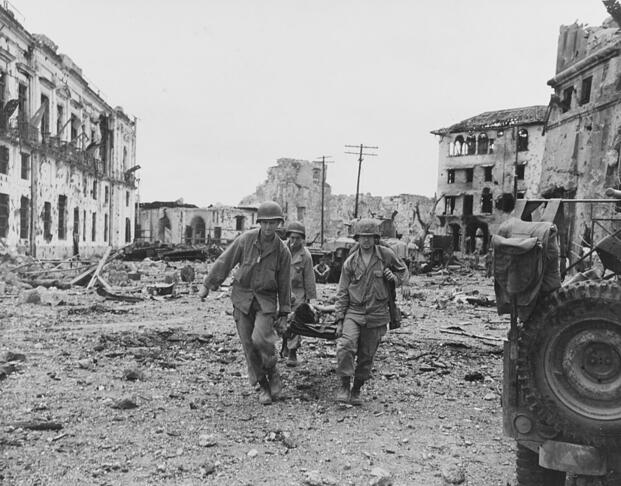
Despite initial restrictions on artillery to protect civilians, the reality of the battle led to widespread destruction. The 37th Infantry Division and the 1st Cavalry faced relentless Japanese resistance, with individual acts of valor, notably by Private Cleto Rodriguez and Pvt. Joseph Cicchetti, helping turn the tide.
Atrocities Uncovered
As Japanese forces retreated, they unleashed horrific atrocities on Filipino civilians. Systematic massacres were reported, including at De La Salle College and the Bay View Hotel, where unspeakable acts occurred. These war crimes left a lasting scar on the city and its people.
Final Assaults
By late February, Iwabuchi’s forces retreated to the fortified Intramuros. American artillery pummeled the area before infantry breached the walls. The fighting continued until March 3, culminating in the capture of the Finance Building and the suicide of Iwabuchi.
The Aftermath
Manila lay in ruins, with civilian deaths estimated between 100,000 to 240,000. The Battle of Manila stands as a testament to the human cost of war, underscored by the subsequent trials and execution of responsible Japanese commanders, including General Yamashita.
Today, the Memorare-Manila 1945 Monument in Intramuros serves as a poignant reminder of the sacrifices made, encapsulating the sentiments of survivors like Isabel Caro-Wilson, who said, “Have I forgiven? Of course, I have. But I haven’t forgotten.”