Autonomous Software Enhances U.S. Air Force’s Drone Wingmen
In a significant breakthrough for military aviation, the U.S. Air Force has announced the successful integration of government-owned autonomous software with its prototype collaborative combat aircraft (CCA). This development represents a pivotal advancement in the Air Force’s strategy to enhance modularity and flexibility within its fleet, using a modular open systems architecture.
The CCAs, designed to operate semi-autonomously, are intended to accompany advanced fighter jets like the F-35A and the forthcoming F-47. The Air Force plans to deploy at least 1,000 of these drone wingmen for various missions, including strike operations, reconnaissance, electronic warfare, and acting as decoys to divert enemy fire. For more details on the CCA development, visit Defense News.
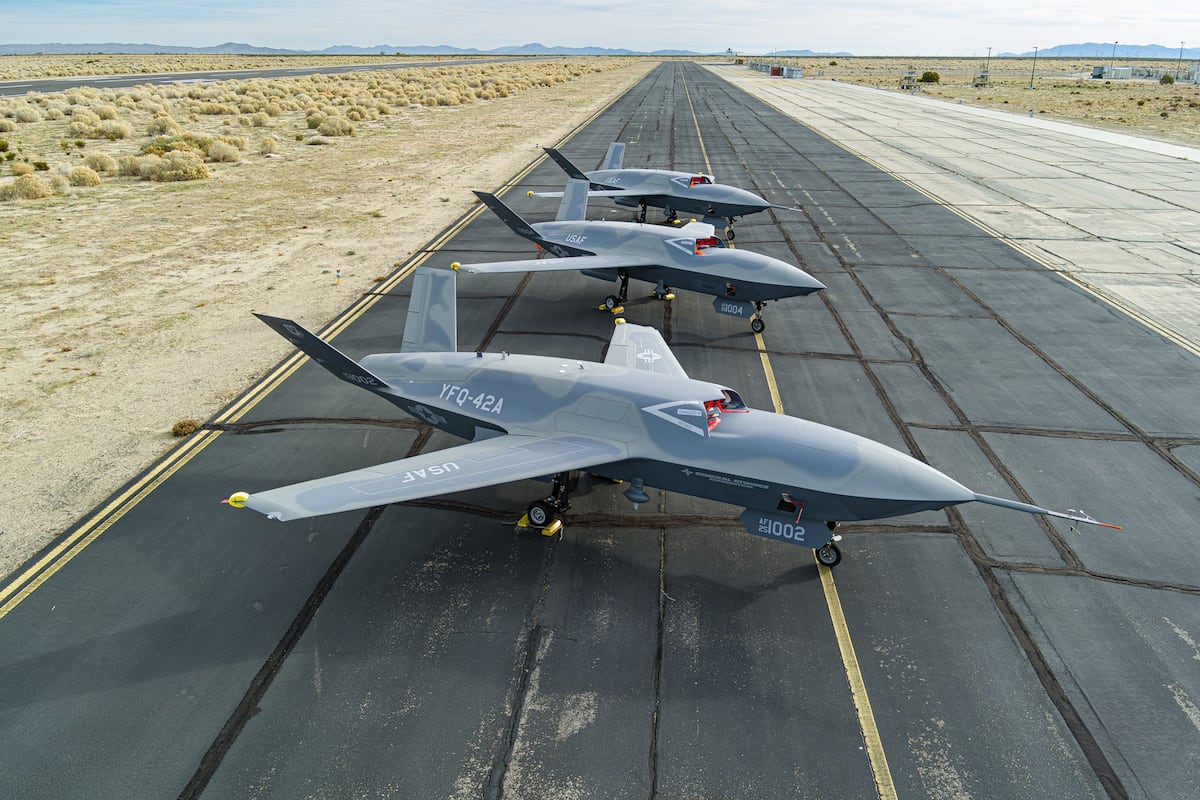
General Atomics and Anduril Industries were contracted in 2024 to develop the initial CCA models, the YFQ-42A and YFQ-44A, respectively. Ground testing commenced in spring 2025, followed by flight testing later that year. The integration of third-party autonomous software was achieved through the Autonomy Government Reference Architecture (A-GRA), facilitating seamless technology integration across different platforms.
“Verifying A-GRA across multiple partners is critical to our acquisition strategy,” stated Col. Timothy Helfrich, the Air Force’s portfolio acquisition executive. “It proves that we are not locked into a single solution or a single vendor. We are instead building a competitive ecosystem where the best algorithms can be deployed rapidly to the warfighter on any A-GRA compliant platform, regardless of the vendor providing the algorithm.”
The Air Force’s strategy to avoid “vendor lock” ensures that new software and algorithms can be rapidly integrated into the CCAs, allowing the force to adapt swiftly to emerging threats. General Atomics and Anduril Industries both expressed satisfaction with the successful integration.
General Atomics highlighted the use of RTX subsidiary Collins Aerospace’s Sidekick Collaborative Mission Autonomy software with the YFQ-42A. This software enabled the drone to conduct its first semi-autonomous airborne mission, with a human operator transmitting commands that the drone executed accurately over four hours.
“We are excited to collaborate with Collins to deliver enhanced autonomous mission solutions,” said David Alexander, president of General Atomics Aeronautical Systems Inc. “The integration of Sidekick with our YFQ-42A demonstrates our commitment to innovation and operational excellence in unmanned aircraft technology.”
Anduril’s senior vice president of engineering, Jason Levin, described the integration as “a meaningful step towards fielding a real operational capability by the end of the decade.” The YFQ-44A’s modular design allows it to be equipped with various mission systems and software to support a wide range of operations.
Levin also noted Anduril’s collaboration with Shield AI on integrating autonomous software, expressing anticipation for the forthcoming flights of the YFQ-44A equipped with this technology.