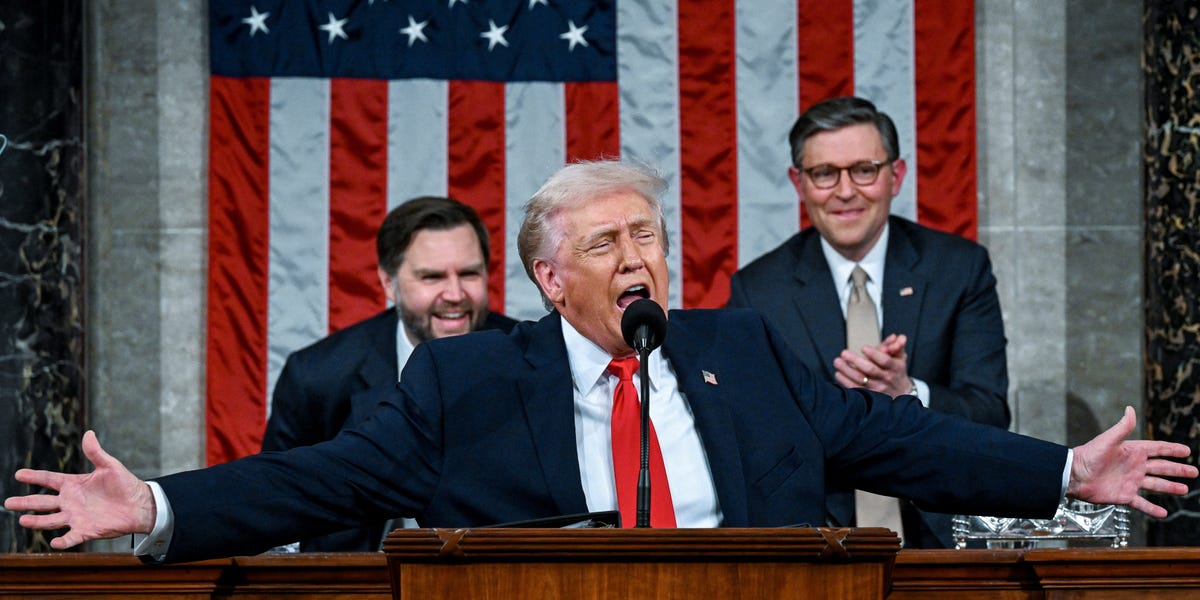
In a move that has stirred widespread discussion, President Donald Trump expressed his disappointment over the recent Supreme Court decision that nullified his key trade tariffs. During his State of the Union address, he labeled the ruling as “unfortunate,” highlighting the significant impact on his economic policies.
The Supreme Court’s decision came as a result of a challenge to the tariffs Trump had implemented in 2025 under the International Emergency Economic Powers Act (IEEPA). These tariffs, a cornerstone of his trade strategy, were struck down, prompting the president to reassure the nation that new trade deals were unnecessary. According to Trump, existing agreements were satisfactory for the other countries involved.
In response to the court’s ruling, Trump swiftly enacted an executive order to introduce a 10% “global tariff” leveraging Section 122 of the Trade Act of 1974. This legislative maneuver allows tariffs to be imposed for 150 days without requiring immediate congressional approval. Trump asserted that these tariffs are “a little more complex, but they’re actually probably better,” suggesting they could lead to an even more robust resolution.
He further stated, “They’re a little more complex, but they’re actually probably better, leading to a solution that will be even stronger than before. Congressional action will not be necessary.” Trump also remained optimistic about the financial implications, saying, “It’s already time-tested and approved, and as time goes by, I believe the tariffs paid for by foreign countries will, like in the past, substantially replace the modern-day system of income tax, taking a great financial burden off the people that I love.”
The IEEPA tariffs had generated approximately $129 billion in revenue, according to the Customs and Border Protection. With the tariffs now void, companies are beginning to seek refunds, and some, such as FedEx, have initiated legal actions in the Court of International Trade.
Reports, including a study by the Federal Reserve Bank of New York, indicate that the economic burden of these tariffs predominantly fell on U.S. firms and consumers, with “90% of the tariffs’ economic burden” impacting domestic stakeholders.
The timing of the Supreme Court’s decision coincides with growing concerns over economic affordability and health. While the U.S. economy experienced a 2.2% growth in 2025, job creation has recently stalled, exacerbating economic disparities. Economists have pointed out that these trends are further widening the gap between the wealthy and the rest of the population.
Public sentiment reflects dissatisfaction, as revealed by a February poll conducted by ABC News, The Washington Post, and Ipsos, which showed a majority of Americans disapprove of Trump’s handling of significant issues like inflation, tariffs, and international relations.
Further illustrating the economic climate, the University of Michigan’s consumer sentiment survey reported a more than 12% decline in consumer confidence compared to February 2025. Dana M Peterson, Chief Economist at The Conference Board, commented that although consumer pessimism has somewhat eased, confidence levels remain “well below” the peak seen in November 2024.