The 2026 State of the Union address delivered by President Donald Trump became a memorable occasion as it moved away from typical policy discussions to honor acts of exceptional bravery. During this widely watched political event, Trump awarded two Congressional Medals of Honor, spotlighting acts of courage spanning across decades yet unified by what he described as “extraordinary American courage.”
Recognizing Valor on the Battlefield
Amidst the political ambiance of the House chamber, the atmosphere transformed into one of military recognition. The event was marked by the presence of uniformed officers, injured veterans, and a centenarian Navy fighter pilot receiving the highest military distinction.
Heroics in Modern Conflict
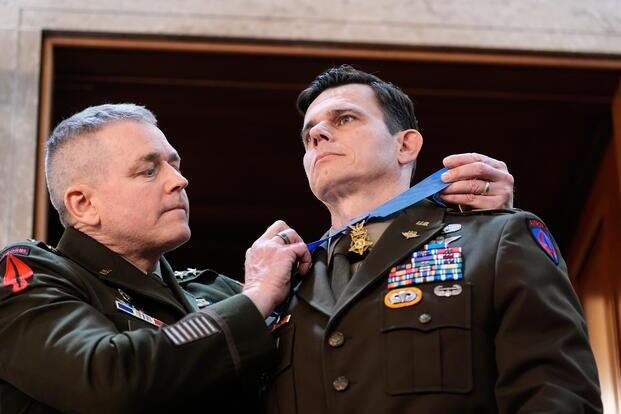
The first Medal of Honor was bestowed upon Army Chief Warrant Officer 5 Eric Slover, a helicopter pilot who sustained injuries during a mission capturing Venezuelan leader Nicolás Maduro in January. President Trump vividly described Slover’s ordeal in a Chinook helicopter under heavy enemy fire.
“While preparing to land, enemy machine guns fired from every angle, and Eric was hit very badly in the leg and hip, one bullet after another,” Trump said. “And yet… Eric maneuvered his helicopter with all of those lives and souls to face the enemy.”
Despite multiple gunshot wounds, Slover managed to reposition the helicopter, allowing door gunners to suppress enemy fire and avert a potentially catastrophic crash. He eventually handed over control to his co-pilot only after ensuring a safe landing.
“In recognition of Eric’s actions above and beyond the call of duty,” Trump said, “I would now like to ask General Jonathan Braga to present Chief Warrant Officer Slover with our nation’s highest military award, the Congressional Medal of Honor.”
The chamber erupted in applause as Slover, accompanied by his wife, was recognized for his heroism. The award served as a reminder of the dangers special operations and aviation crews face, even outside traditional war zones. Trump mentioned that ten other service members from the same mission would be honored at a future White House ceremony.
A Long-Awaited Tribute
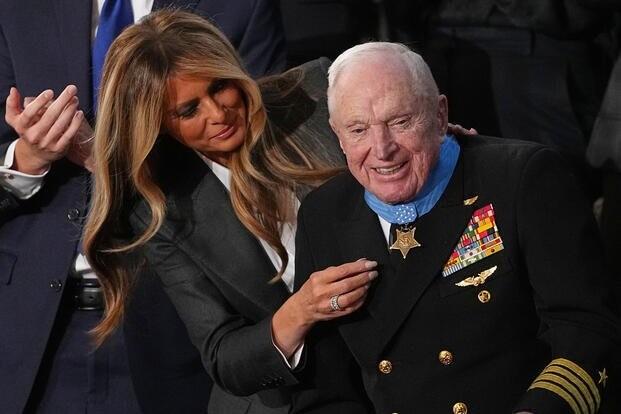
The second Medal of Honor acknowledged a historical act of bravery by retired Navy Capt. E. Royce Williams, aged 100. Williams was celebrated for his aerial combat during the Korean War, a battle that was kept secret for years due to Cold War concerns.
In 1952, Williams, flying a Grumman F9F Panther, faced off against seven Soviet MiG-15 jets in harsh weather over the Sea of Japan. Despite being heavily outnumbered and his aircraft being struck over 200 times, he managed to down four enemy planes.
“Tonight, at 100 years old, this brave Navy captain is finally getting the recognition he deserves,” Trump said.
Previously awarded the Silver Star and later the Navy Cross, Williams’ honor was upgraded to the Medal of Honor following congressional intervention. First Lady Melania Trump bestowed the medal, receiving a standing ovation from the chamber, highlighting efforts to revisit and properly acknowledge past military honors.
Significance for Service Members
Presenting the Medal of Honor during the State of the Union address is a rare occurrence. The two recipients, one representing current military missions and the other a legacy of Cold War heroics, showcased a narrative from the Korean War to current engagements in Latin America.
Trump tied the awards to a broader patriotic theme as the nation approaches its 250th anniversary, stating:
“Everything our nation has done, everything we have achieved has been the work of those few great lifetimes,” he said.
The awards underscored the Medal of Honor’s standards of “conspicuous gallantry and intrepidity at the risk of life above and beyond the call of duty.” Slover’s recognition reinforced the value of courage in modern missions, while Williams’ award acknowledged long-overdue recognition.
As Trump put it while standing beside the recipients, “That’s our highest honor… and it’s an honor to be in the same room with you.”
For a few moments, the focus was not on political discourse but on the sacrifices made by individuals in service to their country.