Russian Aircraft Activity Monitored in North American Air Defense Zones
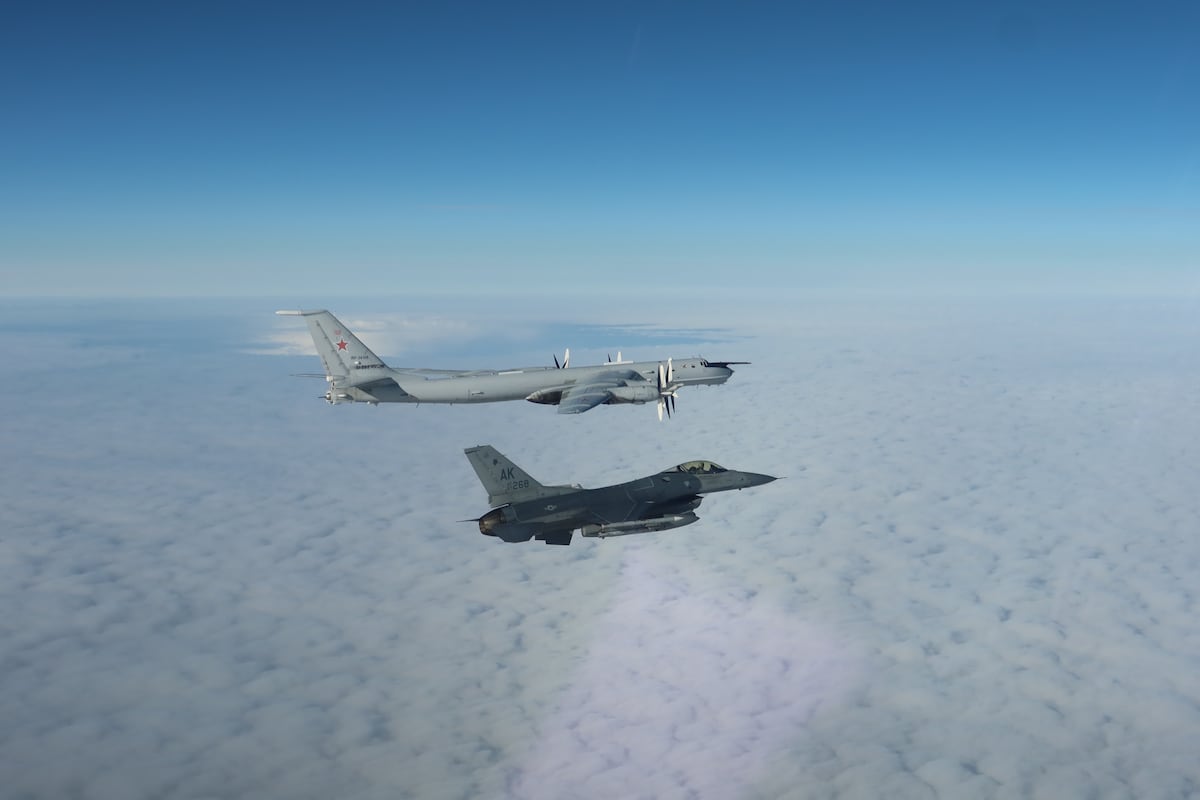
In a routine display of military vigilance, the North American Aerospace Defense Command (NORAD) recently observed two Russian Tu-142 maritime patrol aircraft navigating through the Alaskan and Canadian Air Defense Identification Zones (ADIZ). The event unfolded on Wednesday, sparking a coordinated response from both U.S. and Canadian military forces.
NORAD’s response involved deploying an array of aircraft to ensure these Russian planes were properly identified and monitored. The assets included two U.S. Air Force F-35 Lightning II fighters, two F-22 Raptors, four KC-135 Stratotankers, and an E-3 Sentry AWACS aircraft. Canada contributed with two CF-18 Hornets and a CC-150 Polaris tanker. This show of force underscores the readiness and collaboration between the U.S. and Canadian defense systems.
According to NORAD, the Russian aircraft maintained their course within international airspace, steering clear of any breach into American or Canadian territorial airspace. Such maneuvers are not uncommon and, as stated by NORAD, “This Russian activity in the Alaskan and Canadian ADIZ occurs regularly and is not seen as a threat.”
The Tu-142, an aircraft primarily used for maritime patrol and antisubmarine warfare, is a legacy of the Soviet era, tailored for long missions over expansive oceanic areas. It remains an integral part of the Russian Navy’s reconnaissance capabilities.
Air Defense Identification Zones, or ADIZ, are critical segments that stretch beyond a nation’s sovereign airspace into international skies. They serve as a buffer zone where approaching aircraft must identify themselves for national security purposes.
This interception followed a similar operation the previous month on February 19, when NORAD tracked a group of five Russian military aircraft, including Tu-95 bombers and Su-35 fighters, near Alaska’s ADIZ. On that occasion, U.S. forces, including F-16 and F-35 fighter jets, accompanied by an E-3 and multiple KC-135s, ensured the Russian formation was monitored. As with the recent incident, all aircraft remained within international airspace and posed no threat according to NORAD’s assessment.
NORAD, operating from Peterson Space Force Base in Colorado, employs an extensive defense network. This system integrates satellites, radars, and fighter aircraft, providing comprehensive surveillance and response capabilities to counter potential threats in the airspace surrounding North America.