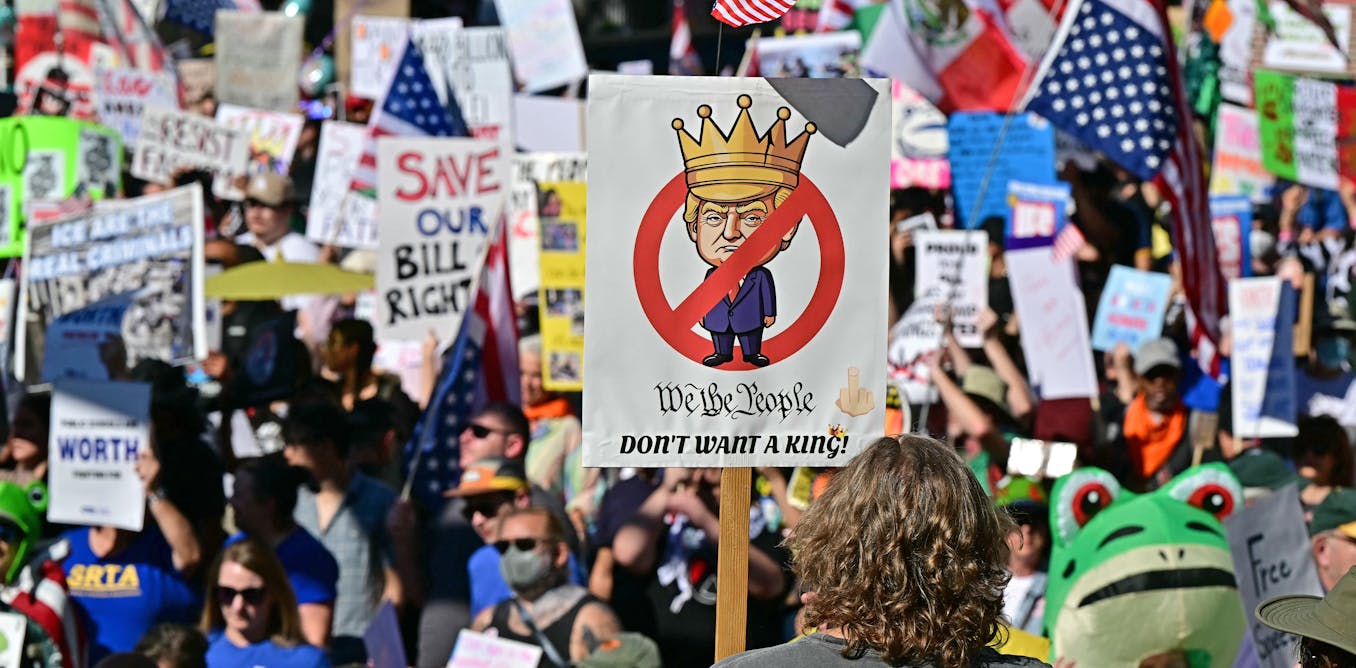
In what is anticipated to be a historic demonstration, organizers are preparing for an estimated 3,000 “No Kings” protests, rallies, and events slated for March 28, 2026. These gatherings are expected to become the largest mass mobilization in the history of the United States, according to the event organizers.
As experts in peace studies and social movements, we explore the ways in which ordinary citizens can influence governmental policy changes.
The turnout for the 2,100 “No Kings” protests held on October 18, 2025, reached an estimated 7 million Americans, setting new records. However, research conducted by us and other scholars, such as our studies and those by other academics, suggests that large-scale protests alone may not suffice to bring about the desired policy changes.
We argue that protest movements can be more impactful when they focus on boycotting corporations that support the government’s agenda rather than solely striving for larger demonstrations.
Historically, boycotts have proven effective in widening public engagement to a level necessary for political change. Boycotts often enlist first-time activists with clear directives like “buy this, not that.” They provide simple methods for individuals to express themselves with minimal time, financial investment, or risk.
Emergence of the ‘No Kings’ Movement
Since June 2025, the “No Kings” movement has been organizing nonviolent protests nationwide to voice widespread discontent with the policies of President Donald Trump’s administration.
The movement’s leadership comprises various nonprofits, including civil rights organizations such as the American Civil Liberties Union, LGBTQ+ advocacy groups like the Human Rights Campaign, progressive political entities like Indivisible and MoveOn, and unions such as the American Federation of Teachers.
These protests are riding a wave of increasing public dissatisfaction with Trump’s second term. According to Gallup’s final presidential poll from December 2025, only about one-third of Americans approved of his leadership.
In March 2026, a Fox News poll indicated that 60% of Americans disapproved of Trump’s immigration policies, while a CBS poll highlighted that 60% opposed the U.S. war with Iran.
The “No Kings” movement has consistently opposed severe federal immigration enforcement practices, such as the expansion of immigrant detentions and deportations. The planned protests on March 28 aim to amplify the broad opposition to the costly Iran war.
Organizers of “No Kings” cite multiple motivations for their protests, including the administration’s election interference threats, healthcare funding reductions, and the rolling back of environmental protections.

Robert Nickelsberg/Getty Images
Growing Dissent Against the Trump Administration
The reach of the “No Kings” protests has expanded across the United States more than ever before.
Demonstrations have occurred in every state, from major cities like Dallas, Philadelphia, and Phoenix to thousands of smaller towns such as Corydon, Indiana, and Hamilton, Montana. Even in traditionally conservative areas, thousands have joined the protests.
Research indicates that when 3.5% of the population engages in nonviolent actions like protests or boycotts, it can lead to policy changes.
For the U.S., this threshold equates to nearly 12 million individuals. The “No Kings” movement would need to almost double its October 2025 size to meet this requirement.
Boycotts present a viable strategy to reach this pivotal point.
The Mechanics of Boycotts
Economic boycotts have long served as a method of collective resistance, wherein people withdraw their labor, purchases, or cooperation to exert pressure on influential institutions.
Boycotts represent a mass form of noncooperation, allowing individuals to resist without taking leave from work, engaging in confrontations, or risking arrest. While protests signal displeasure, boycotts alter the incentives for business leaders. When companies lose customers and profitability declines as a result of boycotts, they can emerge as unexpected allies in public opposition.
For instance, after large-scale protests against federal immigration raids in Minneapolis, major corporations in the state issued a statement urging the government to de-escalate the tensions in the area.
Public Perception of Boycotts
Numerous consumer boycotts are ongoing in the U.S., with a significant number targeting policies of the Trump administration.
Boycott organizers target significant firms like Target, Walmart, Amazon, and Home Depot, which have contributed to the White House ballroom construction project and other Trump-led initiatives.
The People’s Union USA, a movement aiming to utilize consumer power, organized a nationwide “economic blackout” on February 28, urging Americans to abstain from spending for 24 hours to protest corporate influence on U.S. policies. The effectiveness of this boycott remains uncertain.
Successful Corporate Boycotts
In the 1980s, boycotts targeting white-owned businesses in South Africa reduced profits and drew global attention to the apartheid regime, which oppressed the Black majority. As businesses suffered, white business leaders pushed for reforms, eventually aiding the end of apartheid and South Africa’s multiracial elections in 1994.
In the U.S., various boycotts have recently influenced Target’s policies. Right-wing boycotts in 2023, for instance, led to the removal of LGBTQ+ Pride merchandise, causing Target to scale back on diversity practices.
Following Trump’s 2025 executive order banning diversity programs, Target faced left-wing boycotts for ending its Racial Equity Action and Change initiative. The company’s sales declined, and its stock dropped by 33% in the first three quarters of 2025.
By March 2026, boycott leaders claimed victory, attributing Target’s weak financial performance to the boycotts.
Amidst this wave of consumer boycotts, media companies have also faced public pressure.
In September 2025, Disney suspended talk show host Jimmy Kimmel after he suggested that right-wing influencer Charlie Kirk was killed by a fellow conservative. Kimmel accused Trump supporters of “scoring political points” from the incident. Disney owns ABC, where Kimmel’s program airs.
Kimmel’s suspension led to a swift public backlash. Three million viewers called for a Disney boycott to impact its streaming revenue. Facing reputational and financial risks, Disney reinstated Kimmel and extended his contract in December 2025.
This incident underscores how organized consumer pressure can counter political intimidation by focusing on a company’s core economic interests.
Challenges of Uncoordinated Boycotts
Not all boycotts achieve their objectives, even if they succeed in raising awareness.
Their economic impact relies on participation levels, continued engagement, and clear goals. Boycotts lacking coordination and defined aims are less likely to succeed, especially when disparate groups target different companies.
The No Kings protests will undoubtedly continue to showcase public discontent. However, for these efforts to effectively challenge Trump’s policies, we believe the movement may require a more expansive, targeted boycott that can affect the revenue and reputation of companies financially backing the president or supporting his policies.