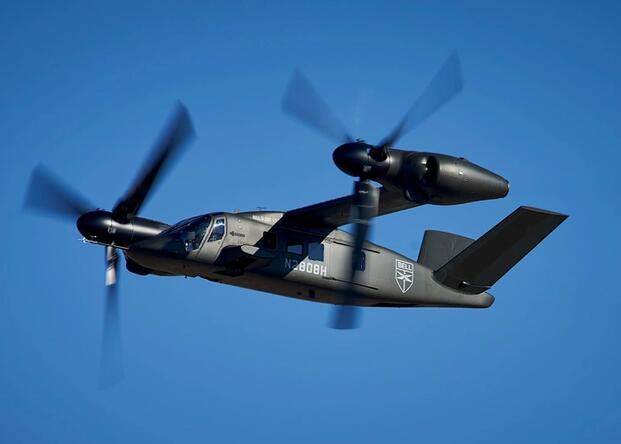
The U.S. Army is poised to revolutionize its aviation capabilities with the unveiling of the MV-75, a next-generation assault aircraft poised to redefine military operations. Developed under the Future Long-Range Assault Aircraft (FLRAA) program, the MV-75 is set to succeed the iconic UH-60 Black Hawk, catering to the evolving demands of modern warfare.
The MV-75’s designation signifies its versatility and advanced capabilities, with “M” standing for multi-mission and “V” for vertical takeoff and landing. This innovative aircraft, selected from Bell’s V-280 Valor design, marks a significant departure from traditional helicopter designs, embracing a tiltrotor configuration that offers dynamic operational flexibility.
Innovative Design Enhancements
A defining feature of the MV-75 is its tiltrotor configuration, allowing the rotors to transition between vertical and horizontal positions. This enables the aircraft to take off and land like a helicopter and fly at speeds akin to airplanes, offering a substantial boost in performance compared to its predecessors.
The MV-75 is expected to cruise at around 300 miles per hour, a significant increase over the UH-60 Black Hawk’s typical cruising speed of 180 miles per hour. Furthermore, its extended range enhances operational reach, crucial for theaters like the Indo-Pacific, where vast distances present logistical challenges. The Army describes its capabilities as going “twice as far, twice as fast” compared to existing platforms.
Operational Versatility
Designed as a multi-role aircraft, the MV-75 performs missions such as air assault operations, troop transport, medical evacuation, and logistical resupply. It carries a squad-sized element of soldiers, with increased speed and endurance allowing for wider operational deployment without dependency on forward staging bases.
This versatility is vital in environments where traditional helicopter operations face limitations due to distance, fuel constraints, or vulnerability to enemy defenses.
Rationale Behind the Shift
The UH-60 Black Hawk, despite its historical success, faces limitations in the context of modern strategic demands. Originally designed in the early 1970s, it catered to a different era of military operations. Today’s scenarios demand speed and range to address the challenges posed by advanced anti-air systems.
Recognizing these needs, the Army opted for a comprehensive replacement rather than incremental upgrades. The MV-75 directly addresses these limitations by offering enhanced reach and reduced transit times, facilitating more agile and unpredictable maneuvers.
Expedited Development and Deployment
The MV-75 program stands out for its accelerated timeline, with initial operational fielding anticipated as early as 2026. This reflects a shift in defense acquisition strategies, emphasizing rapid deployment to respond to emerging threats effectively.
Testing and evaluation are underway at facilities like Redstone Arsenal, where Army test pilots are rigorously assessing performance and safety in preparation for full deployment.
Strategic and Technological Impact
Beyond speed, the MV-75 represents a broader transformation in Army aviation and battlefield integration. Equipped with modular systems, the aircraft is designed for future upgrades, enabling adaptation to evolving technologies.
The platform is expected to seamlessly integrate with unmanned systems, highlighting a shift towards networked warfare where manned and unmanned platforms collaborate to achieve mission objectives. This adaptability is particularly significant for special operations forces, who require aircraft capable of specialized missions without extensive redesigns.
Future Trajectory of Army Aviation
The MV-75 marks a pivotal transition from legacy aviation platforms to a new generation of aircraft tailored for contemporary conflict scenarios. While the Black Hawk will continue to serve, its role will gradually diminish as the MV-75 assumes prominence.
This evolution underscores the Army’s recognition that future conflicts will necessitate faster, more flexible, and more survivable air mobility. If the MV-75 meets expectations, it will not merely replace the Black Hawk; it will redefine air assault operations for the foreseeable future.