South Carolina is the latest battleground in a national redistricting conflict, spurred by a recent U.S. Supreme Court decision. This ruling has opened the door for Republican efforts to reshape congressional districts, particularly those with a majority Black population, potentially altering the political landscape significantly.
Following encouragement from former President Donald Trump, South Carolina Republicans are pressing to revise a district historically held by a Black Democratic representative. This move is part of a broader strategy to capture all seven of the state’s congressional seats.
This redistricting initiative is not isolated to South Carolina. Other states like Alabama and Tennessee are also engaging in special legislative sessions to reconsider their congressional maps. Meanwhile, Louisiana lawmakers are preparing to redraw their districts after the Supreme Court invalidated the current map, citing excessive reliance on race in its formation.
Impact of Supreme Court Ruling
The Supreme Court’s decision in Louisiana has catalyzed a national redistricting effort, reshaping long-standing interpretations of the Voting Rights Act. By ruling that Louisiana’s map leaned too heavily on racial considerations to establish a second Black-majority district, the court has provided a basis for Republicans to contest the validity of majority-Black districts, which have historically favored Democrats.
This decision comes at a pivotal moment, ahead of midterm elections that will determine the balance of power in the U.S. House of Representatives. Since Trump’s push in Texas last year, eight states have adopted new district maps. Republicans anticipate gaining up to 13 seats, while Democrats aim for 10, although some districts may remain competitive.
Challenges in South Carolina
In South Carolina, Democratic U.S. Rep. Jim Clyburn, a long-time representative of the 6th Congressional District, faces potential challenges if Republicans succeed in redrawing his district. State legislative leaders require a two-thirds majority vote to initiate redistricting, a challenging feat given the narrow political margins.
State Senate Majority Leader Shane Massey has cautioned that such efforts might backfire, potentially leading to the election of an additional Democrat to the U.S. House. Massey discussed these concerns with Trump, emphasizing the risks involved.
Alabama Considers New Voting Schedule
Alabama’s legislature is contemplating a bill that could introduce a special congressional primary, contingent on Supreme Court approval for district changes. Alabama Republicans favor a 2023 map that may help them secure at least one of the two Democrat-held seats. The state’s primaries are scheduled for May 19, but this legislation could mandate a new primary if the court’s decision comes too late.
Democratic leaders have criticized this move as an attempt to disenfranchise Black voters, reminiscent of past injustices. Representative Terri Sewell stated, “Republicans are working to secure an electoral victory by taking Alabama back to the Jim Crow era, and we won’t go back.”
Controversy in Tennessee
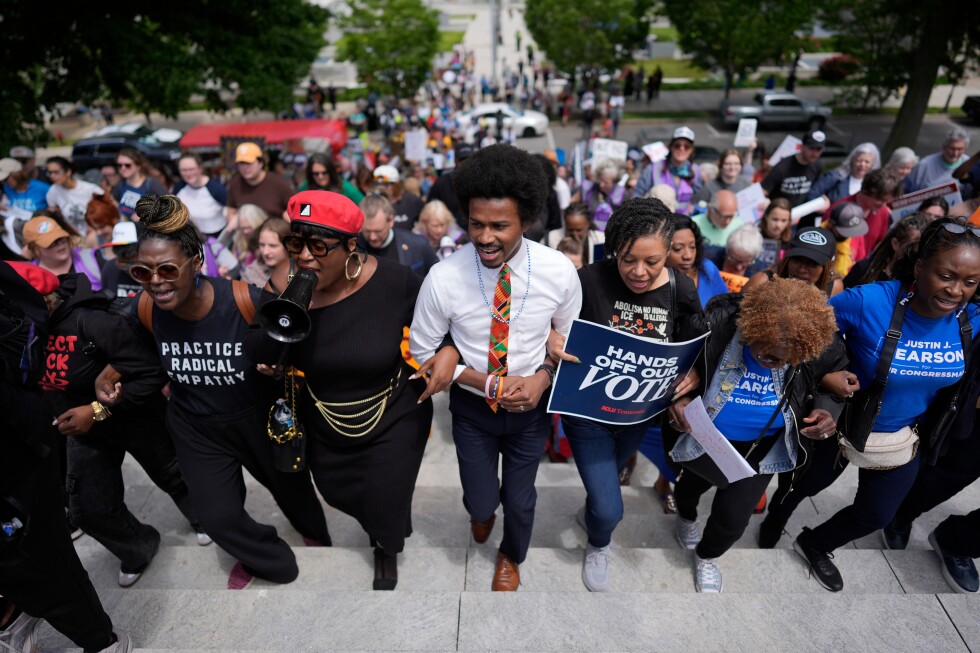
In Tennessee, a special session called by Republican Gov. Bill Lee is examining a plan to dismantle the Democrat-held district centered around Memphis, a predominantly Black city. Although specifics of the plan remain undisclosed, it has prompted significant backlash, with protests and accusations of racial targeting.
Martin Luther King III addressed Tennessee’s legislative leaders, expressing deep concern that this plan could undermine civil rights achievements.
Louisiana’s Delayed Primary
Following the Supreme Court ruling, Louisiana’s Republican Governor Mike Landry postponed the May 16 primary to allow legislative time for redistricting. More than 41,000 absentee ballots had already been cast before this decision, representing a significant portion of the electorate.
The suspension of the primary has prompted several lawsuits from Democrats and civil rights organizations challenging the legality of the postponement.