In a significant political development, Georgia’s Republican legislative leaders have turned down Governor Brian Kemp’s proposal to alter congressional and legislative districts, following a pivotal Supreme Court decision that significantly affects the Voting Rights Act’s protections for minority voters. The move stands in contrast to other Southern states, which have swiftly acted to modify their congressional maps in response to pressures from national party figures.
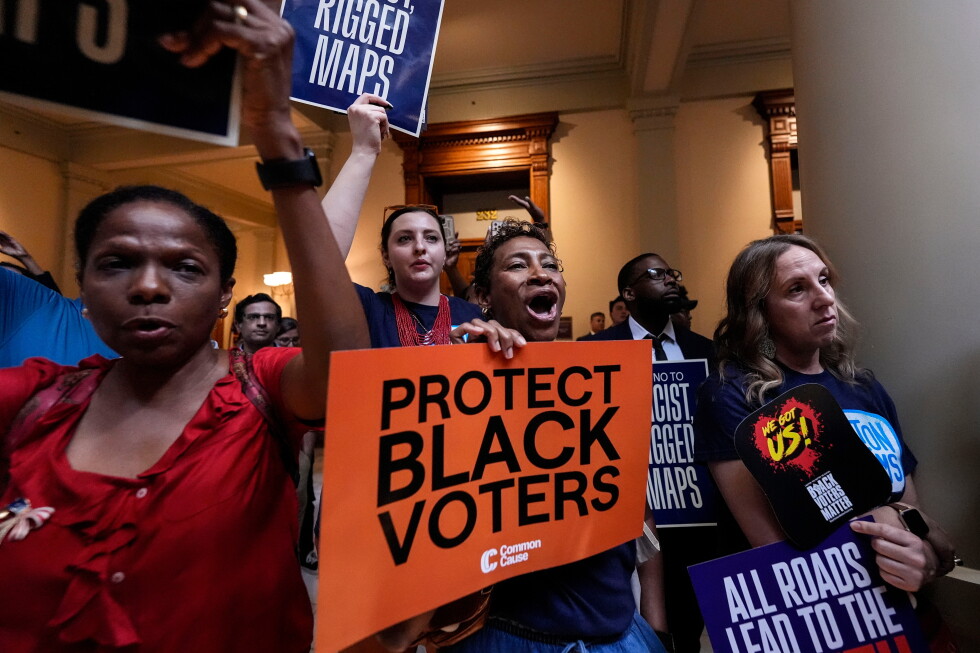
Despite pressures from civil rights organizations and nonwhite lawmakers, Governor Kemp’s request for a redistricting special session was denied. The decision comes amid a backdrop of heightened political activity, with numerous citizens gathering at the Georgia Capitol to make their voices heard.
U.S. Senator Raphael Warnock, Georgia’s first Black senator, emphasized the power of grassroots activism, stating, “Today showed that ordinary people don’t need to wait until November to make their voices heard and protect our democracy. We can stand up and speak right now.”
Governor Kemp’s initiative aimed to redraw the districts not for the imminent elections but for the 2028 cycle. However, his broader call for legislators to reconsider their own districts would have made Georgia the first state to apply the Supreme Court’s ruling in the Louisiana v. Callais case to state legislatures.
State House Speaker Jon Burns communicated to Kemp that the legislature would not address redistricting issues in the upcoming session. The announcement was made amidst a backdrop of demonstrators chanting in support of minority voting rights.
Kemp has argued that the current district maps in Georgia are unconstitutional and sees no reason to postpone redistricting. Yet, Burns emphasized the necessity of a cautious approach, given the implications of the Callais decision, which invalidated Louisiana’s congressional districts as racially biased.
While privately, some Republicans have expressed concerns about a rushed redistricting process potentially backfiring, leading to more competitive districts that could favor Democrats, the possibility of revisiting the issue later remains open.
Shift in Legal Landscape
The Callais decision has altered the interpretation of Section 2 of the Voting Rights Act, which historically ensured that minority communities could elect candidates of their choice. The court’s ruling, delivered by a conservative majority, declared that district apportionments should be “race neutral,” posing challenges for the creation of opportunity districts.
Georgia’s demographics reflect a diverse electorate, with approximately one-third of the state’s 180 representatives being Black, and minorities making up 40% of the population. This diversity has been mirrored in the state’s U.S. House delegation, where five of the 14 districts are majority or plurality nonwhite.
Justice Samuel Alito, in his majority opinion, argued for a race-neutral approach to redistricting. However, civil rights groups contend that such criteria are difficult to apply in Southern states, where race and political affiliation are closely linked.
Opposition from Democrats and Activists
Georgia’s rich civil rights history adds weight to the current debates over minority voting rights. Senator Warnock, who leads the church where Martin Luther King Jr. once preached, criticized the Supreme Court’s rationale in Callais, comparing it to past discriminatory practices masked as “race neutral.”
Warnock pointed out the inconsistency of those who might support district redraws while also honoring King, stating, “If you want to redraw maps and you have the power to do it, I guess you can do it. But keep Dr. King’s name out of your mouth.”
National Political Context
The national scene has been shaped by a contentious redistricting battle, initiated by former President Donald Trump, who urged Republicans to secure their congressional maps. States like Texas quickly responded, while Democrats in California countered with their own strategies.
This ongoing redistricting effort, though fraught with legal challenges, could potentially alter the political landscape in favor of the GOP, despite current polling trends. The implications of these changes are set to play a significant role in shaping future electoral contests.