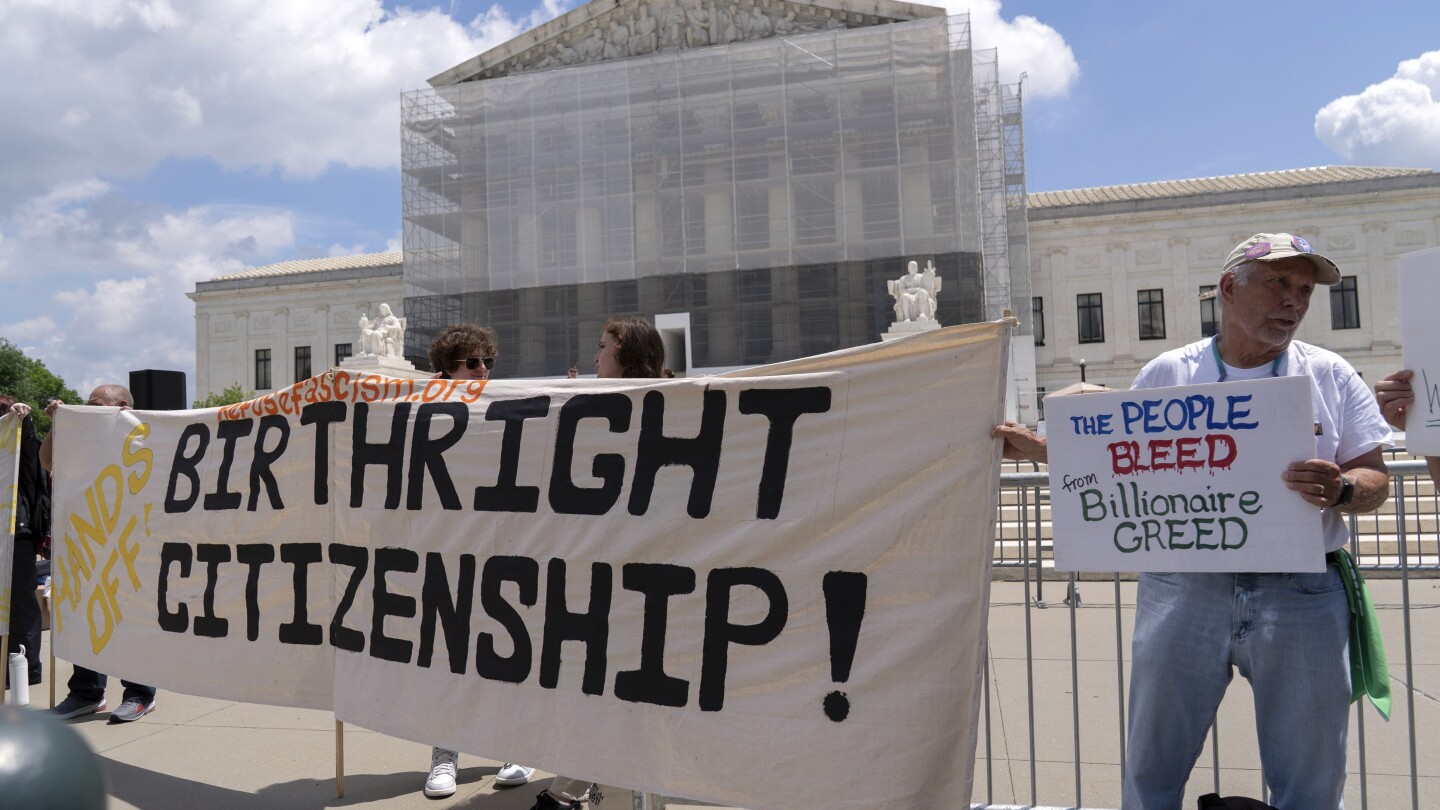
In a pivotal legal discussion, a federal judge has scrutinized the Trump administration’s stance on enforcing its executive order concerning birthright citizenship. At the heart of the matter is whether the government plans to deport U.S.-born children of undocumented or temporarily residing individuals before the new restrictions potentially take effect in late July.
During the proceedings, Justice Department attorney Brad Rosenberg indicated to U.S. District Judge Deborah Boardman that there are no current intentions to deport children covered by the executive order during the 30-day suspension mandated by the Supreme Court. He described the inquiry as purely “hypothetical.”
Judge Boardman requested a detailed explanation by Tuesday on what the administration perceives as permissible actions following the Supreme Court’s recent ruling. She specifically asked if there would be attempts to deport infants born after February 19, who are subject to the executive order but not involved in ongoing legal challenges.
Rosenberg reassured, “No,” clarifying further, “I just want to be clear. I am responding to the court’s characterization of what it believes the United States might do after 30 days from the date of the Supreme Court’s decision. But, again, I would note that (federal agencies) have all been tasked with developing guidelines for implementation of the executive order. So I view that as a hypothetical.”
Judge Boardman expressed confidence in the government’s position, stating, “I take the government at its word that the United States does not intend to do that and it is not doing that.”
The uncertainty following the Supreme Court’s decision is causing significant distress among those affected, as noted by plaintiffs’ attorney William Powell. He emphasized the confusion faced by their clients, who are not legal experts, and the difficulty in assuring them due to the order not being fully blocked.
Powell highlighted concerns beyond deportation, noting the potential enforcement of the executive order in ways that might strip newborns of their rights.
As lower courts navigate the implications of the Supreme Court’s opinion, judges across multiple states, including Massachusetts, Washington, and New Hampshire, have issued their respective rulings on birthright citizenship. However, the nationwide applicability of these decisions remains uncertain.
New Jersey Attorney General Matt Platkin has sought a hearing to discuss the possibility of a nationwide injunction against the executive order, asserting that such a measure would not conflict with the Supreme Court’s recent opinion but left further deliberations to lower courts.
The Supreme Court’s ruling clarified that federal judges lack the power to issue nationwide injunctions, yet left open the question of whether Trump’s birthright citizenship policy could soon be implemented regionally.
Birthright citizenship, a constitutional right under the 14th Amendment, grants American citizenship to all born on U.S. soil, a practice shared by approximately 30 countries. Trump and his advocates argue for stricter criteria for citizenship.