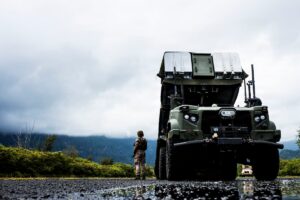
The U.S. Army is charting a path towards standardization across the European defense landscape, focusing on a versatile, multi-functional launcher system. This initiative aims to bolster both offensive and defensive capabilities among NATO allies, as highlighted by Gen. Christopher Donahue, the head of U.S. Army Europe and Africa, during a recent conference in Wiesbaden, Germany.
The newly proposed Eastern Flank Deterrence Line, which zeroes in on the Baltic region, underscores the intention for a universal launcher system. Such a system would feature a common fire control mechanism, allowing for the use of munitions from any country within the alliance. “Everyone loves to talk about long-range fires and air defense,” Donahue remarked, emphasizing the vision of a system that is optionally manned and capable of integrating various munitions.
The Army has grappled with developing a multi-mission launcher capable of countering diverse threats like drones and cruise missiles. Despite canceling a previous program in 2019, efforts continue to find a suitable second interceptor for the Indirect Fires Protection Capability system, with prototypes expected in South Korea soon. The operational theatres of Ukraine and the Middle East are accelerating the need for such adaptable systems, according to Donahue.
Drawing a parallel to the High Mobility Artillery Rocket System (HIMARS), Donahue envisions a launcher adaptable to individual countries’ needs. “HIMARS is a great long-range system,” he stated, suggesting that nations could customize the launcher according to their requirements. This flexibility aims to allow any type of HIMARS variant to be utilized seamlessly across different platforms.
Introduction of CAML
The Army’s Rapid Capabilities and Critical Technologies Office (RCCTO) has issued a call for solutions for the Common Autonomous Multi-Domain Launcher (CAML). This system is designed to be autonomous or optionally crewed, highly mobile, and deployable worldwide. According to Sam.gov, the CAML will potentially replace existing Army launchers.
The request outlines two variants: CAML Heavy, to be mounted on a 15-ton chassis, and CAML Medium, suitable for Family of Medium Tactical Vehicles. These systems will feature autonomous resupply capabilities and are expected to be prototyped within 18 to 36 months post-contract award.
Technological Advancements
Lockheed Martin, a key player in this venture, holds the technology necessary for the CAML project, including systems like MLRS and PAC-3 MSE. Jason Reynolds of Lockheed Martin emphasized the shift towards mobile systems, stating, “What we’re learning in the real world is, if you’re mobile, you’re more survivable.” This adaptability is crucial as current defensive systems are largely stationary.
The company is optimistic about the feasibility of these advancements, given existing technologies. “I don’t think there’s anything technically that would prohibit that,” noted Reynolds, highlighting the integration of current systems rather than creating new ones.
Lockheed’s ship-based Mark 41 launcher, adapted for the ground-launched Typhon system, already exhibits the desired missile flexibility. The recent successful demonstration of Typhon and the autonomous capabilities of HIMARS underscore the potential for leveraging these technologies in the CAML framework, as noted by Paula Hartley of Lockheed’s tactical missile division.