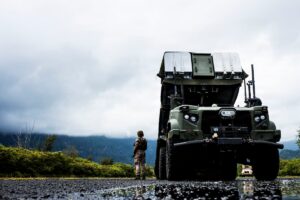
U.S. Army Introduces New Missile Defense Technology in Guam
The United States Army is taking significant steps to bolster its defense capabilities with the latest deployment of the Lower Tier Air and Missile Defense Sensor (LTAMDS) in Guam. This advanced radar system arrived on the island earlier this month, marking a pivotal stage in its operational testing.
Army Secretary Dan Driscoll recently visited Task Force Talon, the unit charged with managing the LTAMDS radars, as part of the Army’s strategic efforts led by Army Chief of Staff Gen. Randy George. The deployment aims to test the cutting-edge technology under actual field conditions, even though it has not completed its development phase.
“Our soldiers on Guam are at the tip of the spear for homeland defense and deserve the very best,” Driscoll stated to Defense News. He emphasized the importance of deploying the LTAMDS to enhance the range and lethality of U.S. weapon systems and expressed excitement about testing it in the Indo-Pacific Command region.
The initiative is part of a broader Pentagon strategy to create a comprehensive air-and-missile defense system in Guam to counter emerging threats. This new radar is intended to be a cornerstone of a defensive shield currently under development on the island, where its strategic location makes it vulnerable yet crucial for U.S. military operations.
In addition to integrating LTAMDS into Guam’s defense, the Army plans further enhancements, including another radar deployment by 2027. The LTAMDS system, developed by Raytheon, is designed to replace older radar systems in the Patriot air-and-missile defense systems, offering 360-degree threat detection capabilities.
The service has been committed to replacing its aging systems and awarded Raytheon a contract in 2019 to produce prototypes over five years. The ambitious project faced challenges, resulting in extended testing to ensure the system’s maturity and readiness for deployment. This comprehensive testing involved eight major missile flight tests and numerous hours of radar tracking and environmental condition evaluations.
Ultimately, the Army aims to achieve full-rate production of LTAMDS by 2028, with operational testing on Guam as part of the Army’s Transformation in Contact initiative. This initiative places new capabilities directly into the hands of soldiers before formal fielding to refine the system’s use in realistic operations.