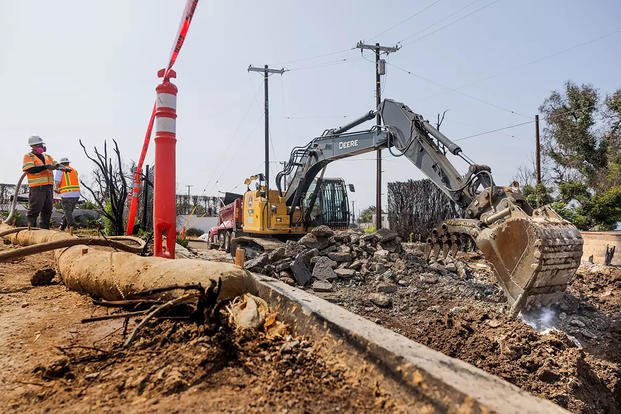
In the aftermath of January’s wildfires that left devastation in Altadena and Pacific Palisades, residents were eager for federal intervention to clear the path for rebuilding. However, the anticipated fresh start has been overshadowed by dissatisfaction with the cleanup efforts.
From March to mid-May, the U.S. Army Corps of Engineers received over 800 complaints regarding debris removal, as reported by the Los Angeles Times. A significant number of these complaints highlighted concerns over incomplete debris removal and deviations from established protocols.
Residents noted that the cleanup primarily focused on the immediate vicinity of destroyed structures, leaving the surrounding areas largely unaddressed. Complaints included instances where contractors left behind debris such as vehicle parts, remnants of home foundations, hazardous trees, and polluted pool water.
Some property owners accused federal contractors of neglecting to remove ash-covered soil beyond the building’s footprint and not digging deep enough as per the guidelines.
Andrew Whelton, a Purdue University expert on natural disasters, shared, “There are no formal standards and requirements after a disaster like this, when it comes to environmental safety and cleanup.” He emphasized the reliance on recommendations and guidelines, which may not always be adhered to.
Despite the issues, representatives from the Army Corps and Environmental Chemical Corp. (ECC), the primary contractor, reported receiving mostly positive feedback. Nonetheless, the Army Corps has sometimes required crews to revisit sites to address homeowner concerns. Glenn Sweatt, ECC’s vice president, stated, “We try to resolve issues to the homeowners’ satisfaction within the FEMA and (Army Corps) guidelines.”
Discrepancies in Cleanup Execution
Although the Army Corps cleared over 9,300 properties in six months, the speed of the cleanup has been questioned. Reports suggest potential soil contamination might be overlooked, as the agencies involved have yet to acknowledge the necessity of soil testing.
Homeowners who signed up for the cleanup anticipated a comprehensive removal of toxic ash and debris. However, the scope of work, often limited to the “structural ash footprint,” left many areas untouched, leading to frustration and confusion among residents. This was exacerbated by the lack of public access to work plans, leaving both property owners and some contractors unclear about the extent of cleanup efforts.
Several complaints to the Army Corps hotline underscored these inconsistencies, including cases where parts of homes were misidentified as patios or where foundational elements were left intact.
Luke Melchior of Melchior Construction Co. observed issues firsthand, attributing them to the varying experience levels of subcontractors. He remarked, “You get different quality of work based on the integrity of the (subcontractor).”
Challenges with Contaminated Water and Soil
Complaints also emerged regarding stagnant pool water polluted with ash, which many homeowners hoped would be drained by federal contractors. Initially, pool water wasn’t eligible for removal, although the rules were later adjusted to include water within the ash footprint.
However, challenges persisted as crews struggled with proper disposal methods, as documented in internal reports. The mishandling of contaminated water raised further concerns about adherence to environmental guidelines.
Soil removal has similarly been inconsistent, with some areas reportedly over-excavated while others remained largely untouched. This inconsistency introduces potential risks of contamination, as noted by residents like Allen Chen, who found his property still covered in ash post-cleanup.
Historical precedents from past wildfire responses, such as the 2017 North Bay fires, indicate that over-excavation can complicate and delay rebuilding efforts. The lack of soil testing and clear cleanup objectives continues to pose challenges for affected homeowners.
Seeking Additional Solutions
In response to these challenges, some property owners have turned to private contractors for further remediation. Companies like OFRS offer soil testing and comprehensive debris removal, providing services that federal crews may have missed.
For homeowners like Chen, insurance has helped cover additional cleanup costs, but this option is not universally accessible. The disparities in cleanup thoroughness have left residents like Shawna Dawson Beer concerned about the long-term health and safety implications.
As rebuilding progresses, the inconsistency in cleanup efforts has led to a patchwork of outcomes, leaving some residents uncertain about the safety and readiness of their land for future development.
(Los Angeles Times assistant data and graphics editor Sean Greene contributed to this report.)
© 2025 Los Angeles Times.
Visit at latimes.com.
Distributed by Tribune Content Agency, LLC.
© Copyright 2025 Los Angeles Times. All rights reserved. This material may not be published, broadcast, rewritten or redistributed.