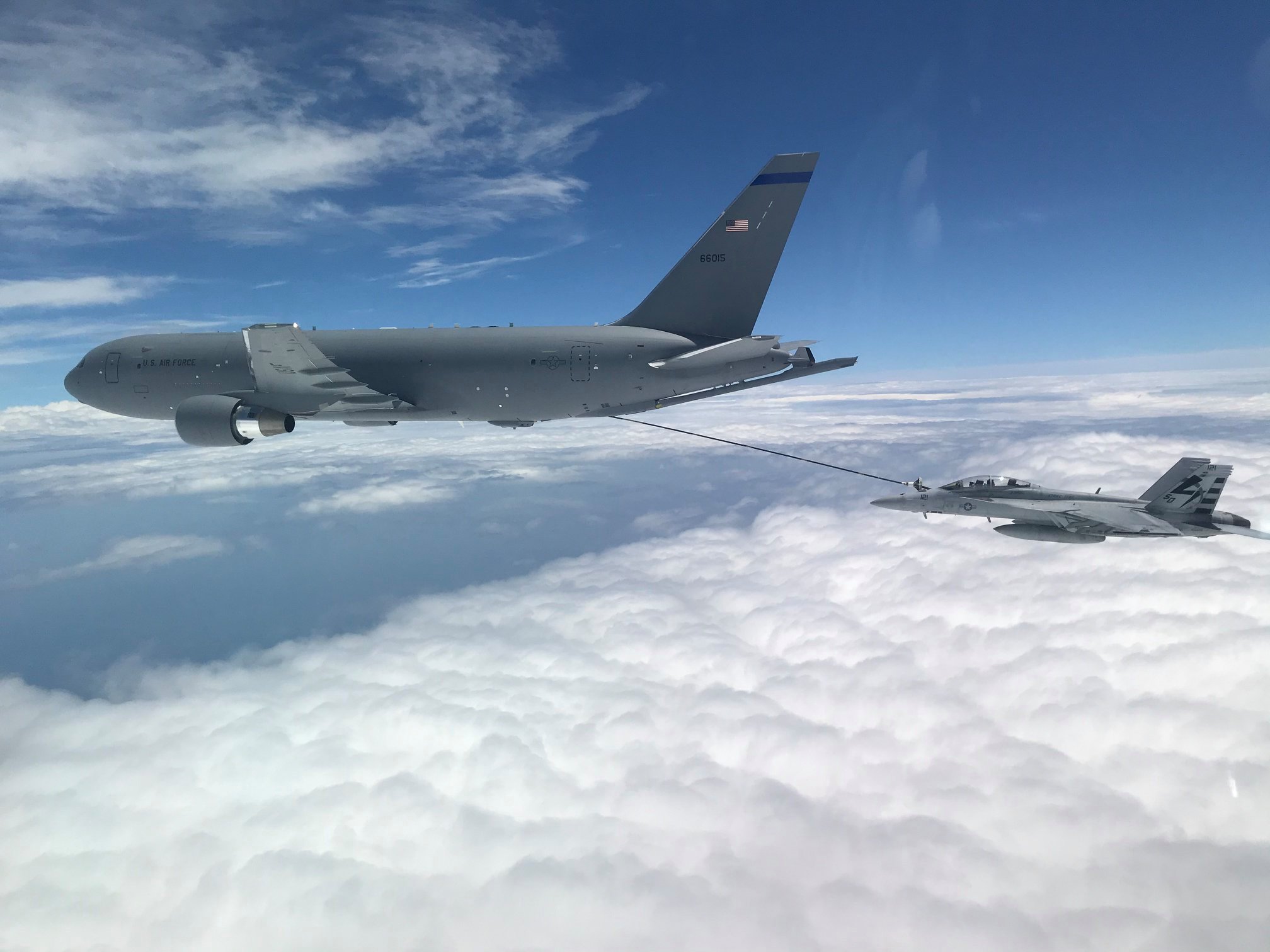
In a significant development for military aviation, the Pentagon has approved a substantial contract with Boeing, valued at $2.82 billion, for the production of 15 additional KC-46A Pegasus tankers. This marks the final batch under the initial agreement established in 2011.
Compared to the previous procurement of 15 tankers, which cost $2.47 billion, this latest acquisition reflects an increase of approximately $350 million. The Pentagon anticipates the completion of the earlier batch by mid-2029, while the newly contracted lot is expected to be finished by mid-2030. Details of the contract can be found here.
The KC-46A Pegasus is currently in service with the U.S. Air Force, which has already received 116 units, with a total of 203 on contract or operational globally. Notably, Japan and Israel are also operators of this advanced tanker model, as stated by Boeing.
“We’re grateful for the trust the U.S. Air Force continues to place in our team,” commented Jake Kwasnik, KC-46 program vice president, in a Boeing release. He emphasized the critical role of the KC-46 in facilitating global military operations and reaffirmed Boeing’s commitment to supporting the warfighter.
This recent award concludes the 13 production cycles initially outlined in the 2011 contract, according to documentation filed with the Securities and Exchange Commission.
Looking ahead, the Air Force intends to procure an additional 75 KC-46As through the Tanker Production Extension program. This initiative is part of a broader strategy to replace the aging KC-135 models, originally built in the 1950s and 60s, with a target of acquiring 263 KC-46As.
However, this expansion is contingent upon Boeing resolving existing issues with the tankers. According to Air Force Vice Chief of Staff Gen. John Lamontagne, these problems, particularly the refueling boom and the Remote Vision System (RVS), need addressing before any new orders are placed. More details on this can be found in a Reuters report.
“We are working through a couple of issues with the contractor, and we are not going to get a new contract for another 75 KC-46s until we work through some of those deficiencies,” Gen. Lamontagne informed a Senate subcommittee, indicating a decision could be two years away.
Boeing has already initiated improvements, completing the first phase of testing for a redesigned RVS 2.0 as of June. The upgraded system is scheduled for deployment by summer 2027, three years later than initially planned, as per a Boeing release.
The financial burden of the KC-46 program has been significant for Boeing, with total losses exceeding $7 billion due to the firm-fixed-price contract, which does not account for cost overruns. This includes a $565 million loss reported last year, attributed to rising production expenses. Additional information can be accessed here.
The main challenges affecting the KC-46 fleet’s readiness include refueling system reliability and parts shortages. To tackle these, the Air Force and Boeing have devised a plan projected to enhance tanker availability by over 20% by 2030, as outlined in a recent Air Force announcement.