An Unforgettable Encounter in Vietnam: A Veteran’s Story
In the dense jungles of Vietnam, 19-year-old John Smith, an infantryman, found himself on a fateful day in May 1970. As he stood on the brink of a hill to take in the scenery, a sudden snap of a wire altered his life forever.
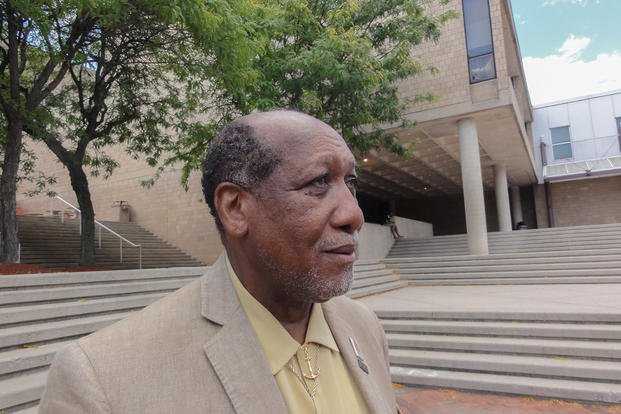
Reflecting on that moment, Smith, now 76 and residing in Newark, shared, “They must’ve thought, ‘This is a beautiful view. Someone’s going to come over here to look at it,’ and they were right. I tripped the wire.” The explosion that ensued resulted in two broken legs and a nearly severed finger—just weeks before his scheduled departure from the combat zone.
This year marks the significant milestone of 50 years since the Vietnam War concluded. According to the National Archives, the conflict, which involved the U.S. from November 1, 1955, resulted in approximately 58,220 American deaths, over 300,000 wounded, and an estimated 2 to 4 million Vietnamese casualties. Officially, the war ended on April 30, 1975.
Smith, who enlisted at 18, was one of many young Americans who served in the Vietnam War, a period he vividly recounts, despite its harsh realities. “I was there for 17 months and 20 days,” he said. “I still don’t know why I was there. You know there was no plausible explanation of why we were in Vietnam.”
Driven by a desire for better opportunities beyond the factory work that only utilized his physical strength, Smith chose to enlist in the Army. “The job wasn’t using my brains—it was using my brawn,” he recounted. “I thought the Army might give me a better opportunity.”
The opportunity, as it turned out, placed him amidst the infantry in Vietnam’s challenging terrain. “Vietnam is a beautiful country,” Smith recalled, noting the striking views from the hilltops. Yet, the beauty was fraught with danger. “In the field, it was elephant grass, vines, trees, and hills. Once you slipped, you couldn’t stop. You just tumbled.”
Life during the war was filled with absurdities. Soldiers often used the same toothbrushes for dental hygiene and rifle cleaning. Smith’s first day was marked by the grim sight of a fallen comrade. “I asked for a priest,” Smith remembered. “I didn’t think I was gonna make it.”
Racial discrimination was another harsh reality. The officer ranks were predominantly white, and favoritism was rampant. Smith described a friendly-fire incident where a white soldier was promoted after leaving the front lines—a scenario unlikely for Black soldiers. Propaganda leaflets from the Vietnamese urged Black soldiers to return home, highlighting racial inequalities in the U.S. “They were 100% correct,” Smith later admitted. “But being 18 or 19, you’re indoctrinated. You don’t see the whole picture.”
As Smith’s tour neared its end in spring 1970, his brother Gene, nine years his senior, arrived in Vietnam, despite U.S. policies preventing siblings from serving simultaneously in combat zones. Gene, who specialized in logistics, remarked, “I ordered helicopters, trucks, and mostly provided fuel,” jokingly contrasting his role with John’s infantry experience.
Tragically, before the brothers could reunite, John was injured by a booby trap. He was evacuated to Fort Gordon, Georgia, and later to St. Albans Naval Hospital in Queens, New York, where he spent nine months recovering. Despite the poor medical care and persistent racism, survival offered him a new beginning.
With the GI Bill and a disability stipend, Smith pursued business studies at Monroe Business Institute and later worked on Wall Street, eventually transitioning to a 26-year career with the Newark Police Department. He also dedicated 31 years to Essex County College, retiring as vice president of the adjunct union.
Smith built meaningful connections, including with the late N.J. Sen. Ronald Rice, and engaged in organizations like the NAACP and the New Jersey Black Issues Convention, focusing on advancing opportunities for the Black community.
Josie Gonsalves, publisher of Public Square Amplified, praised Smith, saying, “I’ve known John for over eight years since I arrived in Newark. He embodies what it means to serve both one’s country and one’s community; he’s always giving without expecting anything in return. John is a teacher and a veteran, and he is an amazing storyteller with countless stories to share. John represents the best of our community.”
Now living with his third wife, Smith reflects on Vietnam with a sense of calm yet vivid clarity. The war’s beauty, chaos, and racial contradictions remain etched in his memory. “I thought I could have a better life by joining the Army. But then you go to hell. They don’t tell you that before you sign up,” he mused, pondering the 50 years since the war’s end.
© 2025 Advance Local Media LLC.
Visit nj.com.
Distributed by Tribune Content Agency, LLC.