The complexities of modern warfare come to life in a new and immersive way through a tabletop wargame that simulates potential conflicts in the Baltic region. As NATO braces for the possibility of Russian aggression, “Littoral Commander: The Baltic” offers both military professionals and civilians a hands-on experience of strategic defense scenarios.
Available for purchase online, this game isn’t just a military tool but also a captivating challenge for any strategy enthusiast. Set around the year 2030, it envisions a Russian invasion that includes scenarios such as a landing on Sweden’s Gotland island, attacks launched from Kaliningrad, and U.S. Marines armed with missiles attempting to thwart Russian naval advances into the Atlantic. A unique humanitarian mission even sees the U.S. evacuating civilians while under Russian disruption attempts.
The American forces, composed of the U.S. Marine Corps, Navy, and some Army units, stand against Russian naval infantry and airborne troops, with both sides represented by cardboard platoon pieces rated for firepower, speed, and range. Players maneuver a variety of American units, including Marine infantry, amphibious vehicles, HIMARS rockets, and more, against Russian counterparts featuring T-90 tanks, multiple rocket launchers, and a fleet of naval ships.
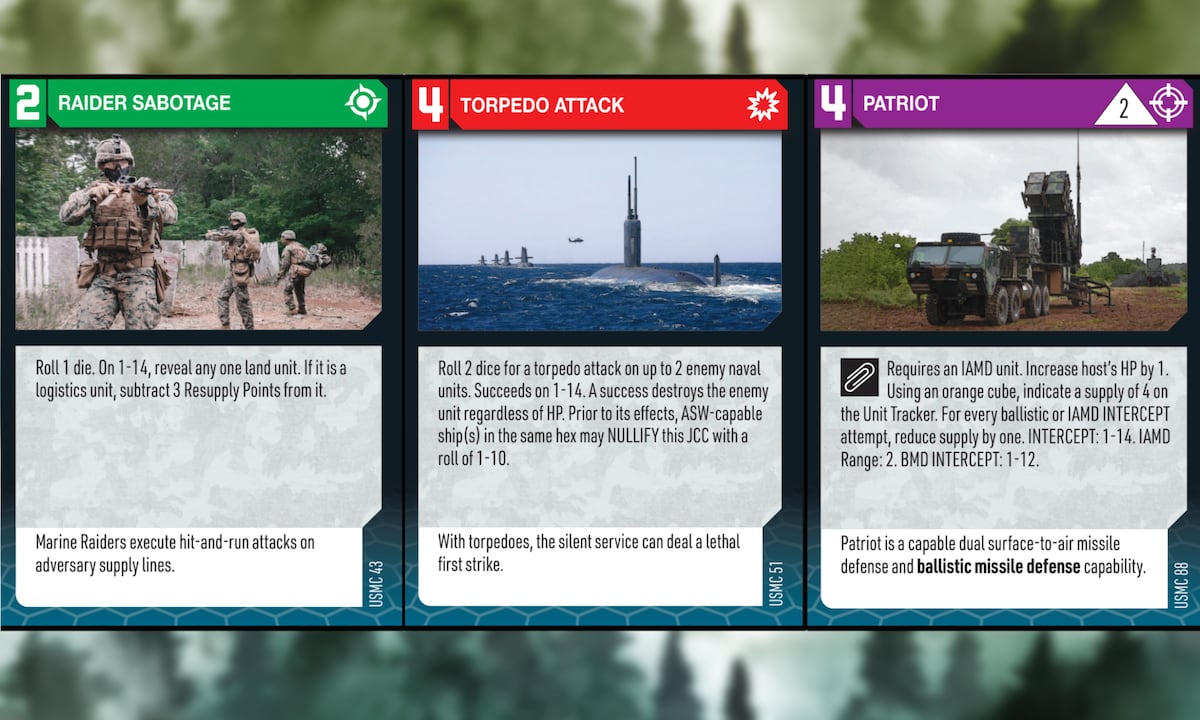
The game’s strategic depth is further enhanced by 277 “Joint Capability” cards. These cards allow players to customize their forces using “Command Points” to select from capabilities like bomber strikes, cyber warfare, and electronic warfare. Sebastian Bae, the game designer, explained to Defense News, “The cards feature a wide range of future, near-future and present-day capabilities to allow players to experiment and explore what capabilities can contribute to different scenarios.”
Players take turns executing moves, engaging in combat, and resupplying, with the ultimate aim to accumulate “Victory Points” through enemy destruction or territory capture. “What can be seen can be destroyed, so don’t be seen,” is a guiding principle, as players engage in a high-stakes game of hide-and-seek. Units remain hidden until detected, adding an element of suspense and tactical planning.
Bae, who designs wargames for the Center for Naval Analyses, noted, “Players must play this cat and mouse game where each side is seeking to establish all sensing and fires superiority.” The game reflects the challenges seen in the Ukraine conflict, where firing on the enemy risks exposure to counterattacks.
Resource management also plays a critical role, with limited guided munitions like missiles and interceptors requiring careful targeting. The “Influence Meter” introduces an additional layer, rewarding strategic victories while penalizing indiscriminate urban bombardment.
“Littoral Commander: The Baltic” follows the initial game in the series, “Littoral Commander: Indo Pacific,” which focused on U.S.-China tensions. These games have been utilized by various military institutions worldwide, including U.S. military staff colleges and the British and Australian armies.
With plans for expansions featuring NATO and Japanese forces, and “Littoral Commander: Australia” set to release soon, Bae aims to bridge the gap between civilian awareness and military preparedness. “Help civilians imagine the challenges and requirements of a Baltic conflict and what that means,” he stated, emphasizing the game’s dual purpose in education and strategic training.