In a time when high-tech solutions were not always reliable, the U.S. Navy found an unlikely ally in pigeons. These birds, often overlooked, played a crucial role in World War II, particularly in ensuring secure communications from submarine-hunting blimps.
The Evolution of Pigeons in Naval Service
The U.S. Naval Academy took its first steps into pigeon training back in 1891, establishing the Navy’s initial pigeon breeding and training program. By 1896, the U.S. Naval Pigeon Messenger Service was formalized, with pigeon lofts springing up at significant naval bases on both coasts.
During the Spanish-American War in 1898, pigeons were pivotal for communication, ferrying messages from ships to the Atlantic seaboard. However, as radio technology advanced, these feathered messengers were made redundant, leading to the auctioning off of Navy pigeons by 1902 as radios became standard on ships.
World War I saw the return of these avian messengers. The Navy created the pigeon trainer enlisted rating, with sailors undergoing six to 12 months of specialized training to manage pigeon facilities at air stations.
Despite advancements in technology, WWII presented new challenges. Radio communications were vulnerable to enemy interception, prompting the Navy to seek alternative methods of message transmission.
Pigeons: The Silent Messengers
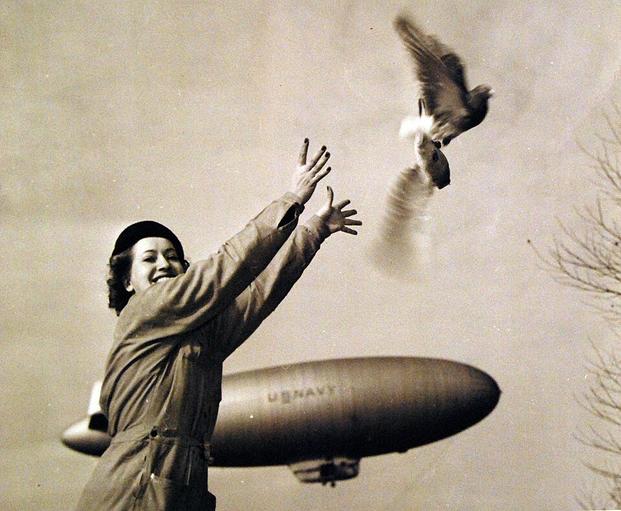
Naval Air Station Lakehurst, New Jersey, became the hub for airships patrolling the Atlantic during WWII. Airships carried six pigeons in crates on each antisubmarine patrol mission. These birds addressed a tactical issue: the need for silent communication. K-class blimps were adept at spotting submarines but sending radio signals risked alerting enemy U-Boats.
Pigeons transported messages using capsules—black for routine and red for emergencies. This allowed destroyers to receive warnings of nearby submarines without alerting the enemy, leading to the success of over 37,000 blimp patrols, with no convoy losses to enemy submarines.
Women Pioneers in Pigeon Training
In 1942, the Navy introduced the Specialist (X) (PI) rating, and by 1943, this role opened to Women Accepted for Volunteer Emergency Service (WAVES). Pearl Nill Robbins was among the first women to complete the training, earning the title of Specialist X (Pigeoneer). She later shared with the Waco Tribune-Herald, “I knew I was a pioneer, first for just being able to join the military service, and second as one of the first females to serve as a pigeoneer.”
The WAVES pigeoneers were responsible for the breeding and training of pigeons at the base but did not participate in blimp patrols. Instead, trained male crews took the pigeons aboard, while the women maintained the pigeon program at the station.
Advancements in Pigeon Breeding
Post-WWI, the Army’s Signal Corps initiated breeding programs to enhance pigeons’ capabilities, producing birds that could cover greater distances at faster speeds. WWII pigeons could travel up to 600 miles, with cruising speeds of 35 to 40 miles per hour, providing a reliable alternative to radio communications.
According to the National Museum of American History, over 95% of messages were successfully delivered by these birds during WWII, offering a secure method of communication between airships and submarine hunters.
The Decline of the Pigeon Era
After WWII, the pigeon trainer rating persisted until the Specialist X pigeon trainer rating was phased out, transitioning to an emergency service category by 1948. By 1961, advancements in secure radio communications finally rendered pigeons obsolete in naval operations.
Though the era of naval pigeons has concluded, these birds provided indispensable service during wartime, ensuring communications remained secure when technology could not.