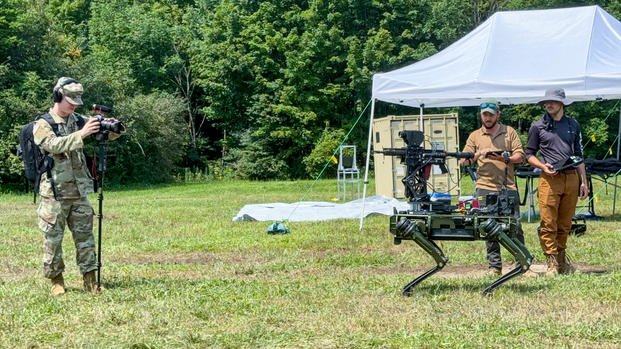
In a race against time, the Pentagon is rapidly integrating artificial intelligence into military operations, prompted by lessons from Ukraine’s battlefield and China’s ambitions in military AI dominance. With a $100 million AI initiative launched by the Department of War in December 2024, the focus is on enhancing decision-making and developing autonomous weaponry.
AI Drones and Their Impact on Modern Warfare
Maj. Gen. William “Hank” Taylor, acting commander of the Eighth Army in South Korea, recently highlighted the growing influence of AI in military strategy. His close relationship with an AI chatbot underscores the shift in military planning driven by Ukraine’s use of AI-powered drones. These drones, equipped with computer vision, effectively target adversaries despite electronic warfare interference. In 2024, both Ukraine and Russia produced over 1.5 million drones, reshaping the cost dynamics of warfare.
Research from the Royal United Services Institute in London indicates that affordable FPV drones are responsible for most of the destroyed Russian equipment. These drones, costing around $500, can neutralize multi-million-dollar tanks when equipped with AI targeting systems priced at $100 to $200.
Pentagon’s $100 Million AI Initiative
The Pentagon’s AI Rapid Capabilities Cell, backed by $100 million, aims to accelerate AI deployment with four pilot programs exploring warfighting and enterprise management applications. According to Radha Plumb, the Pentagon’s chief digital and AI officer, these 90-day experiments are part of a broader effort to integrate AI into military operations.
Early results have been promising, with AI chatbots assisting military doctors and AI systems tested in simulated Pacific combat scenarios. The Pentagon’s goal is to reduce decision-making time in combat, leveraging AI for real-time threat analysis.
China’s AI Ambitions Prompt U.S. Action
China’s significant investments in AI, as detailed in the War Department’s 2024 China military report, are a major catalyst for the U.S. push in military AI. Beijing’s focus on autonomous vehicles and AI-supported radar technologies underscores its commitment to lead the next revolution in military capabilities.
Despite U.S. private AI investments reaching $109.1 billion in 2024, China’s state-run defense sector’s rapid integration poses a challenge. Russia’s partnership with China further complicates the landscape, with joint efforts in autonomous weapons development.
Machine-Speed Decisions in Future Combat
Former Air Force Secretary Frank Kendall emphasized the need for machine-speed decision-making in future warfare. After experiencing an AI-controlled F-16, he expressed confidence in AI’s capability to make combat decisions.
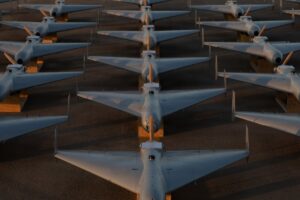
However, the International Committee of the Red Cross has voiced concerns about AI weapons making lethal decisions without human oversight. Despite this, the Air Force’s plans for an AI-enabled fleet of unmanned aircraft by 2028 remain on track.
AI’s Role in Military Logistics and Intelligence
Maj. Gen. Taylor’s Eighth Army uses AI for predictive analysis and intelligence forecasting, a trend reflected across the military. Soldiers are trained in AI fundamentals, with AI tools assisting in logistics, intelligence processing, and equipment maintenance.
At Fort Huachuca, Arizona, AI processes drone footage swiftly, demonstrating the technology’s potential to streamline operations. The global military AI market, valued at $9.3 billion in 2024, is projected to grow significantly by 2030, highlighting the competitive landscape.
As China and Russia advance their AI capabilities, the Pentagon’s $100 million investment represents a crucial effort to maintain U.S. military superiority in the evolving technological battlefield.