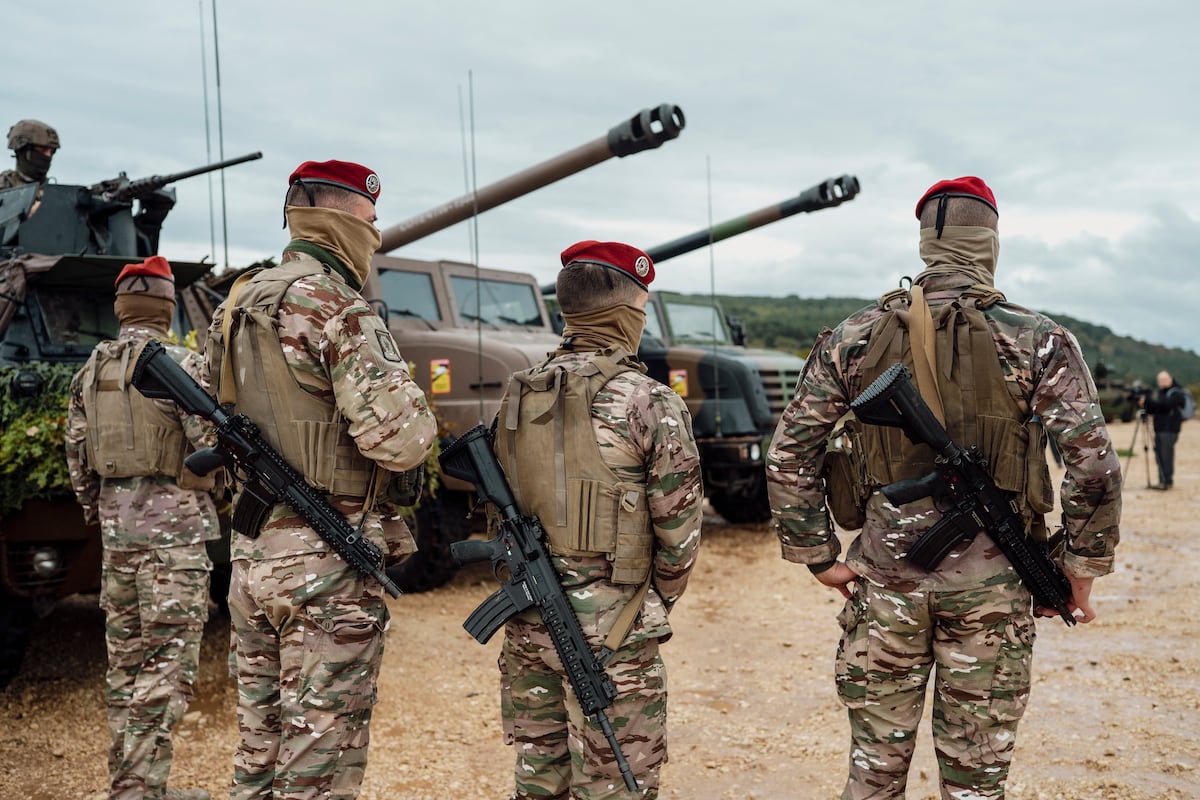
In the competitive world of military artillery, the Caesar howitzer by KNDS stands out with strong prospects in the U.S. Army’s search for a new artillery system. This French-German creation is vying to replace the M777 howitzer, and it has already garnered respect among American artillery personnel who have observed its performance in past conflicts.
Olivier Fort, a former French artillery colonel and current executive at KNDS, highlighted the gun’s reputation post-demonstration at the Canjuers military base in France. “The French Army fired in Iraq, in Afghanistan, we were on the same bases as the Americans, and the Caesar cannon has an excellent reputation among American artillerymen,” Fort stated. KNDS has recently aligned with Leonardo DRS to introduce the Caesar to the U.S. market, with an anticipated order of approximately 400 units to replace the M777, although a formal request for proposals hasn’t been issued yet.
The Caesar howitzer’s credibility is partly built on its extensive use in Iraq, where French crews discharged 18,000 rounds, 70% of which were propelled with five or six charges, allowing for a shooting range of up to 40 kilometers. This performance underscores the system’s capabilities and reliability in high-pressure scenarios.
Globally, KNDS has secured orders for over 720 Caesar units from 14 nations, including Ukraine, which has received about 120 of these truck-mounted guns. The adaptability of the Caesar is evident, as it is available in configurations mounted on six or eight-wheeled trucks. KNDS is also enhancing the system with a Mark II version featuring improved armor and engine power, slated for delivery to the French Army by 2027.
The U.S. Army’s artillery competition in 2021 saw the Caesar contend with systems like Elbit’s Atmos and BAE Systems’ Archer. Fort remarked that Caesar’s deployment in Ukraine, alongside the local Bohdana, has provided KNDS with valuable user feedback for continuous improvement.
Looking ahead, the U.S. Army’s upcoming competition will be more streamlined compared to 2021, with fewer systems being evaluated. Nonetheless, the competition remains fierce, with Elbit, BAE Systems, KNDS Germany’s RCH 155, and potentially Rheinmetall among the contenders.
“In fact, the United States has such a vast artillery that it has multiple needs,” Fort commented, hinting at future replacements beyond the M777, such as the M109.
To meet U.S. preferences for domestic production, KNDS has partnered with Leonardo DRS. Fort explained, “Leonardo DRS is a very large American company that is no less American than any other. With this partnership with Leonardo DRS, we have the same opportunities as the others.” The Caesar system, including its barrel, would be manufactured in the U.S.
In contrast to the high-charge firing in Iraq, Ukrainian crews often use fewer charges to prolong barrel life due to limited replacement availability. The U.S. is keen on extracting technical lessons from the Ukrainian experience, rather than tactical ones, as Fort noted, “They are currently looking very closely at Ukraine’s technical teachings.”