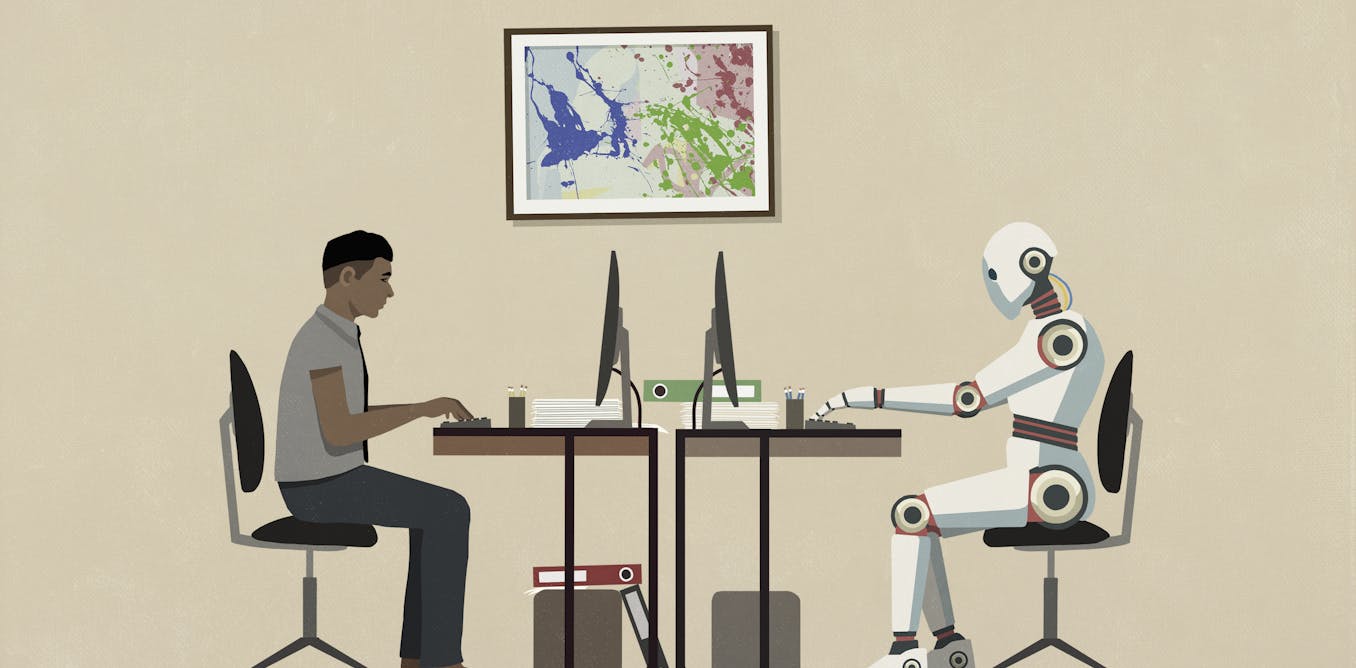
As technology continues to evolve, companies are reshaping their workforce strategies to integrate artificial intelligence (AI) more effectively. Accenture’s recent decision to lay off 11,000 employees highlights this shift, as the firm simultaneously enhances its focus on training workers to use AI. This trend underscores a broader challenge for businesses: balancing efficiency with the need to adapt to new technological landscapes.
Accenture is not alone in this transition. IBM has replaced numerous roles with AI systems, while simultaneously creating new opportunities in sales and marketing. Similarly, Amazon has reduced its workforce even as it expands teams responsible for AI tool development and management. From financial institutions to healthcare and creative industries, the impact of AI is prompting a reevaluation of job roles and the emergence of new ones.
At Drexel University’s LeBow College of Business, where I conduct research, students and executives frequently inquire about maintaining employability in the AI era and building trust in rapidly advancing technologies. The fundamental question they pose is which skills are vital in an economy increasingly influenced by machine learning.
To address these concerns, my colleagues and I conducted two surveys this summer. The Data Integrity & AI Readiness Survey surveyed 550 companies on their AI usage and investment strategies. Meanwhile, the College Hiring Outlook Survey examined 470 employers’ perspectives on entry-level hiring and the importance of AI skills. These surveys provide insights into both the creators of AI and those adapting to work with it.
AI’s Pervasiveness and Workforce Preparedness
Our findings reveal that over half of organizations now rely on AI for daily decision-making, yet only 38% believe their employees are adequately prepared to use it. This disparity is reshaping the job market, as AI not only replaces some roles but also highlights the readiness of others to collaborate with it.
Interestingly, while companies depend on AI, only 27% of recruiters are comfortable with candidates using AI tools for tasks like resume writing or salary research. This reluctance indicates a disconnect in perceptions of “responsible AI use” between businesses and job seekers.
The readiness gap is particularly evident in customer-facing and operational roles, such as marketing and sales, where automation is rapidly advancing. Many employers have yet to update their degree and credential requirements, resulting in a mismatch between current hiring criteria and the skills needed for future work.
Key Skills: Fluency and Trust
Our research identifies “human-AI fluency” as a crucial skill for adaptability. This involves working seamlessly with intelligent systems, scrutinizing their outputs, and continuously learning. The primary challenges companies face in expanding AI involve ensuring compliance with ethical standards and aligning AI with business objectives, which require sound judgment rather than technical prowess.
In my teachings, I emphasize the importance of “digital bilingualism,” the ability to integrate human judgment with machine logic. According to our Data Integrity & AI Readiness Survey, organizations with strong governance and trust report significant performance and innovation gains. Trust encourages employees to explore and learn from mistakes, transforming technology from a source of fear into a learning tool.
The College Hiring Outlook Survey reveals that 86% of employers provide internal training or boot camps, but only 36% prioritize AI-related skills for entry-level roles. Training often focuses on traditional skills, rather than those necessary for emerging AI jobs.
Evolving Hiring Practices
Companies leading in AI are redefining roles rather than merely cutting jobs. Success will depend on hiring individuals who can integrate technology with good judgment, question AI outputs, and translate them into business value. Resumes are becoming less relevant as traits like curiosity and judgment gain importance in intelligent tool usage.
This shift is giving rise to hybrid roles like AI translators, who interpret AI insights for decision-makers, and digital coaches, who guide teams in working with intelligent systems. These roles blend technical skills with human insight, illustrating how future jobs will integrate technology with human capabilities.
The combination of judgment and adaptability is emerging as a new competitive edge. The future will reward those who can harness both human and artificial intelligence to create tangible value.