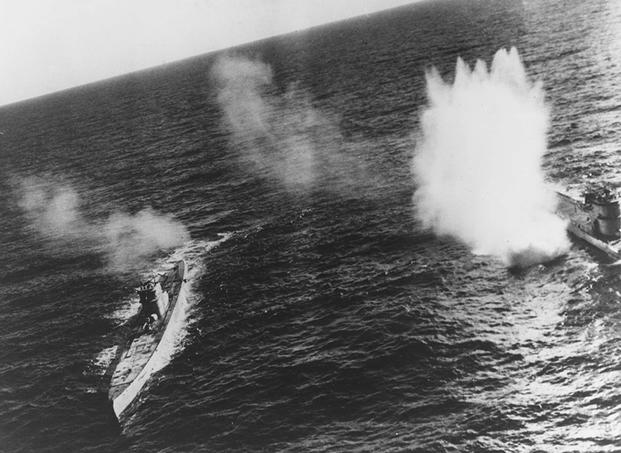
In the midst of World War II, amidst the technological advancements of the era, an unexpected naval engagement unfolded in the Atlantic Ocean. On May 6, 1944, the crew of the USS Buckley, a destroyer escort, engaged in a rare hand-to-hand combat with German sailors from the submarine U-66, echoing centuries-old naval warfare traditions.
USS Buckley: Guardian of the Atlantic Convoys
Launched in 1943, the USS Buckley was tasked with protecting Allied convoys from the notorious German U-boats. Named after Aviation Ordnanceman John D. Buckley, who perished at Pearl Harbor, this vessel was initially used for training until it entered the fray of the Atlantic battle in the spring of 1944.
By May 1944, Buckley was part of Task Group 21.11, operating alongside the escort carrier USS Block Island. Their mission: to secure convoys and pursue enemy submarines. Despite being equipped with advanced radar and sonar, the crew would soon find themselves engaged in combat reminiscent of an earlier age.
The Pursuit of U-66
In the pre-dawn hours of May 6, Lt. Jimmie Sellers, piloting a reconnaissance aircraft from Block Island, spotted U-66, a seasoned German submarine led by Oberleutnant zur See Gerhard Seehausen. The submarine, on its ninth patrol and in dire need of resupply, surfaced near the Cape Verde Islands to recharge its batteries.
Lt. Cmdr. Brent Abel of the Buckley quickly responded, ordering full speed to intercept the enemy. Mistaking the Buckley for a friendly vessel, Seehausen signaled its location, but when the mistake became clear, the U-boat launched a torpedo. The Buckley deftly evaded it, and a fierce exchange of fire ensued, with Buckley‘s guns taking a toll on U-66.
Overhead, Sellers provided a vivid commentary, describing the battle as, “Buckley has opened fire, sub is returning fire. Boy! I have never before seen such concentration! Buckley is cutting hell out of the conning tower!”
Clash on the High Seas
The confrontation took a dramatic turn as Abel ordered his ship to ram the enemy. The impact locked the two vessels together, and chaos erupted. German sailors, some armed with machine guns and others with improvised weapons, boarded the Buckley, leading to close-quarters combat.
The Americans, caught off guard, improvised with whatever was available—shell casings, kitchenware, and even a coffee pot. One sailor used a .45 pistol to fend off attackers, while another sustained the only American injury by breaking his hand in a scuffle.
Despite the surprise, the German boarding party was swiftly overcome, with survivors rounded up by a sailor wielding only a hammer.
As Buckley disengaged, U-66, heavily damaged, collided with the escort again. In a final act of defiance, an American sailor lobbed a grenade into the submarine’s tower, igniting a fire that ultimately sank the U-66, taking its commander with it.
The Aftermath and Legacy
The encounter ended with Buckley rescuing 36 German survivors. Despite sustaining damage, the ship remained afloat and emerged victorious from one of the most unusual naval battles of World War II.
Lt. Cmdr. Abel received the Navy Cross, and the Buckley crew was honored with a Navy Unit Commendation. The ship, after repairs, continued its service, later aiding in the sinking of another U-boat, U-548, in 1945.
Following its decommissioning in 1946, Buckley was eventually scrapped in 1969. However, the legacy of this unique naval engagement endures, as the only instance during World War II where a U.S. Navy ship successfully rammed and defeated an enemy vessel through hand-to-hand combat.