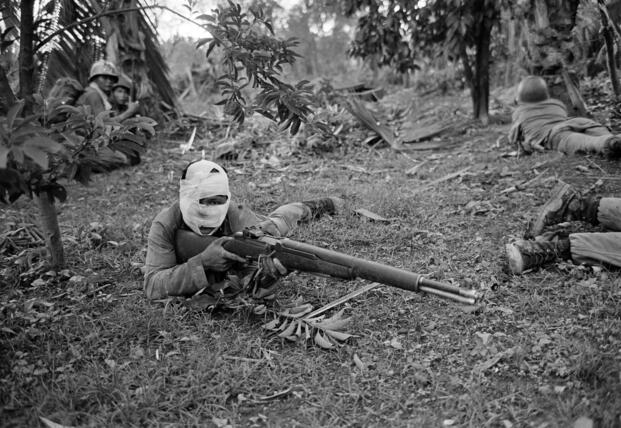
In the dense jungles of Vietnam, a seemingly routine mission turned into a grueling test of valor and resilience for 11 American Green Berets. Stationed at Dong Xoai, they were thrust into a fierce 14-hour battle, challenging America’s military engagement strategies in Vietnam.
Nighttime Assault: Viet Cong’s Tactical Mastery
In the early days of June 1965, Detachment A-342 of the 5th Special Forces Group found themselves at Dong Xoai, a key strategic location north of Saigon. Their mission was to train local Montagnard tribesmen and South Vietnamese forces. But before long, the camp was under siege. Two Viet Cong regiments, the 272nd and 273rd of the 9th Division, stealthily advanced under the cover of night, bringing with them a formidable force of 1,500 to 2,000 fighters.
As the night progressed, the camp endured a relentless barrage. Mortar rounds and recoilless rifle fire shattered the defenses, crippling communication lines and the medical dispensary. The situation demanded immediate leadership, which 2nd Lt. Charles Q. Williams provided after SF Capt. Bill Stokes was wounded.
Desperate Defense and Courageous Efforts
Williams, leveraging his experience from the 82nd Airborne Division, rallied the troops amidst chaos. Despite multiple injuries, he orchestrated a defense, repositioning troops and maintaining morale. Nine Navy Seabees, initially there for construction, joined the fray. Among them was Marvin Glenn Shields, who braved enemy fire to assist the wounded Capt. Stokes.
Amidst the chaos, Williams directed airstrikes and coordinated reinforcements, all while sustaining serious injuries. Shields, with no prior experience with a 3.5-inch rocket launcher, volunteered to help destroy a critical enemy machine gun nest, showcasing extraordinary bravery.
Reinforcements in Peril
As dawn broke, the arrival of ARVN reinforcements marked another turn in the battle. However, the Viet Cong awaited them. Helicopters transporting ARVN troops were ambushed at their landing zones, resulting in heavy casualties. Chief Warrant Officer Ralph Orlando recalled the devastation, noting the dire state of the compound and the relentless enemy waves.
Despite these setbacks, the ARVN 52nd Ranger Battalion managed to reclaim parts of Dong Xoai by June 11. Yet, the Viet Cong’s strategic prowess left the ARVN 7th Airborne Battalion vulnerable, leading to further losses.
Medal of Honor: Acts of Valor
Williams and Shields’ heroism did not go unrecognized. Williams received the Medal of Honor from President Lyndon Johnson in 1966. Shields, posthumously honored, became the first and only Navy Seabee awarded the Medal of Honor. Williams retired as a major and was laid to rest in Arlington National Cemetery in 1982.
The battle underscored the ARVN’s struggles against the Viet Cong and prompted a reevaluation of U.S. military strategy in Vietnam.
America’s Escalation: Entering Full-scale Combat
The aftermath of Dong Xoai prompted Gen. William Westmoreland to deploy the 173rd Airborne Brigade to the region. This marked America’s significant escalation into ground combat. Despite the withdrawal of the Viet Cong, the U.S. faced similar challenges as ARVN forces in the days that followed.
The battle’s toll was heavy. Three Special Forces soldiers, two Seabees, and numerous helicopter crewmen lost their lives. The ARVN suffered over 400 casualties. The Viet Cong, while retreating, left behind a chilling reminder of their tenacity.
With these events, the U.S. military presence surged, setting the stage for future confrontations like the Battle of Ia Drang.