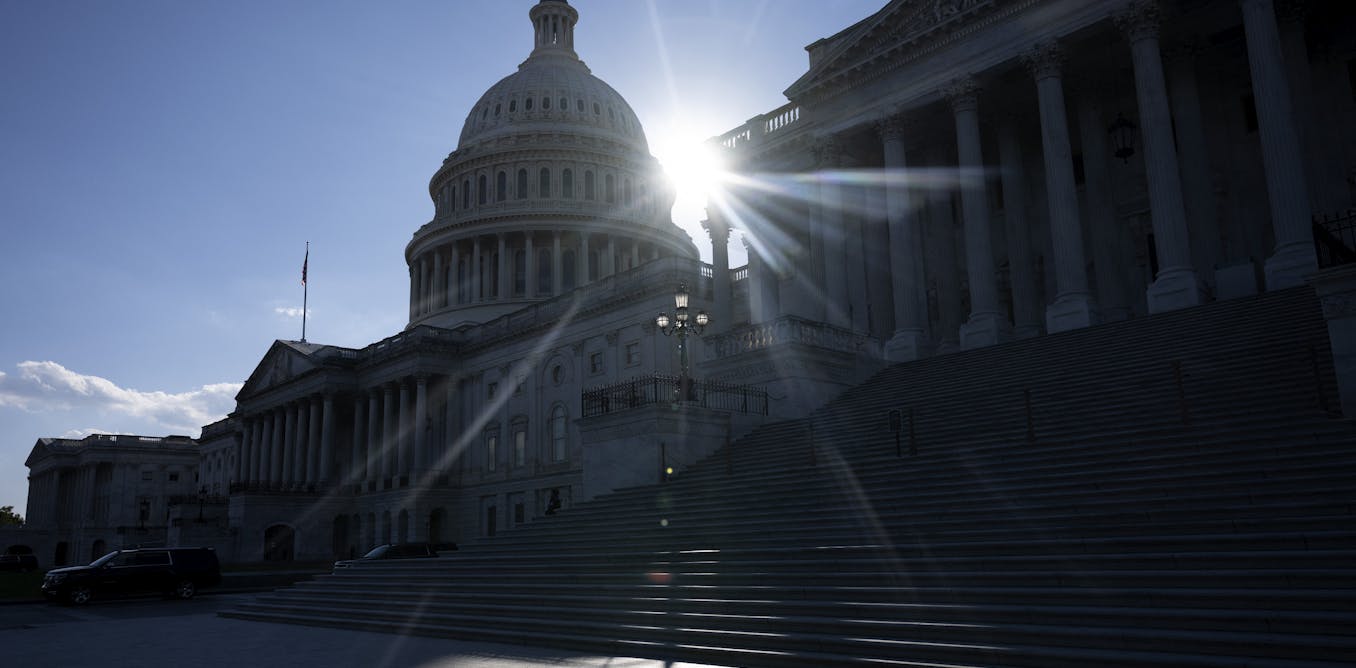
After an extended period of 43 days, the recent U.S. government shutdown concluded late on November 12, 2025. This resolution came as Congress successfully passed a long-awaited funding bill, which President Donald Trump swiftly signed into law.
The lengthy interruption of normal government operations has had noticeable economic repercussions.
In a conversation with Amitrajeet A. Batabyal, an economist from RIT, the discussion explored how the shutdown has influenced consumer behavior, GDP, and international trust in the economic leadership of the United States.
Immediate Economic Consequences
The furloughing of approximately 700,000 government employees has notably impacted consumer spending. Concerns arose as some workers feared potential permanent layoffs due to the Trump administration’s plans to reduce the workforce.
In response, the University of Michigan’s consumer sentiment index dropped significantly in November, reaching levels reminiscent of the pandemic’s worst days. This dip in consumer confidence correlates with decreased spending, adversely affecting retail sectors.
Additionally, the closure of national parks and monuments led to a decrease in tourism activities, compounded by a reduction in flights due to air traffic controller shortages. This effect was felt acutely in popular tourist destinations like Washington D.C. and Hawaii, impacting businesses such as hotels. Prior warnings from the U.S. Travel Association suggested a possible weekly loss of US$1 billion for the travel industry.
Long-term Economic Impact
The Congressional Budget Office estimates the shutdown cost the U.S. economy between $7 billion and $14 billion in GDP due to lost productivity, a loss that cannot be recuperated. International confidence in U.S. economic leadership has also been shaken, exacerbated by a recent credit rating downgrade. This could lead to increased borrowing costs and a weakening of the U.S.’s role in the global market.
China’s economic ascent, coupled with the erosion of trust in the U.S. as a market leader, could further diminish America’s influence in international trade and finance, complicating Washington’s global standing.
Disparity in Economic Impact
The shutdown’s effects have not been uniform across the country. Lower-income groups have suffered more, primarily due to disruptions in the Supplemental Nutrition Assistance Program (SNAP). With 92% of SNAP benefits going to households below the poverty line, over 42 million Americans were uncertain about their benefit payments.
Research indicates that Black Americans have faced more significant impacts due to their higher representation in federal jobs compared to private sectors. Geographically, states like California, Washington D.C., and Virginia, with high federal employment, experienced more pronounced effects. Hawaii, with a large military presence and federal employment, was notably hard-hit.
Recovery Prospects
While shutdowns are temporary, recovery hinges on their duration. Historically, long-term economic trends remain largely unaffected despite short-term disruptions. However, this shutdown set a record for its length and introduced unprecedented uncertainties regarding federal employee backpay and job security, potentially altering spending behaviors even after its resolution.
The reduction in domestic flights presents additional unknowns for economic recovery.
Influence of External Economic Factors
This shutdown occurred amidst a broad tariff war, impacting relations with both allies and adversaries. The resulting economic uncertainty has contributed to inflationary pressures, including rising grocery prices.
The Federal Reserve faces challenges in managing monetary policy amid this uncertainty, compounded by a lack of government data during the shutdown, which has left the Fed navigating without clear guidance.