U.S. Aircraft Carrier Deploys to Caribbean Amid Speculation Over Military Intentions
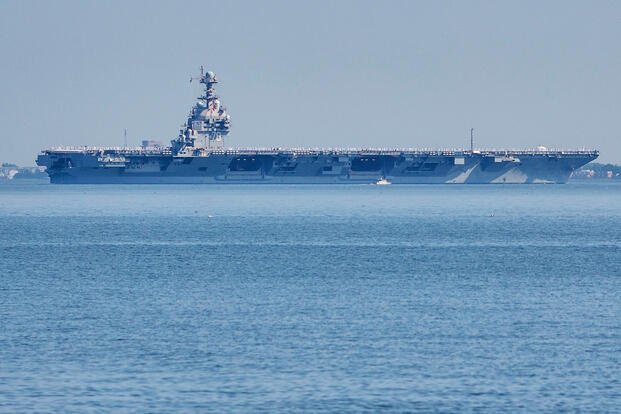
The deployment of the USS Gerald R. Ford to the Caribbean Sea has intensified discussions about the U.S. military’s objectives in South America, particularly as the Trump administration ramps up operations against vessels suspected of drug trafficking. The Navy announced this significant military presence, underlining its role in a counterdrug operation that critics suggest is also aimed at pressuring Venezuelan President Nicolás Maduro.
Since September, at least 80 individuals have been killed during 20 U.S. military strikes on boats accused of drug transportation in the Caribbean and eastern Pacific. The arrival of the Ford marks a substantial increase in U.S. military presence in the region, part of “Operation Southern Spear,” now involving nearly a dozen Navy ships and around 12,000 sailors and Marines.
The carrier strike group, featuring fighter jet squadrons and guided-missile destroyers, made its way through the Anegada Passage near the British Virgin Islands. Rear Adm. Paul Lanzilotta emphasized the group’s role in safeguarding U.S. security and prosperity against narco-terrorism in the Western Hemisphere.
Adm. Alvin Holsey, overseeing the Caribbean and Latin America, expressed readiness to tackle transnational threats destabilizing the region. Holsey, who is set to retire soon, called the deployment a pivotal move to reinforce the security of the Western Hemisphere and the safety of the American homeland.
In Trinidad and Tobago, which lies close to Venezuela, the government confirmed ongoing training exercises with the U.S. military, aimed at curbing violent crime. These exercises, involving Marines from the 22nd Expeditionary Unit, have heightened regional tensions, with the Venezuelan government labeling them as aggressive acts.
Meanwhile, U.S. Army Secretary Dan Driscoll hinted at increased focus on Latin America, revealing plans to reactivate a jungle school in Panama. He stated that U.S. forces are prepared to act according to directives from President Trump and Defense Secretary Pete Hegseth.
The U.S. administration has maintained that the military buildup is intended to halt the drug flow into the U.S.; however, it has not provided evidence confirming those targeted were narcoterrorists. President Trump has suggested expanding military actions beyond maritime operations to include land-based drug interdiction.
Aircraft carriers have historically served as tools for deterrence and pressure, with their warplanes capable of striking deep within adversary territories. While some experts argue the Ford may not be ideal for combating cartels, its presence could serve as a significant intimidation factor against Maduro.
According to Secretary of State Marco Rubio, the United States does not acknowledge Maduro as Venezuela’s legitimate leader, accusing him of election fraud and facilitating drug trafficking. Maduro, facing U.S. narcoterrorism charges, has accused the U.S. of fabricating conflicts and vowed to defend Venezuela against any hostile actions.
Venezuela’s government has recently organized a large-scale mobilization of troops and civilians, preparing for potential U.S. attacks. Amidst these developments, U.S. actions have faced scrutiny from regional leaders, the U.N. human rights chief, and U.S. lawmakers, who are demanding more information on the military strikes’ targets and legal foundations.
Despite pushback, Senate Republicans have opposed legislation that would limit the President’s authority to initiate attacks on Venezuela without congressional approval. The situation remains tense as experts debate the possibility of U.S. airstrikes on Venezuelan soil, with the Ford’s deployment symbolizing renewed U.S. military influence in Latin America.
Elizabeth Dickinson of the International Crisis Group remarked, “This is the anchor of what it means to have U.S. military power once again in Latin America.” The situation continues to evolve, with regional observers closely watching U.S. military maneuvers and their implications.
___
Associated Press writers Anselm Gibbs in Port of Spain, Trinidad, and Gabriela Molina in Caracas, Venezuela, contributed to this report.