In the shadow of World War II, tension gripped the West Coast like a vice. Just months after the harrowing attack on Pearl Harbor, the early hours of February 25, 1942, would see Los Angeles erupt in what many believed was a battle for survival. As sirens wailed and searchlights pierced the night sky, a city on edge faced an invisible enemy, leaving a legacy of questions and theories that persist to this day.
On that fateful morning, the sky over Los Angeles became a theater of chaos. As air raid sirens screamed their warning, searchlights scanned the heavens and anti-aircraft batteries unleashed a devastating barrage. By the time dawn broke, over a thousand shells had been fired, yet no enemy aircraft were found, and the city bore the scars of a battle fought against phantoms.
Japanese Submarine Attack: Los Angeles on High Alert
The attack on Pearl Harbor had left the United States reeling. In its aftermath, the West Coast became a fortress against the specter of enemy invasion. From Seattle to San Diego, cities fortified themselves, with military personnel guarding critical sites and patrols maintaining a vigilant watch. The threat was palpable, especially after the Japanese submarine I-17 shelled an oil field near Santa Barbara on February 23, sowing panic and fear across the region.
With enemy forces seemingly unstoppable, Los Angeles braced for the worst. Naval intelligence warned of an imminent attack, and the city stood poised for conflict. On the night of February 24, flares were reported near defense plants, and an alert kept the city on edge until late into the night.
The Battle of Los Angeles
In the early hours of February 25, radar detected an unidentified object 120 miles west of the city. A blackout was ordered, and reports of enemy planes poured in. By 3:16 a.m., the 37th Coast Artillery Brigade opened fire, filling the sky with over 1,400 rounds of anti-aircraft ammunition. Smoke and explosions filled the air, and the city was thrown into chaos. As fear gripped the residents, accidents and injuries mounted, leaving five dead and many more injured.
As quickly as it began, the “Great L.A. Air Raid” came to an end. In its aftermath, Los Angeles awoke to a city littered with shrapnel and unanswered questions.
Military and Government Offer Conflicting Explanations
The morning after the incident, confusion reigned. With no evidence of enemy aircraft, speculation ran wild. The event occurred just days after President Franklin Roosevelt authorized the mass incarceration of Japanese Americans, leading to the arrest of 20 individuals that night for alleged blackout violations.
Newspapers published contradictory reports, with the Los Angeles Times claiming a foreign attack, while Navy Secretary Frank Knox dismissed it as a false alarm. Secretary of War Henry Stimson contradicted Knox, suggesting unidentified aircraft were involved. The confusion and mixed messages fueled public fear and mistrust.
UFO Conspiracy Theories
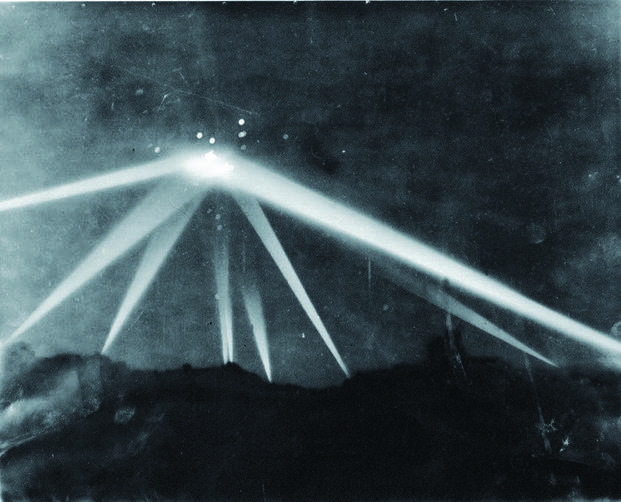
In the years that followed, the incident became enshrined in UFO lore. A heavily retouched photo published by the Los Angeles Times seemed to depict a disc-shaped object illuminated by searchlights, igniting theories of an extraterrestrial encounter. Despite the lack of concrete evidence, the image remains iconic in UFO circles and pop culture, inspiring stories and films about alien invasions.
The Likely Explanation for the Great L.A. Air Raid
Amidst the chaos of war, the most plausible explanation for the “Battle of Los Angeles” is a combination of overzealous defense measures and atmospheric phenomena. The shelling of the oil field had heightened fears of a Japanese attack, and the radar likely detected nothing more than weather balloons. The ensuing panic led to a massive military response to an imagined threat.
Later analyses attributed the incident to a meteorological balloon that sparked a cascade of nervous reactions. A 1983 Air Force review concluded that “war nerves” and meteorological balloons were the primary culprits.
While the Axis powers never launched an air raid on Los Angeles, the fear of such an attack was not unfounded. Throughout the war, Japanese and German forces targeted the American mainland, instilling a pervasive sense of vulnerability. The “Battle of Los Angeles” remains a testament to the intense anxiety and uncertainty that gripped the nation during World War II, a reminder of how easily fear can take hold in the fog of war.