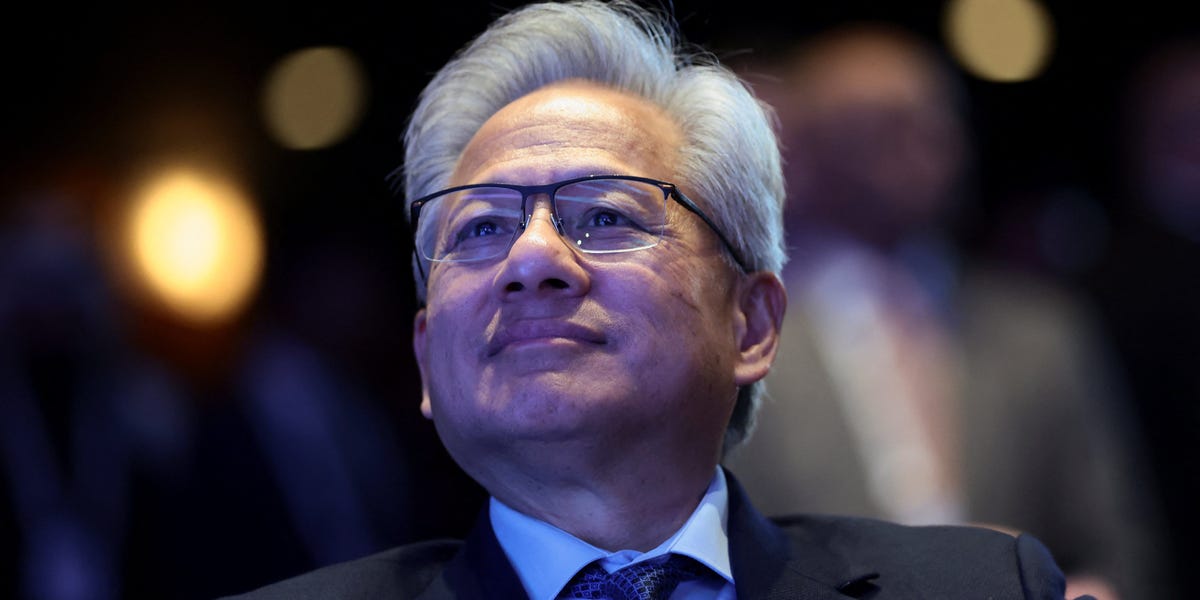
Nvidia’s impressive earnings have provided a much-needed boost to Wall Street.
On Wednesday, Nvidia, the prominent chip manufacturer, announced a significant $57 billion revenue for the quarter. This was largely driven by its data center division, which exceeded expectations by generating $51 billion, surpassing the forecasted $49.3 billion.
Furthermore, Nvidia has raised its fourth-quarter sales guidance to $65 billion, sparking renewed interest in AI and semiconductor stocks following a period of instability. Nvidia’s stock experienced a more than 3% increase in after-hours trading, with other chipmakers like Advanced Micro Devices, Broadcom, and Taiwan Semiconductor also seeing positive gains.
The AI Bubble Concerns
CEO Jensen Huang tackled the ongoing debates about the potential AI bubble.
“There’s been a lot of talk about an AI bubble,” Huang stated during his earnings address. “From our vantage point, we see something very different.”
He emphasized Nvidia’s unique position in the AI landscape, excelling in all stages from pre-training to inference. Huang cited the shift from CPUs to GPUs, the revenue-generating potential of AI through ads, and the rise of agentic AI systems as reasons for continued growth. Despite concerns about AI’s impact on jobs, Huang remains optimistic about the future.
Strategic Partnerships
Nvidia highlighted its new collaborations during the earnings call.
Among the partnerships, Nvidia has aligned with OpenAI, Anthropic, Uber, and xAI. In September, Nvidia announced a joint letter of intent with OpenAI, targeting a strategic partnership to deploy at least 10 gigawatts of Nvidia systems for OpenAI’s next-gen AI infrastructure. This venture is expected to see Nvidia investing up to $100 billion in data center infrastructure by the latter half of 2026.
Additionally, Nvidia entered a “deep technology partnership” with Anthropic, committing up to $10 billion. On the same day, Anthropic announced a $30 billion expenditure to scale its Claude AI model on Microsoft’s Azure platform, powered by Nvidia.
Nvidia and xAI also announced a substantial data center in Saudi Arabia, featuring Nvidia chips, with Elon Musk’s AI startup as its inaugural client.
Challenges with China
Export restrictions on China remain a pressing issue.
Nvidia’s CFO, Colette Kress, expressed disappointment over US export restrictions limiting sales of advanced AI chips to China. She noted that large orders from China were absent this quarter due to “geopolitical issues” and increased competition.
Nvidia continues to project zero data-center or compute revenue from China in the fourth quarter but intends to engage with both US and Chinese regulators.
Growth Prospects
Nvidia is focusing on robotics and AI infrastructure for growth.
Robotics emerged as a key growth area with automotive sales reaching $592 million in Q3, marking a 32% increase from the same period in 2024.
Nvidia’s latest 10-Q filing acknowledges the complexities of expanding power infrastructure as a “multi-year process,” yet remains confident in the potential of AI infrastructures, such as data centers, to drive growth.
According to Kress, “We believe Nvidia will be the superior choice for the three to $4 trillion in annual AI infrastructure built,” projecting demand to surpass expectations by the decade’s end.
The Role of Hyperscalers
Hyperscalers are pivotal to Nvidia’s growth.
Kress informed investors that hyperscalers like Meta are projected to contribute “roughly half” of Nvidia’s long-term opportunities as they adopt accelerated computing and generative AI.
She also noted Nvidia’s role in enhancing Meta’s service quality, boosting user engagement on platforms like Threads and Facebook.
CEO Huang countered the notion that only major tech firms invest in GPUs, emphasizing the benefits of Nvidia’s GPUs for companies with limited resources, improving scale, speed, and cost.