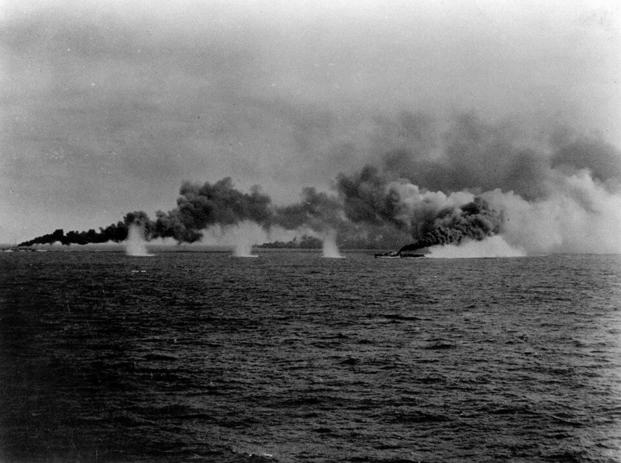
In the early hours of October 25, 1944, the U.S. Navy’s escort-carrier group “Taffy 3” found itself facing an unexpected threat. The Imperial Japanese Navy’s formidable battleship fleet, led by Vice Adm. Takeo Kurita, loomed on the northern horizon off Samar. Despite being outgunned, the small fleet of six escort carriers, three destroyers, and four destroyer escorts had to defend the invasion forces in Leyte Gulf without any backup.
An American Destroyer Faces the Odds
The USS Johnston, a Fletcher-class destroyer commanded by Cmdr. Ernest E. Evans, was the first to react. Evans, who had vowed, “This is going to be a fighting ship. I intend to go in harm’s way,” lived up to his word. The Johnston laid a smoke screen to shield the carriers and charged toward the enemy fleet at full speed, launching all ten of its torpedoes at the Japanese heavy cruiser Kumano. The attack was successful, as one torpedo hit its mark, disabling Kumano and forcing the Suzuya to provide escort.
Despite sustaining heavy damage from return fire, including a disabled radio and engine, the Johnston continued to fight. Its 5-inch guns targeted the heavy cruiser Chikuma and engaged the battleship Kongō, causing the latter to change course.
Taffy 3’s Resolute Defense
The courage displayed by Cmdr. Evans inspired the rest of Taffy 3’s ships to join the counterattack. The USS Hoel, USS Heermann, and the destroyer escort Samuel B. Roberts launched torpedo runs against intense enemy fire. Aircraft from the carriers, including Avengers and Wildcats, took to the skies armed with whatever they could muster, even depth charges when bombs and torpedoes ran out.
Their relentless defense sowed chaos within the Japanese fleet. Smoke screens, aggressive attacks, and continuous airstrikes led to confusion, damaging several Japanese ships and causing others to fall out of formation. The Japanese lost three heavy cruisers—Chikuma, Chōkai, and Suzuya—by the day’s end.
Despite severe damage, the Johnston re-engaged, darting between rain squalls and trading fire with much larger ships. A torpedoman aboard later recalled, “We got off all ten torpedoes, and they ran hot, straight, and normal!”
The Yamato, the largest battleship ever built, unleashed its massive guns on the Johnston, mistaking it for a cruiser. The shells tore through the destroyer, leaving it crippled. By 9:30 a.m., the Johnston was immobilized under heavy fire, prompting Cmdr. Evans to order the crew to abandon ship. The destroyer sank shortly after 10:00 a.m., with only 141 of its 327 crew members surviving. Evans, who was missing, was posthumously awarded the Medal of Honor for his bravery.
Legacy of the USS Johnston
The Johnston‘s actions left a significant impact on the battle. Its torpedo strikes and gunnery disrupted the Japanese fleet, buying critical time for the carriers to launch airstrikes and retreat. The battle resulted in the loss of three Japanese heavy cruisers and a strategic withdrawal, securing the beachhead in the Philippines.
The Battle of Leyte Gulf, which marked a turning point in the Pacific War, saw the eventual destruction of the Japanese fleet, including the sinking of the Yamato during the Okinawa Campaign. In 2019-2021, the wreck of the Johnston was discovered at a depth of 6,456 meters, setting a record for the deepest shipwreck until the Samuel B. Roberts was found at 6,895 meters a year later. The legacy of the Johnston and its crew is commemorated with a Presidential Unit Citation, celebrated for their extraordinary valor in the face of overwhelming odds.