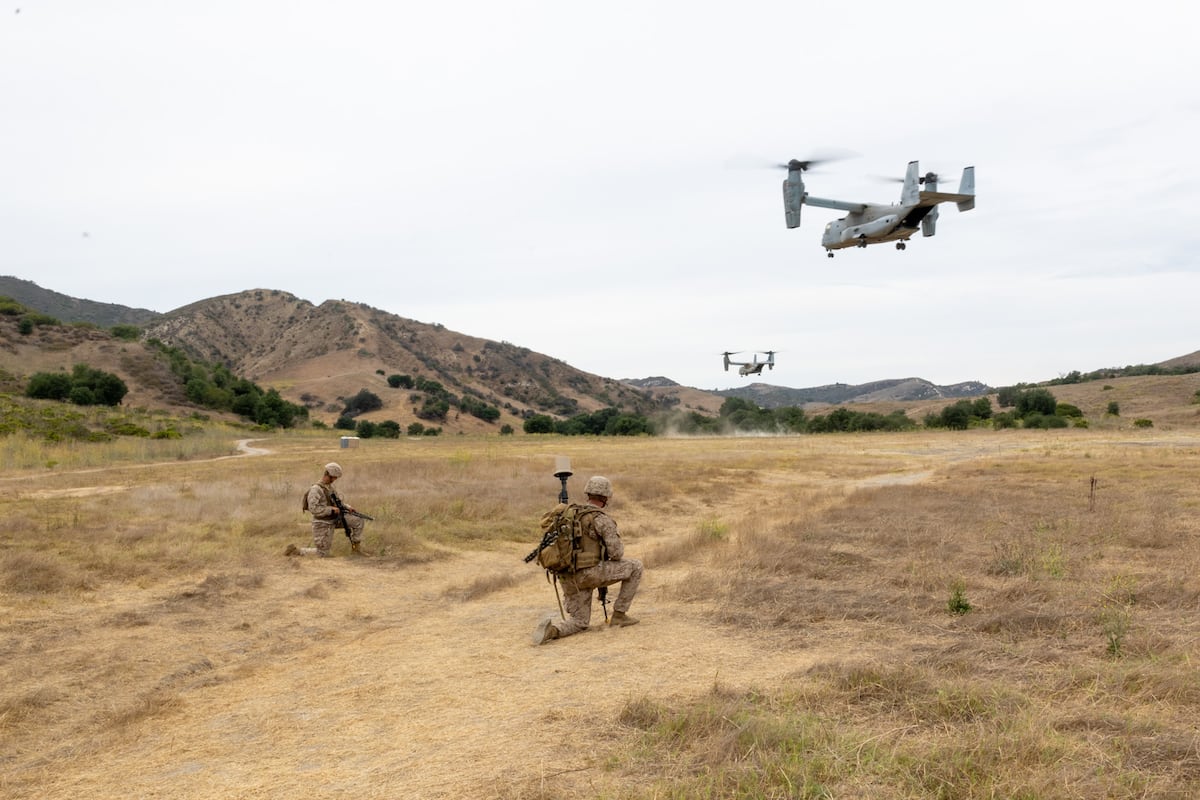
The U.S. Marine Corps is envisioning a future where in just 90 minutes, a functional airfield can emerge from a remote desert or island outpost. This ambitious goal relies on the rapid deployment of sophisticated navigation systems from aircraft like the MV-22 Osprey or CH-53 King Stallion.
The focus is on acquiring the Expeditionary Precision Approach Landing Capability (EPALC), as detailed in a recent request for information from Naval Air Systems Command. This initiative seeks advanced flight line navigation systems, enabling Corps aircraft to land in any weather, whether manned or unmanned.
The system must be compact enough to fit into MV-22, CH-53, or C-130 transports and require no more than 90 minutes for a four-person team to set up. It should provide precision guidance for aircraft in conditions where visibility is limited to half a mile, with an operational range of 20 nautical miles. The equipment needs to be robust, withstanding temperatures from -20 to 145 degrees Fahrenheit and 85% humidity.
These specifications align with the Marine Corps’ “Expeditionary Advanced Base Operations” (EABO) concept. This strategy focuses on small, self-reliant units operating from temporary, austere locations in coastal regions, aimed at enhancing sea control and fleet support. A 2021 description notes EABO’s emphasis on mobile, low-profile forces capable of sea denial and fleet sustainment.
Security features are also paramount, necessitating systems that identify friendly forces, resist jamming, and operate with minimal detectable signatures. This new capability echoes the ship-based Joint Precision Approach and Landing System (JPALS), which has improved aircraft carrier landings with GPS-based guidance, particularly under challenging conditions.
RTX-owned Collins Aerospace, the maker of JPALS, has developed the land-based expeditionary version, eJPALS, designed for quick setup and full functionality within 90 minutes. An eJPALS fact sheet highlights its compatibility with JPALS airborne software, offering pilots familiar instrumentation and optional air traffic control surveillance.
In 2021, the Marine Corps tested eJPALS at Marine Corps Air Station Yuma, Arizona. Over three weeks, the system supported 50 landings, including vertical approaches by F-35B Joint Strike Fighters. This successful trial has prompted consideration for budget inclusion, as reported by Breaking Defense.
Collins Aerospace has also proposed eJPALS to the U.S. Air Force, as noted in Defense News. The new RFI aims to explore commercial solutions for the EPALC, with interested companies invited to respond by January 16.