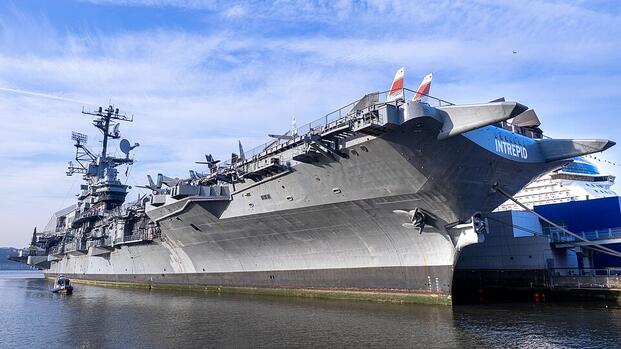
In an impressive feat of digital preservation, the USS Intrepid, a storied aircraft carrier with a rich history, has been meticulously scanned and archived. This ambitious project was a collaboration between the Intrepid Museum and FARO Technologies, resulting in an extensive 14.7-terabyte digital archive that captures the ship’s entirety with millimeter precision.
An Ambitious Undertaking
Utilizing cutting-edge laser scanning technology, the Essex-class carrier, which spans 872 feet, was thoroughly documented, producing over 1,300 scan clusters. This process resulted in a highly detailed digital twin that not only captures the ship’s structure but also the personal artifacts and stories that fill its corridors.
Chris Malanson from the Intrepid Museum and Irene Radcliffe from FARO Technologies discussed the intricacies of this project with Military.com, highlighting its significance as FARO’s most challenging cultural heritage project to date.
Innovation Born from Necessity
The project originated from the museum’s interest in applying 3D scanning technology to historic sites. However, with the onset of the COVID-19 pandemic, the museum’s closure created an opportunity to access and scan public areas. “Because the ship was closed, we were able to scan the public areas,” Malanson explained. This unexpected advantage allowed access to parts of the ship that had been inaccessible for years.
Initially a training exercise for FARO’s team, the project evolved into a comprehensive documentation effort, uncovering maintenance issues and personal artifacts, and capturing the daily life aboard a vessel where the average crew member was just 18 years old.
Precision Technology at Work
The digital preservation utilized lidar-based laser systems placed on tripods throughout the ship’s decks. Each scan collected two million measurement points, providing precise data on distances and positions. “It’s tripod-based,” Radcliffe shared. “You put the scanner in a location, it spins around and captures everything it sees—the ceiling, the walls, all of it—then you go to the next room and create an overlap.”
This meticulous process involved navigating narrow ship passages and steep ladders, with particular care taken to move fragile and expensive scanning equipment safely.
Unveiling Human Stories
Scanning revealed spaces sealed for decades, offering insights into the lives of the sailors who served aboard the Intrepid. “Each day was a new discovery,” Malanson said, noting the ship’s resemblance to a small city, complete with amenities like a barber and hobby rooms. The project unearthed crew artwork and personal items, bringing the ship’s history to life.
A Storied Past
The USS Intrepid, commissioned in 1943, earned its name “The Fighting I” through significant combat roles in World War II and Vietnam, surviving kamikaze attacks and aiding in space mission recoveries. The ship’s historical significance is preserved not only through its physical structure but also through the stories of those who served on it.
Preservation Through Innovation
The digital archive is invaluable beyond educational purposes, aiding in maintenance and restoration efforts. The scans revealed structural issues and enabled careful planning for restoration projects, minimizing the impact on historic spaces. “We now had all of that information,” Malanson noted, highlighting how the digital record surpasses the ship’s original blueprints.
The technology also facilitated the display of delicate artifacts, using detailed scans to create custom supports and enclosures for items like a kamikaze propeller.
Bringing History to the Public
Many areas of the Intrepid remain closed to visitors for safety, but the scanning project is changing this through virtual reality experiences and interactive displays. Visitors can now explore restricted areas virtually, gaining insights into the ship’s operation and crew’s lives.
The museum plans to expand the project, scanning its aircraft collection for digital display, allowing global audiences to examine artifacts closely.
Looking Ahead
The project serves as a testament to the potential of technology in preserving history. For Malanson and Radcliffe, the digital preservation of the Intrepid is about honoring the individuals who served aboard it. “What makes the Intrepid worth preserving in this cutting-edge way is our crewmembers,” Malanson stated.
The museum continues to develop new applications, exploring augmented reality experiences to further bring history to life.
“We just started to scratch the surface of what we can utilize this for,” Malanson said. “We are 100 percent committed to exploring this and using this as a powerful tool to better explore and present our history.”
For more information about the Intrepid Museum and its digital preservation efforts, visit their website. A video detailing the project is available on YouTube.