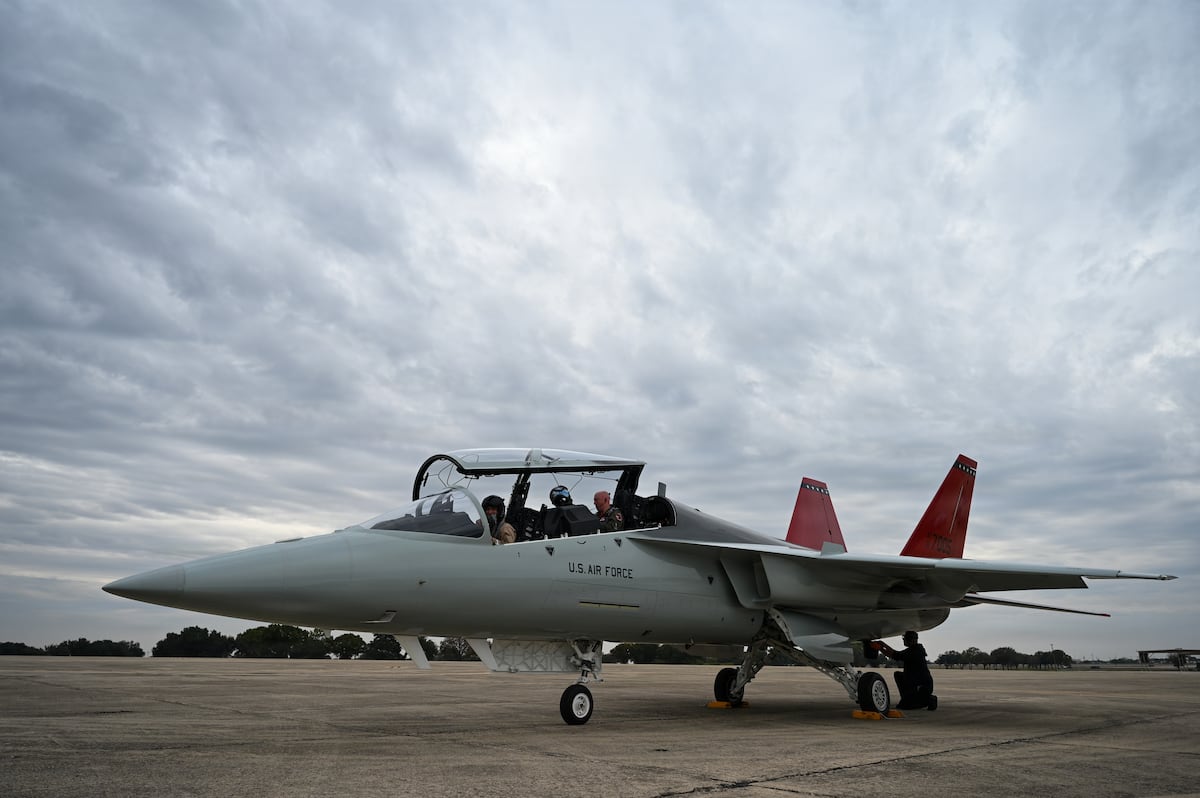
The T-7 Red Hawk, a new chapter in Air Force pilot training, has officially touched down at Joint Base San Antonio-Randolph in Texas. This marks the beginning of the T-7 era as the Air Force transitions to training its pilots on this cutting-edge aircraft.
Although the arrival of the T-7 Red Hawk is a significant milestone, it is just the start of integrating this Boeing-made jet into the Air Force’s pilot training program. This modern trainer is designed to prepare pilots for advanced aircraft, including the F-22 Raptor, F-35 Joint Strike Fighter, B-21 Raider stealth bomber, and F-47 fighter.
Lt. Col. Michael “Hyde” Trott, commander of the 99th Flying Training Squadron, piloted the T-7 from Boeing’s facility in St. Louis, Missouri, to Sheppard Air Force Base, Georgia, on December 3. Following this, Lt. Col. Phillip “Clean” Bourquin completed the journey to Randolph on December 5. A planned arrival ceremony was delayed due to weather conditions.
Despite the squadron’s instructors not yet flying the T-7, they have spent extensive time in simulators to acclimate to the aircraft’s operations. These preparations have been complemented by efforts to develop manuals, simulators, and course material in collaboration with Boeing and the Air Force’s T-7 program office.
“We have a lot of time with the avionics, the pilot-vehicle interface, and the sim itself,” Trott stated. “We have been providing feedback from an aircrew perspective on how those read and what they contain.”
Trott and Bourquin are scheduled to undergo further training in St. Louis, including ground and academic sessions as well as additional simulator hours, before commencing actual flights.
Trott expressed confidence in his preparation, citing the advanced simulators as highly effective training tools. “The jump from simulator to jet in the T-38 has a gap that needs to be bridged,” he noted, highlighting the T-7 simulator’s realism.
The T-7 simulator stands out with its 360-degree high-fidelity visuals, offering a realistic flying experience. It even simulates G-forces, adding to the tactile feedback pilots receive.
Next step: Training the trainers
With the T-7’s arrival, the 99th Squadron is set to conduct maintenance and other activities to prepare the jet for operational status. A training plan is underway to ready pilots for flying the T-7, and maintainers are also being trained to certify them for repairs, with Boeing providing support on-site.
Jillian Watson, from Air Education and Training Command, mentioned that the first batch of 39 T-7 maintainers would undergo training on the jet’s systems from January through June. Preparations have been ongoing to facilitate rapid training commencement after the holidays.
This particular T-7 is not a test aircraft but remains a developmental model as the aircraft is still under development. Trott emphasized familiarity with its capabilities, expressing eagerness to begin flights and training operations.
The initial flights will focus on training instructor pilots, including basic fighter maneuvers practice. Instructors will assess the T-7’s flight characteristics, determining maneuver speeds and developing official tactics and procedures.
While the 99th Squadron does not train students directly, it prepares instructors who will then teach flying at other locations. The first student flights on the T-7 are projected for fall 2027, with initial operational testing set to begin in summer 2027. The Air Force anticipates reaching initial operational capability by late summer 2027, with plans to expand the fleet at Randolph to 14 jets by August 2027.
The 99th Squadron, with its historical ties to the Tuskegee Airmen and the iconic red-tailed fighters of World War II, finds itself at the forefront of this new era. “When you’re a kid, you dream about being a pilot, and then you achieve that dream,” Trott reflected. “Being able to do something as historical as this is not lost on me.”