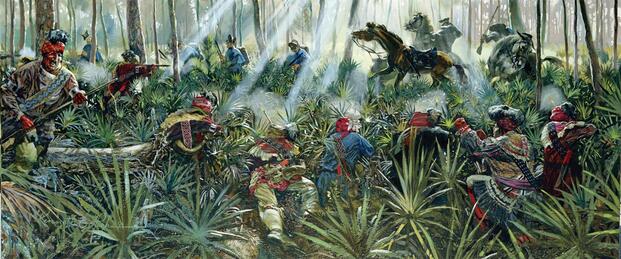
In the dense wilderness of central Florida on December 28, 1835, a single gunshot shattered the morning calm. This shot, fired by Chief Micanopy, was the harbinger of a fierce battle where 180 Seminole warriors ambushed 110 American soldiers. By day’s end, 108 soldiers lay dead, marking the onset of the Second Seminole War.
Despite being vastly outnumbered, with only around 2,000 warriors standing against a 30,000-strong U.S. army, the Seminoles engaged in the longest and costliest Native American conflict in U.S. history. They faced heavy losses and displacement but never surrendered.
Prelude to Conflict
Before this war, the Seminoles had clashed with the U.S. between 1817 and 1818. General Andrew Jackson’s forces invaded Spanish Florida, attacking Seminole villages while pursuing escaped slaves. In 1819, Spain ceded Florida to the U.S., and by 1821, white settlers began moving into lands where about 5,000 Seminoles lived.
Florida was also a refuge for escaped slaves, many living in Black Seminole communities. By the 1830s, Black Seminoles numbered in the hundreds and were integral to the resistance against American encroachment.
In 1823, the Treaty of Moultrie Creek confined the Seminoles to a reservation in central Florida. It promised provisions that were rarely delivered, while settlers infringed on the reservation’s boundaries. By 1830, President Andrew Jackson’s Indian Removal Act sought to relocate eastern tribes, leading to the Treaty of Payne’s Landing in 1832, which demanded that Seminoles leave Florida for Oklahoma. Many resisted, including the young warrior Osceola, declaring, “My skin is dark, but not black!”
The Dade Massacre
On December 23, 1835, Major Francis Langhorne Dade led a column from Fort Brooke towards Fort King. Seminole scouts tracked their movements, and by December 28, they ambushed the troops, killing nearly all of them. Only two soldiers survived the massacre.
This attack, alongside simultaneous assaults on Fort King, led to national outrage and demands for military retaliation.
Swamp Warfare
Early 1836 saw the Seminoles and Black Seminoles conduct raids across Florida, burning plantations and freeing slaves. Leaders like Chief Micanopy and Osceola orchestrated guerrilla tactics that took advantage of Florida’s challenging terrain, rendering conventional military operations ineffective.
General Thomas Jesup, noting the racial undertones of the conflict, remarked, “This is a negro, not an Indian war,” highlighting the intertwined fates of Seminoles and Black Seminoles.
Despite being outnumbered, the Seminoles used swamps and hammocks to their advantage, conducting ambushes and retreating into areas American troops couldn’t reach. They effectively used tactics to draw U.S. soldiers into vulnerable positions.
Betrayal and Capture
In a series of betrayals, American forces captured key Seminole leaders under false pretenses of negotiation. Coacoochee and Osceola were both seized during peace talks, causing public outrage. Osceola died in captivity, refusing any removal agreements.
Coacoochee’s subsequent escape from Fort Marion reinvigorated the resistance, solidifying his leadership among the Seminoles.
Christmas Battle
On Christmas Day 1837, Colonel Zachary Taylor engaged Seminole and Miccosukee forces at Lake Okeechobee. Despite heavy losses, the Seminoles retreated into the Everglades, continuing their resistance.
War’s End and Legacy
By 1842, after significant financial and human costs, the U.S. declared the war over without a peace treaty. Thousands of Seminoles were forcibly relocated, but hundreds remained, never officially defeated. Their descendants form today’s Seminole Tribe of Florida, preserving their legacy.
The war’s brutal history is commemorated at sites like Dade Battlefield Historic State Park, serving as a reminder of the longest and deadliest U.S. conflict with Native Americans.