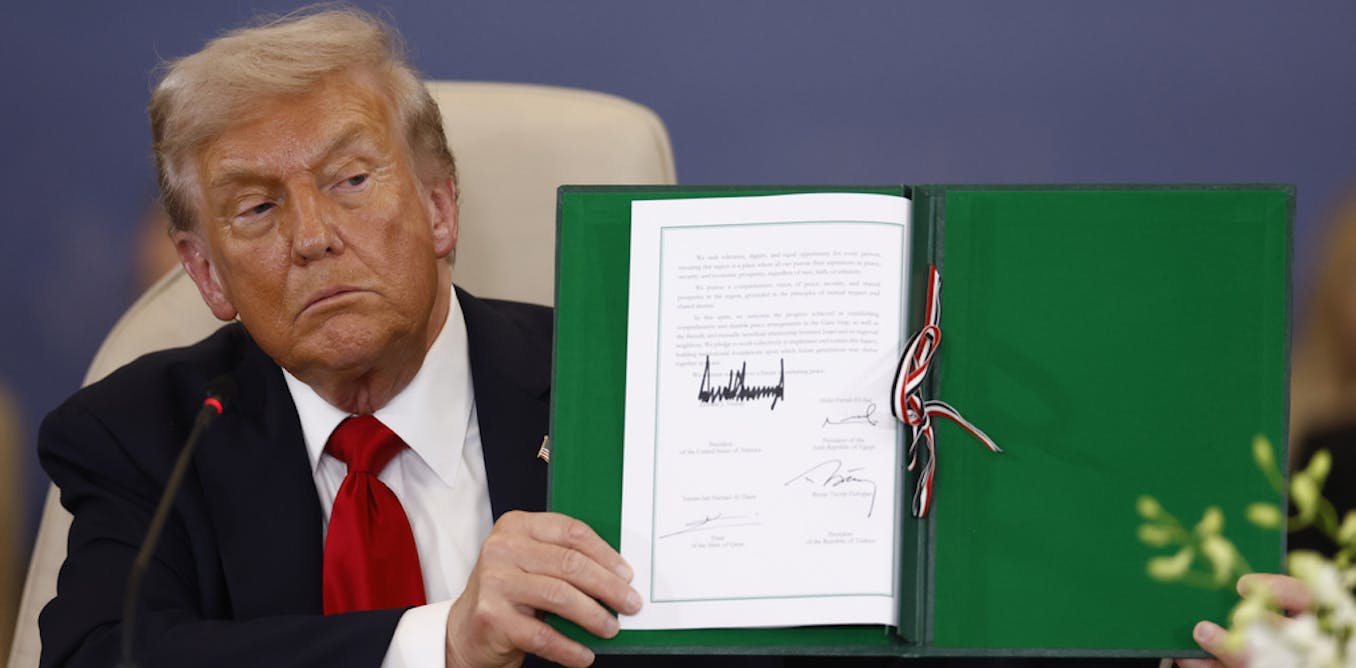
The size of a signature might reveal more about a person than just their name. This intriguing idea has been explored for decades, linking the dimensions of one’s autograph to traits like self-esteem, status, and even narcissism. Recent studies have brought this hypothesis back into the spotlight, with a particular focus on high-profile personalities.
Donald Trump’s signature, known for its bold and expansive style, has sparked renewed interest. His autograph recently appeared in a book gifted to Jeffrey Epstein on his 50th birthday, and Trump himself is quite fond of his signature. As he stated in a speech to military leaders on September 30, 2025, “I love my signature, I really do. Everyone loves my signature” (source).
Linking Signature Size to Personal Traits
My journey into studying signature size began unexpectedly over 50 years ago, during my time as a work-study student at Wesleyan University. While working in the psychology library, I observed that faculty members used significantly more space to sign their names than students did. This observation led me to investigate further, gathering numerous signatures and comparing them by measuring the space they occupied.
My findings revealed that faculty signatures were consistently larger than those of students, suggesting a connection between signature size and status. Further studies comparing blue-collar workers and professors corroborated these results, indicating that both age and status influenced signature size.
Signature Size and Narcissism
Although my research extended into the field of business psychology, examining CEOs of Fortune 500 companies, it wasn’t until a call from the Harvard Business Review in 2013 that the link between signature size and narcissism was explored. This call was prompted by research from Nick Seybert, an associate professor at the University of Maryland, who investigated the potential connection between the two traits.
Seybert’s research did not find a direct relationship, but it sparked my curiosity. I conducted a study with my students, using a narcissism scale alongside signature measurements. The results revealed a significant positive correlation, which Seybert later confirmed with his own student samples.
The notion that signature size could indicate narcissistic tendencies gained traction, leading to further research in various countries including the UK, Germany, Uruguay, and China. The Journal of Management even included signature size as a metric for assessing CEO narcissism in a 2020 publication.
Expanding Research Horizons
Signature size is now being used to explore personality traits beyond narcissism, including its impact on perception. A study published in the Journal of Philanthropy demonstrated that larger signatures on fundraising letters could increase donations, highlighting how signature size might influence others’ behaviors.
As the field continues to grow, the implications of these findings suggest that signature size is a more robust indicator of personality traits than initially expected. It remains to be seen where this research will lead, but the fascination with this simple yet telling aspect of identity persists.