In a rapidly evolving world, the United States stands at a crossroads. The potential to spearhead a new industrial era driven by artificial intelligence and robotics is within reach, but the risk of lagging behind in a world dominated by foreign technology looms large.
Marc Andreesen, a prominent venture capitalist and cofounder of Andreesen Horowitz, addressed this critical juncture during the Reagan Library’s Economic Forum. He emphasized that America’s future economic vitality hinges on embracing advanced manufacturing technologies, particularly in robotics, rather than clinging to the past.
Reindustrializing America
Andreesen highlighted the immense potential of robotics, stating, “I think there’s a plausible argument — which Elon also believes — that robotics is going to be the biggest industry in the history of the planet.” He envisions a world where “billions, tens of billions, hundreds of billions of robots of all shapes, sizes, descriptions” perform myriad tasks, underscoring the necessity for the US to lead this technological transformation.
Failure to do so, he warned, could result in an era where “Chinese robots” become ubiquitous globally, posing significant economic and strategic challenges to the US.
Decline of Traditional Manufacturing
The call for innovation comes amid a protracted decline in manufacturing’s role within the US economy. Manufacturing, once a cornerstone, constituted over 25% of the US GDP in 1947 but dwindled to less than 12% by 2017, as reported by the Bureau of Economic Analysis. Similarly, manufacturing jobs, which accounted for nearly a third of US employment in 1947, now represent just about 8% of the workforce, according to the Bureau of Labor Statistics.
Efforts to revive this sector, such as imposing tariffs, have been insufficient. A Wells Fargo report suggests the US requires a $2.9 trillion investment to return to 1979 employment levels, a feat deemed an “uphill battle.” Goldman Sachs analysts concur, pointing out that tariffs alone cannot offset China’s advantages in labor cost and government support.
Innovation as a Path Forward
With traditional manufacturing in decline, the need for innovation is pressing. An April 2024 report by the Manufacturing Institute and Deloitte projects a demand for 3.8 million new workers by 2033, yet warns of potential skill shortages.
Andreesen advocates for a radical shift in manufacturing, proposing AI-driven “alien dreadnought” factories. He envisions these hyper-automated facilities as central to producing robotics, drones, electric vehicles, and AI-powered machines, which could rejuvenate rural areas and establish the US as a leader in embodied AI.
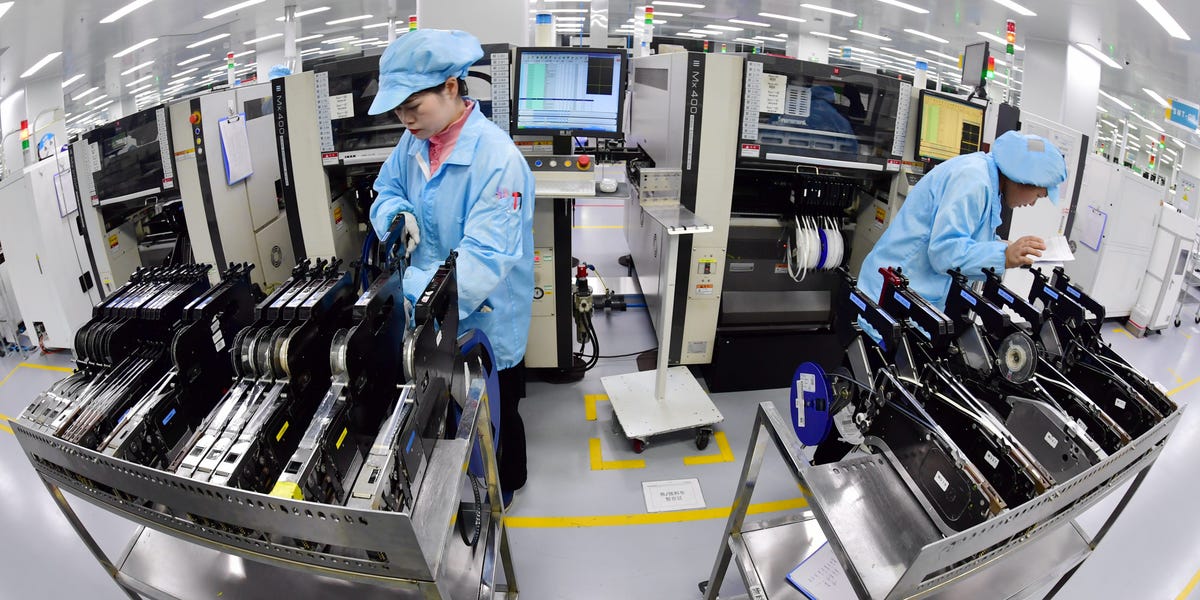
He elaborated, “We shouldn’t be building manufacturing lines that have people sitting on a rubber mat for 10 hours screwing screws in by hand. We should be building what Elon calls alien dreadnought factories.” Elon Musk has used this term, notably in 2016 and 2020, to describe his vision for highly automated Tesla factories.
Andreesen asserts that this transformation is crucial for resolving broader challenges, such as national security concerns, economic stagnation, and bridging the urban-rural divide. He stressed the urgency: “We have to do it because if we don’t do it, China’s going to do it — and we don’t want to live in that world.”