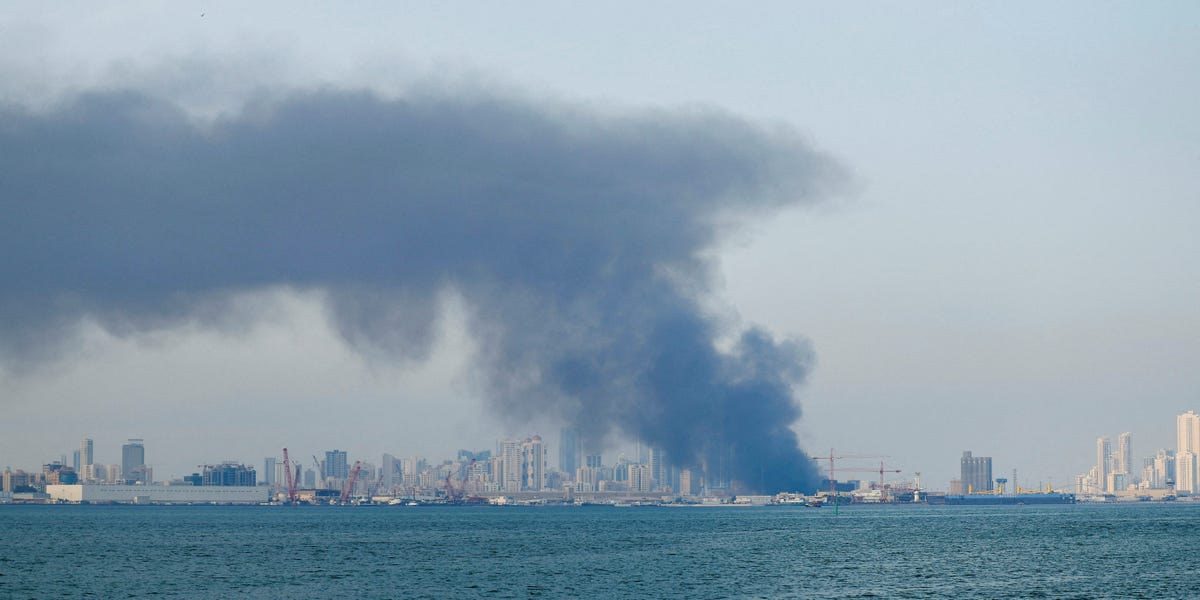
Financial markets in Asia and the US were thrown into turmoil following the recent military actions by the US and Israel against Iran.
Here’s a summary of how major assets are responding:
Oil
Brent oil, a key global benchmark, surged by 13% and WTI crude rose by 12% after the market reopened on Sunday evening in the US. These gains moderated slightly, with Brent and WTI trading 7.7% and 7.2% higher at $78.50 and $71.90 per barrel, respectively, by 1:30 a.m. ET on Monday.
Traders in the energy sector are preparing for the potential extended closure of the Strait of Hormuz, a pivotal route for global energy shipping.
Economist Mohamed El-Erian commented, “The immediate price shocks are being accompanied by a fresh wave of supply chain disruptions. This isn’t just a question of whether the Straits of Hormuz are physically closed; the logistical friction is already here,” highlighting the impact on insurance, maritime cargo, and aviation.
Barclays analysts labeled the situation as the “worst fears” for oil on Saturday, noting that other energy commodities are also vulnerable to repricing.
Strategists at Franklin Templeton indicated that the Strait of Hormuz functions as “the macro circuit breaker,” with increased shipping costs noted just a day after the attacks. They warned that Qatar’s significant LNG export role means that shipping risks could affect the gas market as much as the oil market.
Amid these developments, rising oil prices could exacerbate inflation and potentially trigger a global economic recession, analysts warned.
Stock futures
US stock futures for the three primary indexes fell by over 1% as market participants evaluated the possibility of a prolonged conflict. Despite this, the market’s current assessment suggests a low risk of an extended or expanded regional conflict.
Adam Hetts, global head of multi-asset at Janus Henderson, noted, “There are additional key market transmission channels to monitor if uncertainty persists.” He emphasized that ongoing uncertainty could suppress investor sentiment, making global developed market sovereigns and safe-haven currencies more appealing.
Hetts further stated that persistent uncertainty and elevated oil prices could deter the Federal Reserve from implementing rate cuts this year.
Gold
The price of gold rose by 2% to approximately $5,380 per troy ounce. The geopolitical tensions have bolstered the bullish outlook for gold, which has been on a record-setting streak over the past year.
Bitcoin mirrored the decline in other risk assets, including stocks, dropping over 1% to around $66,130.
US dollar
The dollar index, which gauges the greenback against a basket of other major currencies, increased by 0.6%.
Barclays analysts remarked, “The first order reaction to the weekend’s escalation will likely see the dollar benefit on the back of higher energy prices and elevated risk aversion.”
Risk-off, but no panic selling
Asian equities were also affected, with Japan’s Nikkei 225 down by as much as 2.7% and Hong Kong’s Hang Seng decreasing by 2.8% on Monday.
Chris Weston, head of research at Pepperstone, described the market sentiment as risk-off but noted that the asset price movements were orderly and not indicative of panic selling.
Within energy markets, Brent crude’s failure to maintain levels above $80 a barrel suggests that traders have already accounted for significant supply disruptions. OPEC+’s plans to increase oil output by 206,000 barrels per day from April may also be curbing further price increases.
Paul Eitelman, global chief investment strategist at Russell Investments, advised investors to consider the broader macroeconomic environment when assessing recent market events. He remarked that the US energy landscape has changed considerably, with the country now being the largest oil and gas producer and net exporter. Additionally, gasoline’s share in US consumer spending has substantially decreased since the oil shock era of the 1970s to 1990s.
“Oil shocks are less important to global markets than they were decades ago. At this time, we believe the strikes are unlikely to derail global fundamentals,” Eitelman stated.