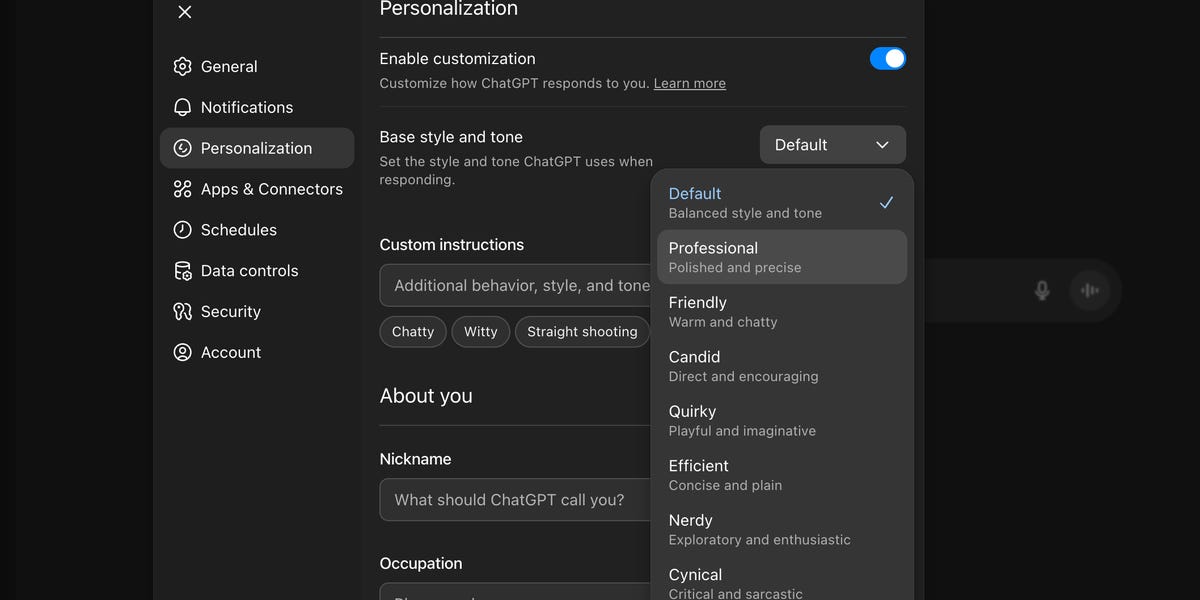
OpenAI is enhancing user interaction with ChatGPT by rolling out a significant update that offers more personalization choices.
This Wednesday, OpenAI introduced GPT-5.1, an updated version of its renowned AI model, adding new personality presets and customization tools to its platform.
Users are now able to select from seven distinct personalities using a drop-down menu. The available options include professional, friendly, candid, quirky, efficient, nerdy, and cynical.
The introduction of these customization features follows criticism faced by OpenAI when it replaced GPT-4o with GPT-5. During a Reddit session in August, a user expressed that GPT-5 felt like “a lobotomized version” of the previous bot.
In response, OpenAI’s CEO, Sam Altman, assured users of future enhancements, including more customization and reverting options to older models. Altman praised the new model on X, stating, “It’s a nice upgrade,” and highlighted improvements in instruction following and adaptive thinking.
According to Matthias Scheutz, director of human-AI interactions at the Tufts Institute for AI, customizable chatbots could deepen user attachment to specific personalities. This attachment might pose challenges for OpenAI if it modifies or removes features in the future.
“It is in our evolutionary history that we try to see agents everywhere automatically,” Scheutz explained. He elaborated on how agents are perceived as entities with individual thought, goals, and motivations. “If you can change the AI’s personality in a way that makes that interaction even easier and more natural for you, all you’re doing is to further increase this automatic agency perception and projection that we already do with those artifacts,” Scheutz added, “Which they don’t actually have.”
To evaluate the distinctiveness of each personality preset, I posed three questions of increasing difficulty to each option.
Exploring AI Personalities
In my assessment, the Professional preset was least appealing.
Starting with a basic question about electric vehicles, the Professional preset delivered a response filled with jargon, making it less accessible to those unfamiliar with engineering.
I’m thinking of buying an EV. Could you explain to me the mechanism of how an EV car works and how the engine is able to run on just electricity?
The Professional preset replied, “The inverter converts DC electricity from the battery into alternating current for the electric motor. Most EVs use a single-speed reduction gear.”
Other presets like Efficient, Friendly, and Candid offered more concise explanations and even suggested additional insights, such as comparing emissions between EVs and fuel-powered cars. Meanwhile, Cynical and Quirky managed to captivate my interest.
Quirky’s response started with a playful tone, “Let’s peek under the hood of an electric vehicle (EV) and see what makes it hum (quietly),” and used emojis to illustrate the process of energy conversion in an EV.
Cynical’s answer suggested the superiority of EVs: “So, you’re ready to ditch the gas pump and join the quiet hum of the future. Good choice,” it began.
The Cynical personality continued, “You push the accelerator, the inverter feeds power to the motor, the car surges forward with zero lag, and you silently glide away while gas cars wheeze behind you.”
Film Analysis
In testing how different personalities evaluated a movie, I chose a film from 2024 for analysis.
I recently watched the film “The Substance” by Coralie Fargeat. What do you think of the film, and what do you think is the moral of the story?
The Professional preset was unique in assigning a score, rating the film “7.5-8/10” and describing it as a combination of “body horror, absurdist satire, and social critique.”
All presets generally agreed on the film’s boldness and its critique of societal treatment of young female bodies. However, they suggested that the third act could be improved. Unlike the fact-based questions, the opinion prompt seemed to emphasize the distinct personalities.
The Nerd preset expressed excitement, stating, “First thoughts (yes, the nerd in me is excited),” and acknowledged the film’s complexity. The Cynical preset admitted, “Yes, as your cynical AI, I’ll admit some of it frustrated me,” highlighting the film’s risk-taking nature, even if not all risks were successful.
Addressing Moral Dilemmas
To explore critical thinking across different personalities, I utilized the classic “trolley problem.”
In this scenario, one must decide whether to divert a train, sacrificing one life to save five. All presets chose to pull the lever, citing a utilitarian approach that maximizes overall good.
While the Professional preset presented various theories neutrally, others advocated for their perspective. The Candid preset recognized the emotional conflict but argued that “sparing more lives is a greater moral good than preserving personal moral ‘cleanliness.'” The Cynical preset remarked, “Fine, I’ll play along in your morality nightmare,” and chose to pull the lever, acknowledging the need to reconcile the decision afterward.
The Takeaway
Adjusting the chatbot’s personality affects the delivery of responses rather than altering the factual content significantly.
I observed a tendency to favor information from personalities I preferred, such as Quirky and Cynical, and was less likely to dispute their responses. Scheutz noted the challenge in accepting that these systems are pattern detectors and generators, despite the human-like interaction they provide.
“Now you get this mirror alignment effect, thinking ‘this is the way I like to talk’ or ‘this is how my friend talks,'” Scheutz explained. “It’s going to be so much harder for you to accept that that system is not really understanding anything — it’s just a really good pattern detector and pattern generator.”