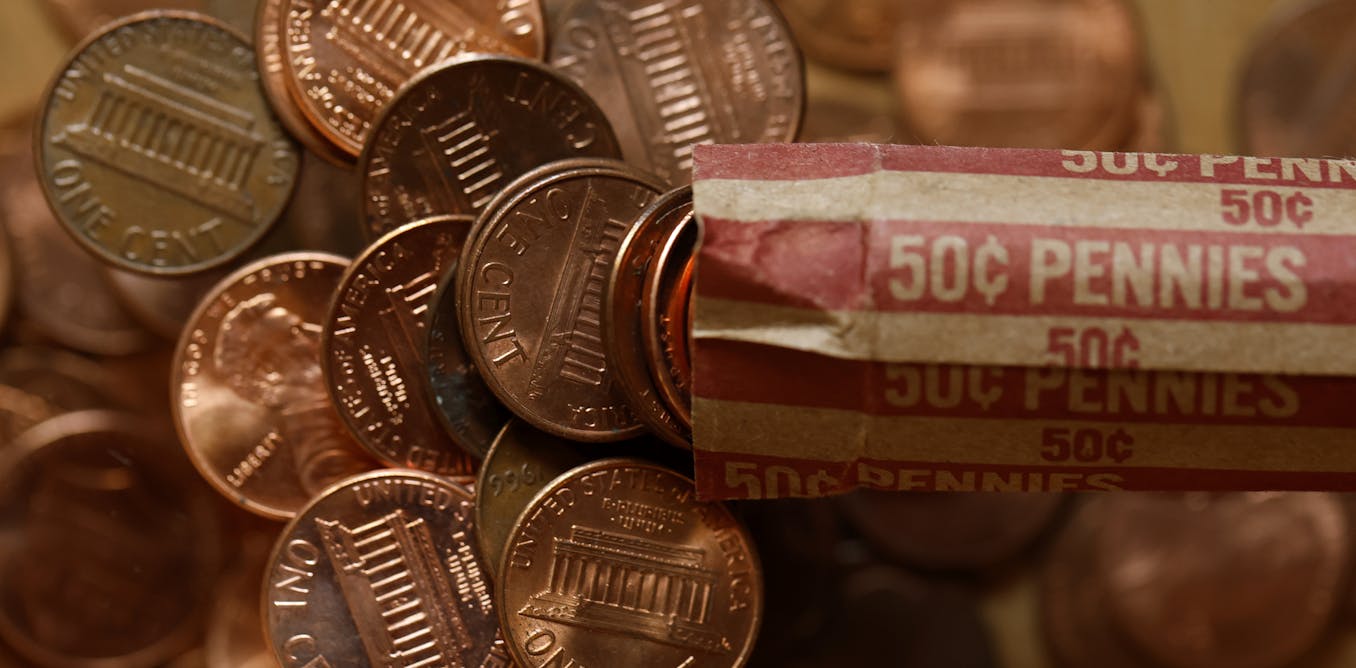
The humble penny, a staple of American currency for over two centuries, now faces its final curtain call. Despite its diminutive value, each penny costs about four cents to produce, making it an economic burden. As Americans often find them tucked away in jars or forgotten in pockets, the penny’s cultural presence remains significant.
The penny is intertwined with everyday life and traditions, from the “take a penny, leave a penny” trays to being a symbol in classic items like penny loafers and the custom of tossing one into a fountain for luck. However, the U.S. Mint halted the production of pennies on November 12, 2025, as per a directive from the White House. Though still legal tender, existing pennies will gradually phase out of circulation.
The cessation of penny production brings broader implications, especially for small businesses that rely heavily on cash transactions. Those without bank accounts, who are often least able to adjust to even minor price shifts, will feel this change acutely. This insight comes from my experience as a former chief financial officer and a current professor focusing on Main Street business challenges.
Benefits for Some
The U.S. government stands to save millions annually by ceasing penny production, sidestepping the inefficiency of minting coins that cost more than their face value. Financial institutions like banks and credit unions will also benefit by eliminating the logistical burden of handling pennies, thus cutting labor and operational costs.
Companies in the armored-carrier industry, like Loomis and Brink’s, will find relief from the cumbersome and costly task of transporting pennies, reducing their fuel and labor expenses. Large retailers, with their robust infrastructures, are well-positioned to handle this transition efficiently, from updating systems to negotiating lower card processing rates that smaller businesses can’t access.
Challenges for Others
Small businesses may face increased challenges as they adapt to the penny’s departure. The need to round cash transactions to the nearest nickel, known as a “rounding tax,” could cost businesses and consumers around $6 million annually. Additionally, these businesses often cannot negotiate reduced card-processing fees, making the shift towards digital payments a costly endeavor.
Handling cash itself incurs costs, as noted in analyses that compare cash handling expenses against those of debit transactions. For many consumers, particularly older adults, lower-income households, or those without banking access, the elimination of the penny could mean small but impactful cost increases.
Neutral Impact for Some
Digital-first consumers might remain largely unaffected by the penny’s exit, as electronic transactions will continue to be precise. Businesses are exploring ways to ensure cash and electronic transactions are handled smoothly in this new era.
Despite the economic logic behind discontinuing the penny, the change highlights the varying impacts on different sectors. For some, this shift presents an opportunity for efficiency, while for others, it underscores existing economic challenges. Ultimately, even the smallest change can ripple through the economy, affecting those who can least afford it.