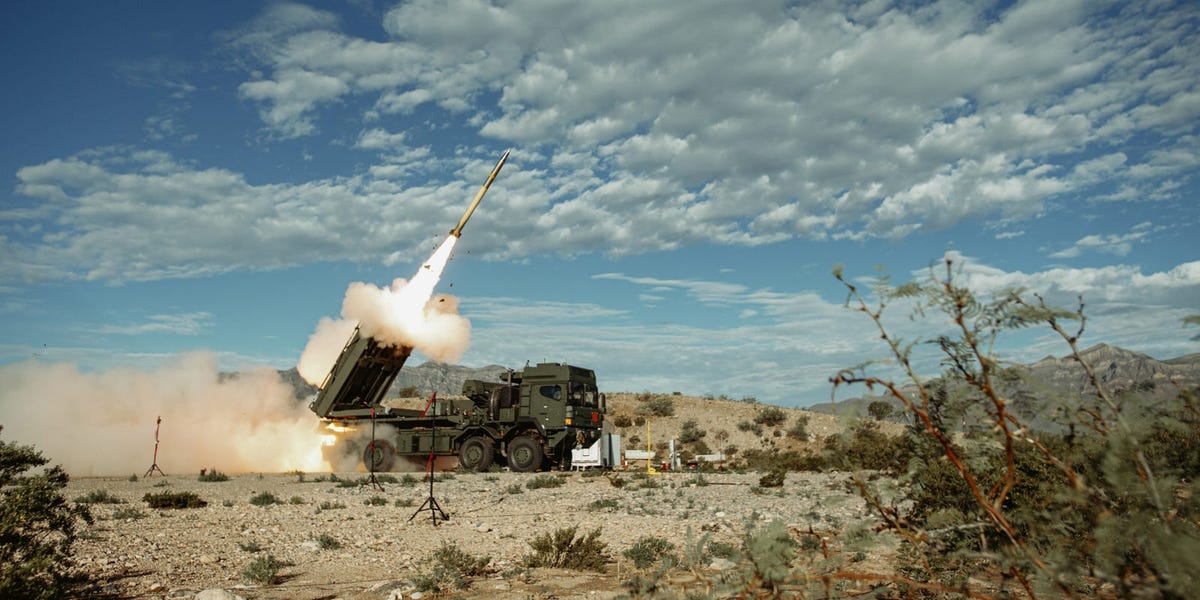
The successful test of a new rocket system marks a significant advance in military artillery capabilities. The Global Mobile Artillery Rocket System (GMARS), developed through a collaboration between the US and its allies, was recently test-fired, showcasing its impressive firepower.
GMARS is capable of launching twice the munitions of the M142 High Mobility Artillery Rocket System (HIMARS). According to a statement by Lockheed Martin, the system was recently tested at the White Sands Missile Range in New Mexico, successfully firing Guided Multiple Launch Rocket System (GMLRS) rockets. These precision-guided munitions, used by the US Army and its allies, demonstrated the system’s capabilities.
Lockheed Martin describes GMARS as a flexible long-range precision launcher compatible with existing platforms, including HIMARS. It can be equipped with two Army Tactical Missile Systems (ATACMS), four Precision Strike Missiles (PrSMs), and 12 GMLRS or its extended versions, all manufactured by Lockheed Martin.
This configuration significantly expands the firing options beyond HIMARS. ATACMS can reach a maximum range of 190 miles, while the PrSMs, intended as a replacement, can hit targets up to 310 miles away. The GMLRS, more of a rocket artillery than a tactical missile, has a range of 43 miles, with an extended variant reaching 93 miles.
Equipped with advanced guidance systems like GPS, sensors, and laser guidance, these munitions offer precision targeting. The Army considers long-range precision fires crucial to its transformation strategy, which aims to deploy long-range land and maritime missiles by 2027, as outlined by US Defense Secretary Pete Hegseth.
The PrSM is central to this transformation. In June, the Army tested this missile’s capability against a moving target at sea, underlining its versatility.
Efforts to enhance HIMARS’ flexibility, as part of broader long-range initiatives, also include the new Mid-Range Capability or Typhon system.
Current conflicts, such as the war in Ukraine and Middle Eastern tensions, underscore the Army’s need for such advanced systems. As Lockheed Martin notes, GMARS is built on Rheinmetall’s HX military truck series, enhancing interoperability between US and allied launchers and munitions, especially in Europe.
Interoperability is increasingly important for the Army and its international partners. Last month, Gen. Christopher Donahue, commanding general of US Army Europe and Africa, emphasized the desire for commonality among systems, especially for long-range and air defense capabilities.
“Right now, there are many nations that if they buy a platform and another nation buys that platform, they’re not interoperable because of that lack of common operating system,” Donahue stated at the LANDEURO Conference in Germany. “We want it to be one system optionally manned,” he added, “and we want to be able to take munitions from any country and shoot through that.”
Modularity, allowing reconfiguration based on mission needs, combat conditions, enemy tactics, and personnel requirements, is also a top priority, as emphasized by recent military strategies.