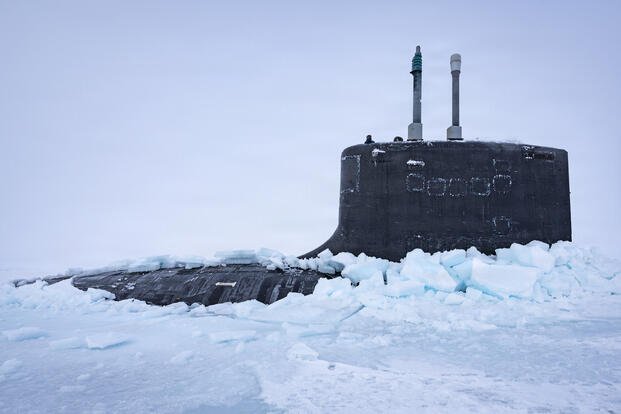
Plunging into the icy depths of the Arctic, two U.S. Navy submarines marked a significant milestone on March 7 by completing the 100th under-ice operation since these missions began nearly eight decades ago. This landmark event highlights the evolving strategic importance of the Arctic region in contemporary naval operations.
Vice Adm. Richard Seif, Commander of Submarine Forces, initiated Operation ICE CAMP Boarfish from a drifting ice floe in the Arctic Ocean, with the USS Delaware (SSN 791) and USS Santa Fe (SSN 763) playing pivotal roles in the mission.
A Base on Moving Ice
ICE CAMP Boarfish, a three-week initiative, is designed to evaluate submarine capabilities and conduct research in the harsh Arctic environment. The temporary base, built on a drifting ice floe, includes sleeping quarters, a command center, and essential infrastructure for a team comprising sailors, Marines, and civilians from multiple nations.
“The complexity of establishing a fully functional base on a moving sheet of ice cannot be overstated,” said Capt. David Nichols, officer in tactical control of this year’s exercise. “The professionalism and dedication of every service member and civilian here is what makes this vital mission possible.”
Allied forces from Australia, Canada, France, the United Kingdom, and Norway are participating alongside U.S. personnel, with researchers from Japan’s marine science agency and Norway’s defence research institute contributing as well. The U.S. Marine Corps and Air National Guard are also involved.
The Navy’s Arctic Submarine Laboratory, which serves as the submarine force’s center of excellence for polar operations, oversees the mission, coordinated by the Undersea Warfighting Development Center. ICE CAMP is now classified as a formal operation, underscoring its strategic importance.
From a WWII Submarine to the 100th Evolution
The operation’s name honors USS Boarfish (SS 327), a World War II submarine renowned for its combat achievements in the Pacific. In 1947, Boarfish led Operation Blue Nose, pioneering under-ice navigation with new sonar technology. This mission paved the way for future Arctic exploration.
In 1958, USS Nautilus (SSN 571) completed the first full under-ice transit, and in 1959, USS Skate (SSN 578) surfaced at the geographic North Pole, marking another historic milestone. ICE CAMP Boarfish represents the 100th under-ice operation since these pioneering voyages.
Why the Arctic Matters Now
As climate change reduces sea ice, new shipping lanes emerge, and resource extraction becomes feasible in previously inaccessible areas. These shifts have significant military implications, as Vice Adm. Seif emphasized: “The Arctic is a critical region for national security and global stability. Our commitment to a sustained presence and operational readiness here is unwavering. ICE CAMP Boarfish allows us to test and refine our capabilities, deepen our interoperability with key allies, and ensure our submarine force can project power and defend our nation’s interests in any environment, at any time.”
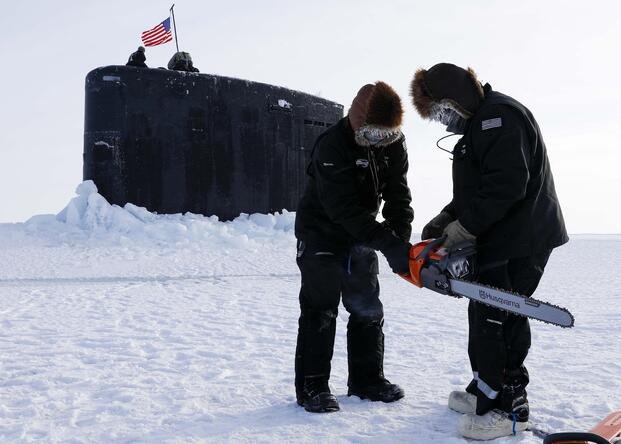
With Russia’s Northern Fleet active in the same waters and increased commercial shipping through the Arctic, the Pentagon’s Arctic Strategy underscores the region’s strategic priority. The reclassification of ICE CAMP as an operation reflects this evolving importance since Boarfish first ventured beneath the ice in 1947.