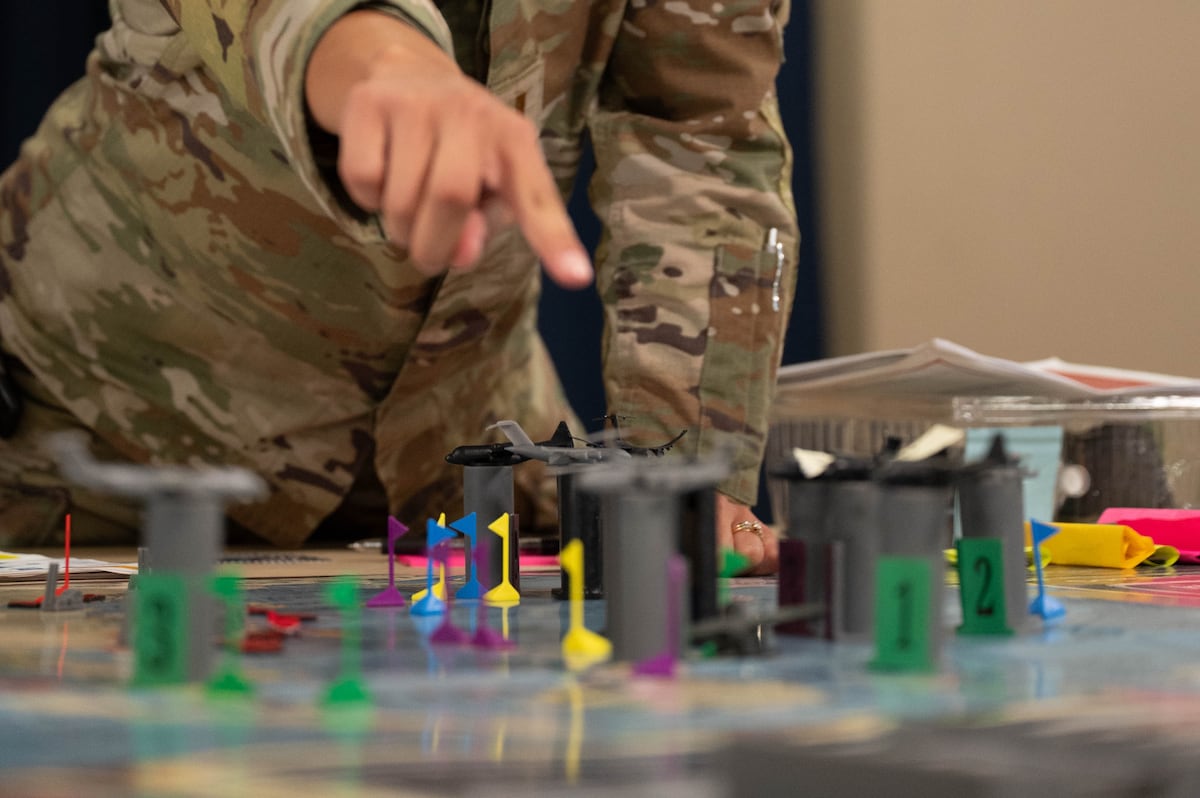
AI Revolutionizes U.S. Air Force Wargaming with Speed and Precision
The U.S. Air Force is making a significant leap forward by integrating artificial intelligence into its wargaming systems. This move aims to enhance the speed and efficiency of military simulations, addressing long-standing challenges in defense exercises.
A recent request for information reveals the Air Force’s plan to develop a cloud-based, AI-driven “digital sandbox” designed to conduct wargames at remarkable speeds, potentially 10,000 times faster than real-time scenarios. This innovation, known as the WarMatrix system, is set to tackle issues that have plagued traditional defense simulations, such as inefficiency and excessive manual effort.
According to the Air Force’s RFI posted on November 23, “Currently, the DAF [Department of the Air Force] faces challenges including the inability to answer critical questions about capabilities, Courses of Action (COA) analysis, or costing, due to a reliance on disconnected, outdated, and vendor-locked tools.”
This initiative is described by the Air Force as a transformative shift from conventional, analog methods to a fully digital and scientific approach.
RELATED
The WarMatrix project is an ambitious endeavor, aiming to provide a comprehensive toolkit and orchestration environment that enables rapid scenario creation and offers a unified analytical workflow. An Air Force spokesperson explained to Defense News that the system allows “human on the loop adjudication” during wargames.
The Air Force seeks technologies capable of running simulations at super-real-time speeds, potentially accelerating processes up to 10,000 times faster than real-time. This capability could result in hundreds or thousands of iterations being completed in the same timeframe as a single tabletop game iteration.
Moreover, the WarMatrix system must accommodate hundreds of users and tens of thousands of entities. It is designed to work across various classification levels, from Unclassified to TS/SCI/SAP, and be compatible with existing simulations like AFSIM and others used by different military branches. The system’s interface aims to lower barriers to entry, making it easier for airmen to access the Defense Department’s simulation tools.
The Air Force emphasizes that the government will lead the integration of WarMatrix, avoiding outsourcing for design and implementation. The reliance on AI is crucial to overcoming previous challenges in defense wargaming, such as inefficient computer opponents and the need for “pucksters,” human players who control enemy forces in simulations.
Matthew Caffrey, a former chief of wargaming at the Air Force Research Laboratory, highlighted past issues with slow computer models, stating they “would be too slow to adjudicate four moves in a week.” In contrast, WarMatrix plans to employ sophisticated AI to enable competent and realistic computer players.
WarMatrix will also alleviate the administrative burdens placed on wargame designers and umpires by using AI to facilitate real-time transcription and diarization of qualitative data, such as commander discussions, for rapid analysis.
In addition, AI will serve as an advisor, assisting players in crafting courses of action by using a neuro-symbolic process to evaluate options based on risk assessments and resource tradeoffs.
Despite past challenges with complex simulations, the Air Force assures that WarMatrix will combine computational accuracy with human insight, ensuring strategic and transparent decision-making. The system is designed with features like auditable trails to address the shortcomings of previous “black box” mega-simulations.
As the Air Force spokesperson noted, “This tool is being built by wargamers for wargamers,” underscoring the commitment to creating an effective and user-friendly wargaming environment.