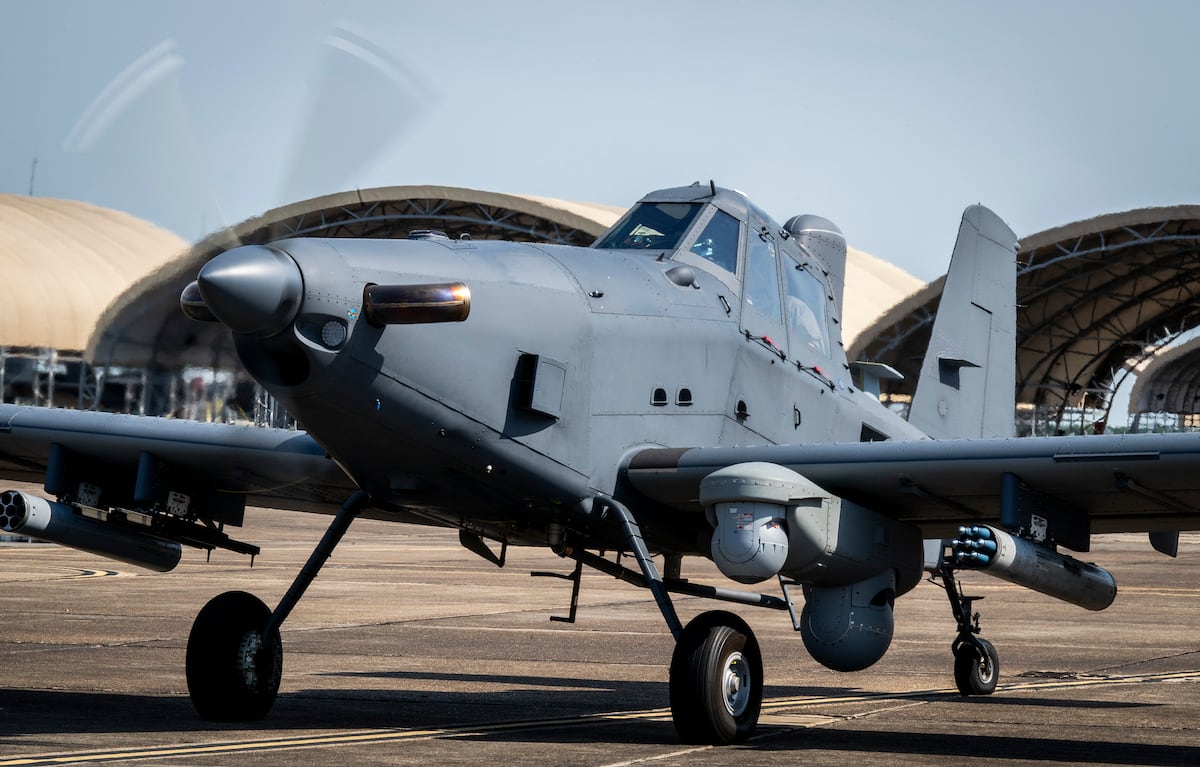
Skyraider II: The Air Force’s Versatile New Aircraft
In an ambitious move, Air Force Special Operations Command (AFSOC) is exploring the potential of the Skyraider II, a new aircraft designed to be versatile and easily deployable. This innovative approach was highlighted during Special Operations Forces Week, where officials discussed its unique capabilities.
The OA-1K Skyraider II, a single-engine aircraft derived from the Air Tractor AT-802, offers isolated special operations units the advantage of overhead surveillance and firepower, even from rugged terrain with minimal support. Its design is reminiscent of a “Swiss Army Knife” in terms of functionality, as described by Lt. Col. Robert Wilson, the chief of AFSOC’s armed overwatch requirements branch. Read more.
The aircraft’s rapid assembly and disassembly make it possible for the Skyraider II to be packed into cargo planes like the C-5 or C-17 and deployed globally within hours. Lt. Col. Wilson emphasized that with the OA-1K, “any place, any time, anywhere” is more than just a motto, but a tangible capability. Read more.
AFSOC commander Lt. Gen. Mike Conley highlighted the OA-1K’s cost-effectiveness and modularity, noting its potential to fulfill various operational roles, including armed overwatch, at a lower cost than traditional platforms.
This cost-efficiency is achieved through platform consolidation. According to a 2023 Government Accountability Office report, SOCOM refers to the integrated use of aircraft for close air support, strike missions, and intelligence, surveillance, and reconnaissance as “the stack.” The Skyraider II is promoted as a budget-friendly solution capable of performing multiple roles. Read more.
Currently, the Air Force operates 18 Skyraider IIs and anticipates adding more by October. These aircraft are named after the Vietnam-era A-1 Skyraider and presently operate from Will Rogers Air National Guard Base in Oklahoma, with future operations planned at Cannon Air Force Base, New Mexico, and Davis-Monthan Air Force Base, Arizona.
The program initially aimed for 75 Skyraider IIs, but financial constraints have reduced this number to 53, following a GAO report that questioned the necessity for a 75-aircraft fleet. This reduction aligns with the Pentagon’s strategic pivot toward potential high-end conflicts, particularly with China, where a slow, low-flying turboprop without an ejection seat faces challenges.
Lt. Col. Wilson acknowledged, “The 75 quantity figure is the program record. I would say, as the capability sponsor, less than 75 is not desirable. We would like to see it at the program record of 75, but … just being pragmatic, obviously, with resource constraints that could potentially limit the program less than that.”