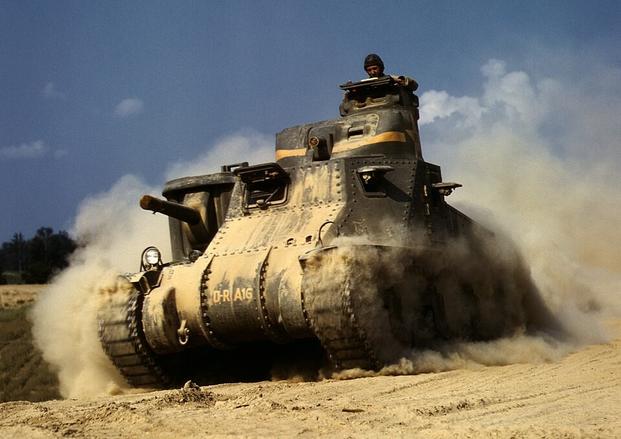
In the midst of World War II’s North African campaign, a small group of American soldiers found themselves unexpectedly engaged in combat against German forces. These soldiers, operating three M3 Grant tanks, played a unique role in a conflict that occurred before the United States had officially committed ground troops to the theater.
The Unofficial American Presence in North Africa
The summer of 1942 saw the British Eighth Army struggling against Erwin Rommel’s Afrika Korps. Amidst the British retreat, a small contingent of American tanks, manned by U.S. crews, joined the fray. Though the United States had not yet formally entered the ground war, the British urgently needed reinforcements, leading to the deployment of M3 medium tanks, known as “Grants,” through the Lend-Lease Act.
These tanks, alongside U.S. advisers from the 1st Armored Division, were initially meant to train British forces. However, the chaotic environment of the desert war provided an opportunity for these American soldiers to engage in combat. Among the mission’s senior officers was Maj. Henry Cabot Lodge Jr., a Massachusetts senator eager for combat experience against Axis forces.
By June, Lodge’s unit was integrated into the British 2nd Armoured Brigade near Acroma, west of Tobruk. As the battle of Gazala unfolded, these American-manned tanks found themselves in the thick of the fight, marking an unusual early American involvement in the North African campaign.
Engagement in the Desert
The details of this engagement remain sparse, but it’s clear that the American tanks advanced alongside their British allies. They engaged German and Italian forces, possibly disabling several enemy vehicles. While the operation was brief, it demonstrated the surprising presence of American military assets in North Africa prior to the official U.S. involvement.
The M3 Grant, characterized by its tall design and hull-mounted 75mm gun, provided much-needed firepower for the British, able to counter the German Panzer III. Lodge praised the tanks and the crews’ performance: “The men who went over from this force were the equal of anything they encountered in the desert. They came out with three tanks, and they left nine less to chase them. The tank that you call the M-3 is the match of anything in the world.” (Time).
An Overlooked Chapter of History
While Time magazine celebrated this skirmish as a milestone for American forces, the reality was more nuanced, with American soldiers acting in an advisory capacity. However, their involvement blurred the lines between observer and combatant, especially given Lodge’s eagerness for action. Although quickly overshadowed by larger events, such as the battle of El Alamein and Operation Torch, this mission represented a significant moment in the lead-up to full American engagement in North Africa.
This episode, though largely forgotten, left a cultural legacy, inspiring the 1943 film “Sahara” and its 1995 remake. For a brief period in June 1942, three American tanks stood against Hitler’s forces in the North African desert.