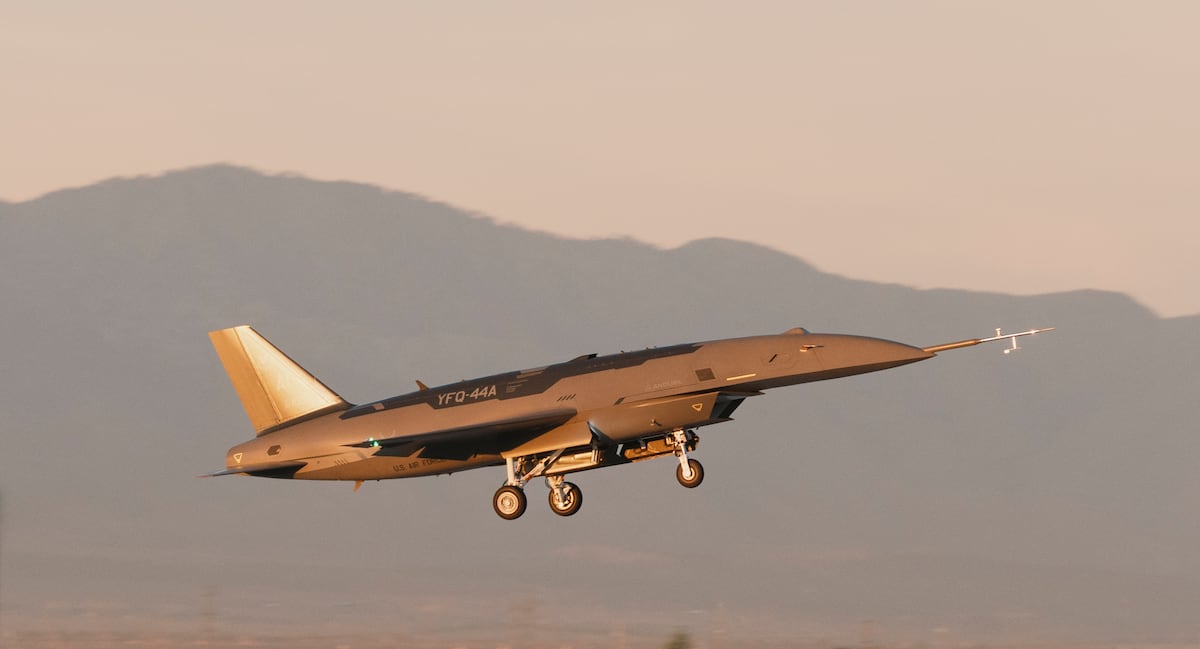
The U.S. Air Force has initiated flight tests for its second prototype drone wingman, marking a significant step in its quest to enhance aerial combat capabilities. The Anduril Industries’ YFQ-44A drone took to the skies on Friday at an undisclosed location in California, as announced by the Air Force.
This development comes on the heels of the first test flight of the YFQ-42A, a similar prototype designed by General Atomics, which was conducted in August. “This milestone demonstrates how competition drives innovation and accelerates delivery,” stated Air Force Secretary Troy Meink. “These flights are giving us the hard data we need to shape requirements, reduce risk, and ensure the CCA program delivers combat capability on a pace and scale that keeps us ahead of the threat.”
The Air Force envisions a future where at least 1,000 semiautonomous collaborative combat aircraft (CCA), driven by artificial intelligence, support manned fighter jets like the F-22, F-35, and the upcoming F-47. These drones are expected to perform a diverse range of tasks, including attack missions, reconnaissance, and electronic warfare, thereby extending the operational capabilities of the Air Force’s fleet.
In April 2024, Anduril and General Atomics were awarded the initial CCA contracts, with prototype ground testing commencing in May 2025. A decision on which prototype will proceed to production is anticipated within this fiscal year.
During the Air & Space Forces Association’s conference in September, Anduril highlighted its dedication to achieving semiautonomous flight, rather than remote piloting, for its CCA. This focus on autonomy, according to company officials, required additional development time but is expected to streamline subsequent testing phases.
Jason Levin, Anduril’s senior vice president of engineering for air dominance and strike, emphasized the importance of these advancements, stating, “Through flight testing, Anduril and the Air Force are developing those collaborative, manned-unmanned teaming concepts and tactics that will inform how we integrate, fight with, and sustain truly autonomous aircraft.”
Levin further confirmed that all tests of the YFQ-44A, both taxi and flight, are conducted in a semiautonomous mode. “This is a new age of air power,” he remarked, highlighting the absence of traditional piloting controls. Anduril has achieved this technological milestone in just 556 days from the initial design phase, underscoring the rapid pace of innovation in the field.
For more details on the collaborative combat aircraft and their development, visit Defense News.