Amidst the chaos of gunfire and artillery, Pvt. Burton Holmes emerged, gravely injured, from the battlefield. His unit had been deceived into advancing on Hill 188 under a false pretense of surrender, only to be ambushed by German forces. Despite his injuries and a malfunctioning rifle, Holmes refused medical attention, opting instead to rearm and continue fighting until his final breath.
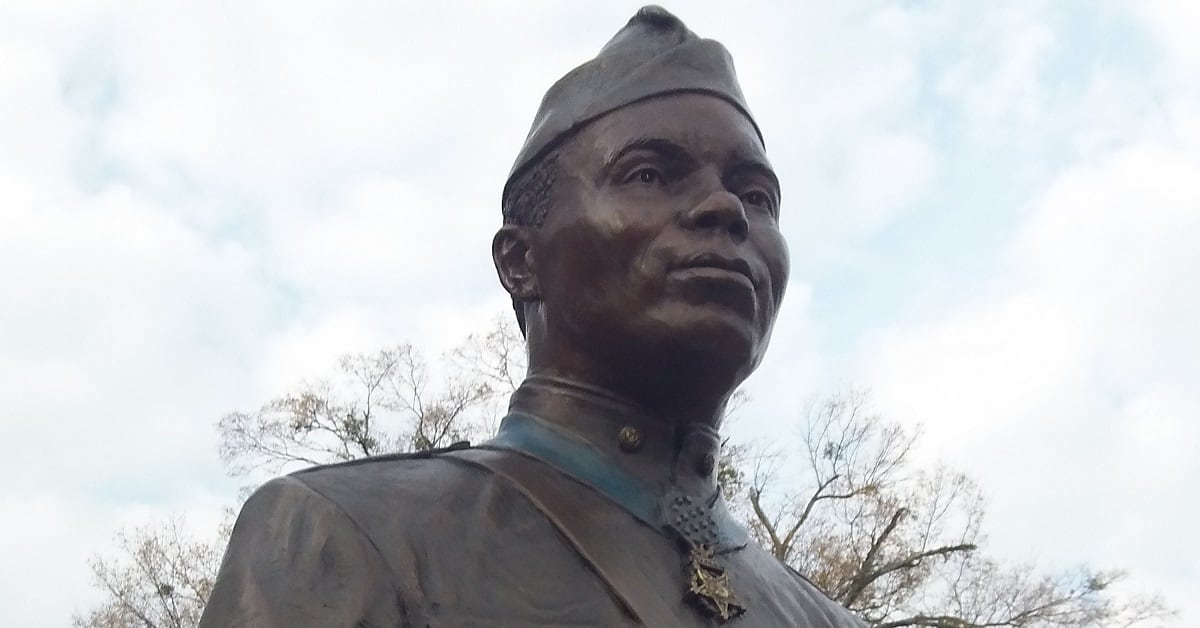
This unwavering determination was a hallmark of Company C. Cpl. Freddie Stowers, another valiant soldier, continued to push forward despite being fatally wounded, urging his comrades onward until his life was claimed by enemy fire. Both Holmes and Stowers were put forward for the Medal of Honor for their courageous actions during the Battle of Hill 188 on September 28, 1918. However, only Stowers would posthumously receive this prestigious accolade—73 years later.
Born on January 12, 1896, in Sandy Springs, South Carolina, Stowers was the grandson of a slave and was working as a farmhand when the U.S. entered World War I. Drafted into the Army on October 4, 1917, he trained at Camp Jackson before being assigned to Company C, 1st Battalion, 371st Infantry Regiment, 93rd Division, American Expeditionary Forces, heading to France in April 1918.
The 371st Infantry, one of four segregated Black regiments designated for service in France, was largely composed of draftees from South Carolina, with additional troops from nearby states. Initially relegated to support roles by the American Expeditionary Forces, their fate shifted when the French army, in need of reinforcements, requested these Black units.
Assigned to the 157th Division, led by Gen. Mariano Goybet, the 371st was deployed to the front lines. By mid-September, the division was well-prepared to hold its positions at Avocourt and Verrières. Stowers, by then a corporal in charge of half a squad, faced a critical moment on September 26 when the Meuse-Argonne campaign commenced. Two days later, his company advanced on Côte 188, only to be ambushed by German troops feigning surrender.
As chaos ensued, Stowers found himself the highest-ranking surviving member of his unit after senior leaders were killed or incapacitated. He bravely led his men forward, managing to infiltrate a German trench and neutralize a machine gun position. Despite being mortally wounded, Stowers continued to inspire his men to press on, ultimately enabling them to capture the hill.
Stowers’ leadership galvanized the 371st Infantry, contributing to further successes at Bussy Ferme and other locations, though at a cost of 133 lives. While the French honored him with the Croix de Guerre and his commander recommended him for a Medal of Honor, the paperwork was reportedly lost. It wasn’t until 1990 that a reevaluation of minority soldiers’ contributions led to Stowers’ sisters being presented with his Medal of Honor at the White House the following year.
Today, Cpl. Stowers lies near where he fell, in the Meuse-Argonne American Cemetery and Memorial, a testament to his bravery and sacrifice.