Franco-German Combat Air System Faces Uncertainty Amidst Partner Disputes
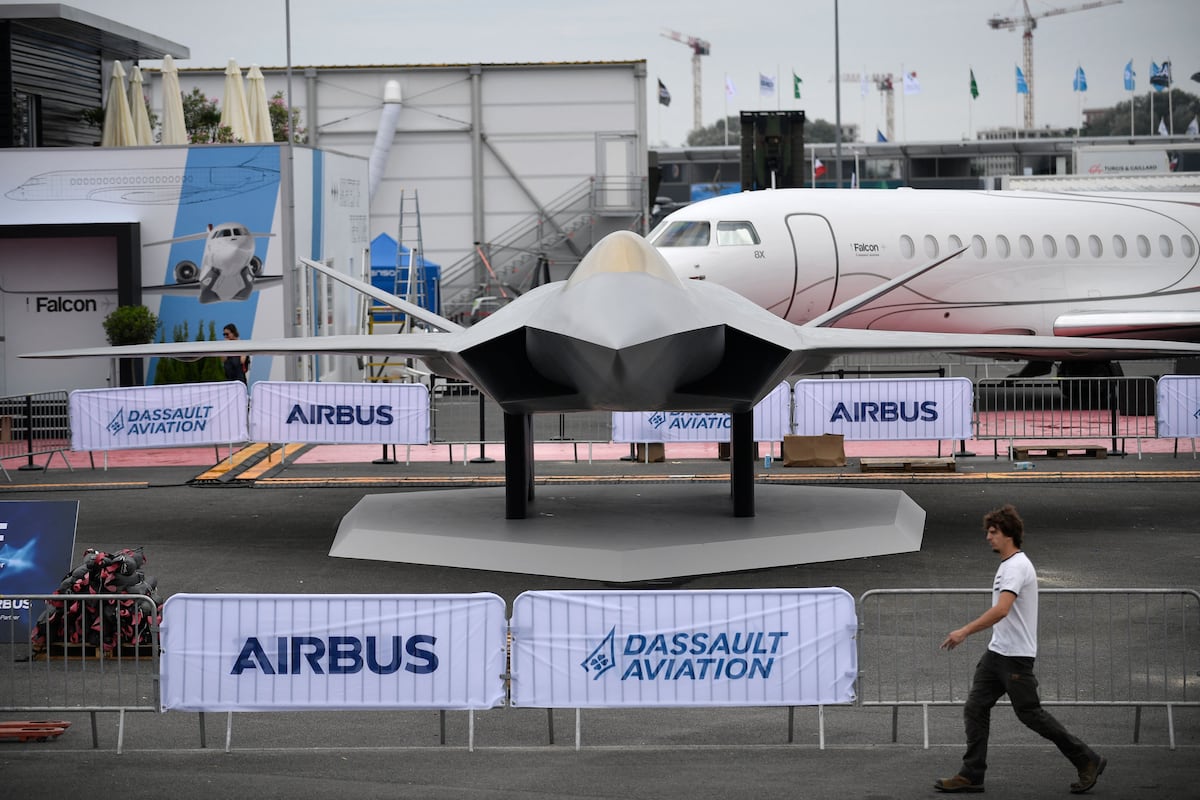
The ambitious Franco-German initiative for a future combat air system is teetering on the brink, primarily due to mounting tensions between Dassault Aviation and Airbus. Dassault Aviation’s CEO, Eric Trappier, expressed doubts about the project’s viability if Airbus continues to resist collaboration, stating, “If Airbus maintains its position of not wanting to work with Dassault, the matter is dead.”
The Future Combat Air System (FCAS), unveiled in 2017 by French President Emmanuel Macron and then-Chancellor Angela Merkel, encompasses several components, including a new fighter aircraft, drones, and a combat data cloud. Despite being a collaborative effort, disagreements over leadership roles and work distribution between Dassault and Airbus have persisted over the years.
The project’s organizational framework designates France as the lead nation, with Dassault Aviation spearheading the new fighter aircraft segment. Trappier emphasized the necessity of a singular leader to oversee the program’s direction, stating, “Not everyone is happy with this, but I believe that in order to develop combat aircraft of this level for the future, we need a leader.”
Trappier criticized Airbus’s push for a co-leadership model, arguing for a clear hierarchy. He asserted that Airbus has deviated from the original terms of their agreement, prompting the need for government intervention to resolve the impasse. While French and German government decisions are pending, Trappier refrained from speculating on potential outcomes.
The divergence in operational requirements further complicates matters. German Chancellor Friedrich Merz highlighted differing national needs, as Germany does not require a carrier-capable fighter with nuclear capabilities like France. Despite this, Trappier assured that French authorities and Germany have reached an agreement on operational needs.
Airbus has not shown a willingness to resolve the existing disputes with Dassault, according to Trappier. Instead, the company is communicating through external entities like labor union IG Metall and the German Aerospace Industries Association (BDLI). These groups have advocated for a “two-aircraft solution,” a concept Airbus supports but is opposed by Dassault and France.
Airbus CEO Guillaume Faury has expressed the company’s commitment to playing a leading role in a restructured FCAS. However, Trappier stands firm against the dual-aircraft proposition, although he acknowledged that Dassault could independently develop a next-generation aircraft for a budget significantly lower than €50 billion.
Trappier also highlighted the distinct expertise of Dassault and Airbus, noting Dassault’s superior proficiency in combat jet development compared to Airbus’s focus on commercial jets. He emphasized that expertise should not automatically grant co-leadership status.
While phase 1 of the FCAS fighter progresses, unresolved issues have stalled phase 2 negotiations, including leadership for the test-flight program. Concurrently, Dassault is pursuing a contract with India for 114 Rafale jets and plans for a post-Rafale combat aircraft, expected well beyond the 2040s. The Rafale’s F5 standard, featuring an unmanned stealthy loyal wingman drone, is anticipated to enter service around 2035.