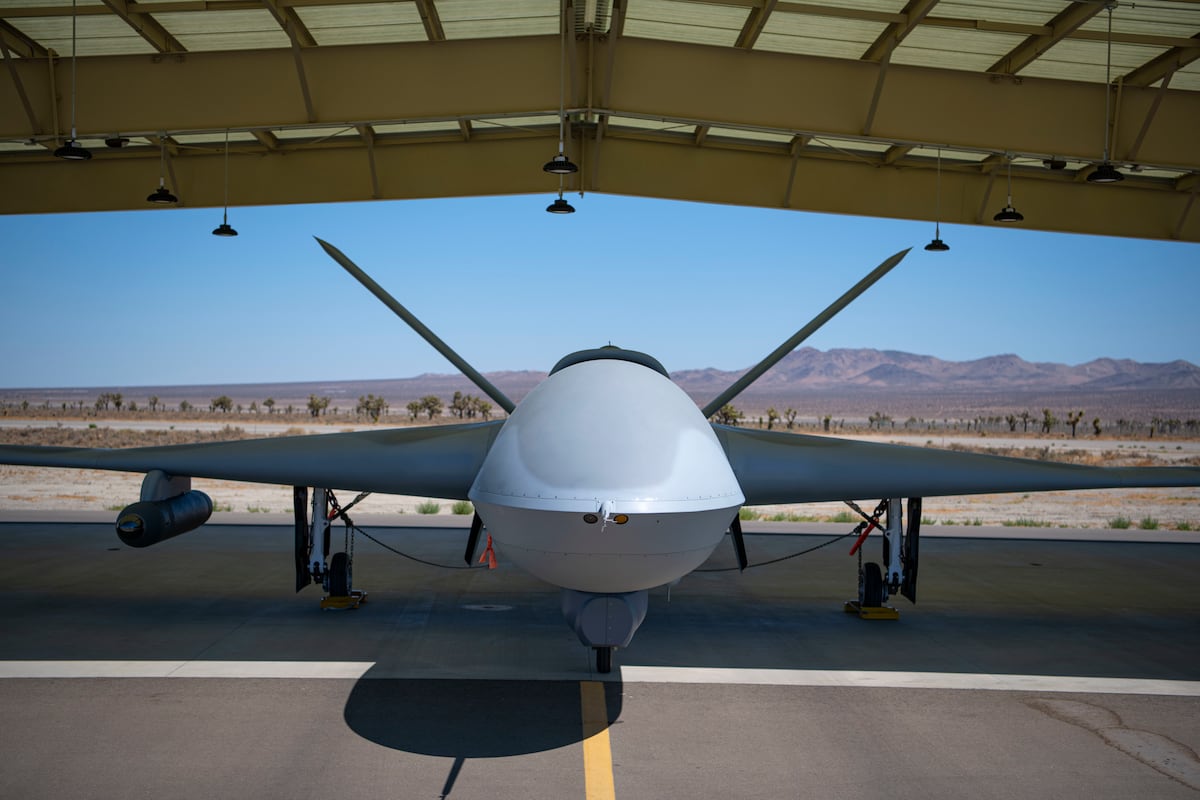
Technological Leap: Piloted and Unmanned Jets Collaborate in Air
The skies are witnessing a new era of collaboration between human pilots and unmanned aircraft. A Lockheed Martin F-22 Raptor stealth fighter pilot recently controlled an MQ-20 Avenger drone during a test flight, marking a significant step in human-machine cooperation, according to General Atomics.
The MQ-20 Avenger boasts advanced stealth capabilities, utilizing its internal storage to transport smaller drones and weapons. Equipped with unique engine technologies, it remains elusive to both radar and infrared detection. The drone is engineered to breach enemy defenses and deliver up to 3,000 pounds of precision-guided munitions.
“General Atomics is in a pretty unique situation here, given that we already have operational uncrewed jets to use for experimentation,” commented C. Mark Brinkley, a spokesperson for the company, in an interview with Defense News.
Brinkley emphasized the strategic advantage of the MQ-20, stating, “The MQ-20 Avenger, tricked out with mature mission autonomy software, is a perfect CCA surrogate and allows us to move fast and move first.” The term CCA refers to collaborative combat aircraft.
This unmanned aerial partner enhances the covert capabilities of the F-22 Raptor, a supersonic, multi-role stealth fighter described by the U.S. Air Force as unparalleled by any current or anticipated fighter aircraft.
“We don’t want to wait for the CCA fleet to be fielded to begin leaning in on F-22 teaming,” Brinkley explained. “We already know the F-22 will play a critical role in crewed-uncrewed teaming operations, and General Atomics is in a unique position to get started now.”
During the demonstration, the F-22 pilot managed the Avenger drone using a tablet integrated with systems developed by L3Harris. This included L3Harris Software‑Defined Radios and BANSHEE Advanced Tactical Datalinks.
The BANSHEE system is engineered for orchestrating drone swarms, enabling the control of multiple unmanned aerial vehicles within a formation. It can also be adapted to manage cruise missiles.
Reflecting on the company’s investment in unmanned jets, Brinkley stated, “We’ve been putting our own money into uncrewed jets for 17 years. This is just one more milestone in a long history of leaning forward.”