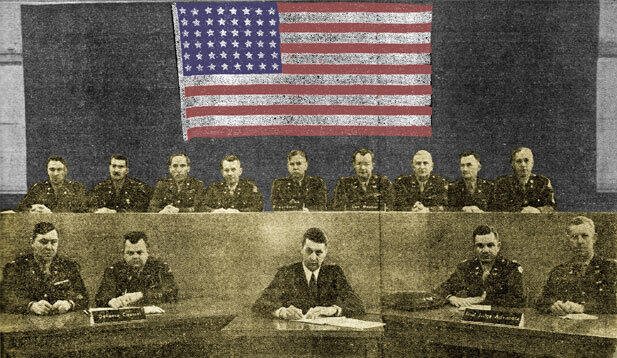
In a historical incident that unfolded during a turbulent period of World War II, Fort Lawton became the scene of a tragic occurrence involving racial tension and legal controversy. The events began with the death of an Italian prisoner of war, Guglielmo Olivotto, whose body was discovered hanging at the military site, leading to a series of accusations and trials that would resonate for decades.
The Initial Incident at Fort Lawton
Located on Magnolia Bluff above Puget Sound near Seattle, Fort Lawton served as a critical Pacific staging area during the war. Over one million soldiers passed through its gates, including 200 Italian POWs from the 28th Italian Service Unit, who arrived in May 1944. These Italians, unlike others, were not committed fascists but rather soldiers drafted into Mussolini’s army and later agreed to aid American operations, with restrictions.
Adjacent to the Italian compound were the barracks of the 650th and 651st Port Companies, comprised of Black soldiers. These units faced a stark contrast in treatment compared to the Italian POWs, who enjoyed more freedoms and leisure activities in Seattle. This disparity contributed to mounting racial tensions exacerbated by incidents like the forcible removal of a Black woman from a bus in March 1944.
On the night of August 14, 1944, a confrontation broke out between a Black soldier, Pfc. Willie Montgomery, and Italian POWs, culminating in a violent clash that involved up to 200 soldiers. Amid the chaos, Italian POW Guglielmo Olivotto was found dead, prompting an investigation that would later reveal significant irregularities.
Investigation and Trial
The Army’s investigation, led by Brig. Gen. Elliot Cooke, uncovered troubling details, including the role of Pvt. Clyde Lomax, a white military policeman. Witnesses alleged Lomax not only abandoned his duty but also incited violence. Despite these findings, Lomax faced minimal consequences, while 43 Black soldiers were charged, with three facing potential execution. A classified report, the Cooke Report, pointed to Lomax and systemic failures, but it was withheld from the defense.
Lt. Col. Leon Jaworski, later known for his role in the Watergate scandal, prosecuted the soldiers. His strategy relied on testimonies from Italian POWs and select soldiers, some with personal grievances against the accused. The defense, led by Maj. William Beeks, struggled due to limited preparation time and the suppression of critical evidence. Ultimately, 28 soldiers were convicted, with sentences ranging from six months to 25 years, followed by dishonorable discharges.
Aftermath and Reopening of the Case
Years later, journalist Jack Hamann revisited the case, uncovering the suppressed Cooke Report and a broader narrative of injustice. His book, “On American Soil,” catalyzed legislative action, and in 2007, the Army Board for Correction of Military Records overturned the convictions, acknowledging the wrongful prosecution.
In 2008, a formal ceremony at Discovery Park honored the exonerated soldiers. Samuel Snow, one of the convicted soldiers, expressed satisfaction upon receiving his honorable discharge, but passed away shortly after. Roy Montgomery, another accused soldier, also received an apology and discharge, finding peace in the resolution.
The Fort Lawton incident remains a poignant reminder of the complexities of wartime justice and racial dynamics in the military.
Sources: Jack Hamann, “On American Soil,” University of Washington Press, 2007; Dominic W. Moreo, “Riot at Fort Lawton, 1944,” iUniverse, 2004; Heather MacIntosh, Priscilla Long and David Wilma, HistoryLink.org; National Registry of Exonerations, UC Irvine Newkirk Center; The Seattle Times; National Archives AOTUS Blog; BlackPast.org; Washington State Historical Society; Friends of Discovery Park.