In a significant legal development, a U.S. Army soldier stationed at Fort Wainwright, Alaska, has been handed a lengthy prison sentence for his involvement in producing and distributing child sexual abuse material. This case underscores the growing challenge faced by authorities in tackling online child exploitation.
David Andres Mayoral, aged 21, has been sentenced to 32 years in federal prison following his guilty plea to multiple charges, including the production and possession of child pornography. As detailed in an announcement by federal prosecutors, Mayoral will also be under supervised release for life after serving his prison term.
Mayoral’s arrest stemmed from a federal grand jury indictment in March 2025, which came shortly after his apprehension outside Fairbanks. The judge presiding over the case emphasized the need to protect children from Mayoral’s persistent abusive actions.
According to U.S. Attorney Michael J. Heyman, Mayoral “hid behind the perceived anonymity of the internet” to exploit minors. The efforts of diligent investigators were crucial in uncovering his actions, as stated in the official release.
The case highlights the increasing burden on military and federal investigators as they confront a surge in child exploitation activities online, fueled by the widespread use of encrypted messaging apps and advanced AI technologies.
A Cybertip Cracked the Case
The investigation into Mayoral’s activities began in September 2024, following a tip from the National Center for Missing and Exploited Children. This tip was forwarded to the Army Criminal Investigation Division at Fort Eustis, Virginia, and involved five images uploaded to the chat platform Discord.
Upon reviewing the images, agents found content depicting prepubescent girls. Subsequent search warrants executed at Mayoral’s residence and on his electronic devices uncovered a trove of illicit files.
A forensic analysis revealed over 2,500 still images and more than 680 videos of child sexual abuse material, alongside approximately 1,000 computer-generated or AI-created files, as reported by the Justice Department. Some of the material depicted violent assaults on children.
According to court documents, Mayoral communicated with adults and minors on various platforms, discussing sadistic acts, encouraging self-harm, and attempting to locate potential victims for abduction. He also confessed to sexually abusing a 9-year-old child.
A Growing Online Threat
This case is indicative of a broader pattern tracked by the National Center for Missing and Exploited Children (NCMEC), which acts as a central repository for online child exploitation reports. In 2024, the NCMEC’s CyberTipline received 20.5 million reports, as detailed in the center’s data.
Reports of abuse imagery created using generative AI tools surged by approximately 1,325% in the same year, rising to about 67,000 from 4,700 the previous year. This increase has been identified as one of the most alarming trends by the NCMEC.
The center also recorded over 1,300 reports in 2024 related to violent online groups that promote sadistic behavior and self-harm among minors, representing a 200% increase from 2023.
Special Agent in Charge Michele Starostka from the Army CID’s Western Field Office remarked on the case, indicating the ongoing commitment to apprehending those who exploit children, as noted in the Justice Department release.
The investigation was conducted by the FBI’s Anchorage Field Office and Army CID through the bureau’s Child Exploitation and Human Trafficking Task Force, with Assistant U.S. Attorney Carly Vosacek leading the prosecution.
The case falls under Project Safe Childhood, a Justice Department initiative established in 2006 to combat online child predators by coordinating resources at federal, state, and local levels.
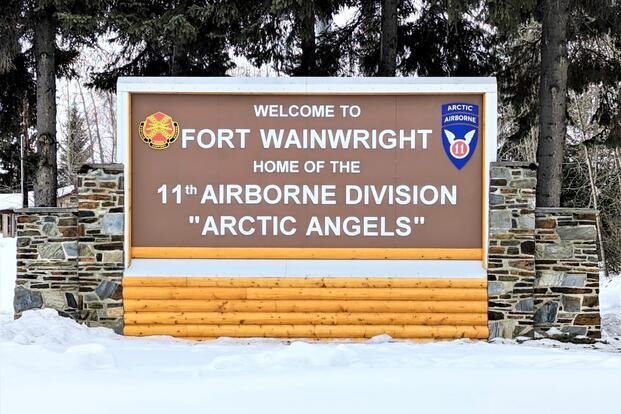
Fort Wainwright, located near Fairbanks, serves as the headquarters for U.S. Army Garrison Alaska and accommodates units of the 11th Airborne Division, according to its public affairs office. The installation covers an area of more than 1.6 million acres in interior Alaska.