With France’s ongoing efforts to extend its military reach into the near-space region, the nation is making significant strides to secure this contested environment. Recently, France successfully demonstrated its capability by shooting down target balloons over 20 kilometers high, signaling a new phase in its defense strategy.
France is enhancing its radar systems to detect and intercept high-altitude objects ranging from 20 to 100 kilometers. Philippe Koffi from the Directorate General for Armament highlighted that this involves adapting current fighter jets and air defenses. Future plans include deploying lasers, space planes, and stratospheric drones.
At the Paris Air Show, Armed Forces Minister Sebastien Lecornu emphasized the growing militarization of near-space, drawing parallels to developments in low Earth orbit and the ocean floor. The 2023 incident involving a Chinese high-altitude balloon over the United States, which was later shot down, was frequently referenced by officials when discussing France’s strategy.
Brig. Gen. Alexis Rougier, tasked with leading very high altitude initiatives within the French Air and Space Force, explained, “As technology develops, we will collectively be flying higher and faster, and therefore investing in this altitude range between 20 and 100 kilometers, for both civilian and military purposes.”
Rougier also pointed out the legal ambiguities surrounding near-space. While international agreements like the Chicago Convention and the Outer Space Treaty define airspace and outer space, they do not clearly delineate the boundary between them. “Beyond the international legal ambiguity on this point, the challenge lies in our capacity to climb so high and so quickly to enforce sovereignty,” he said.
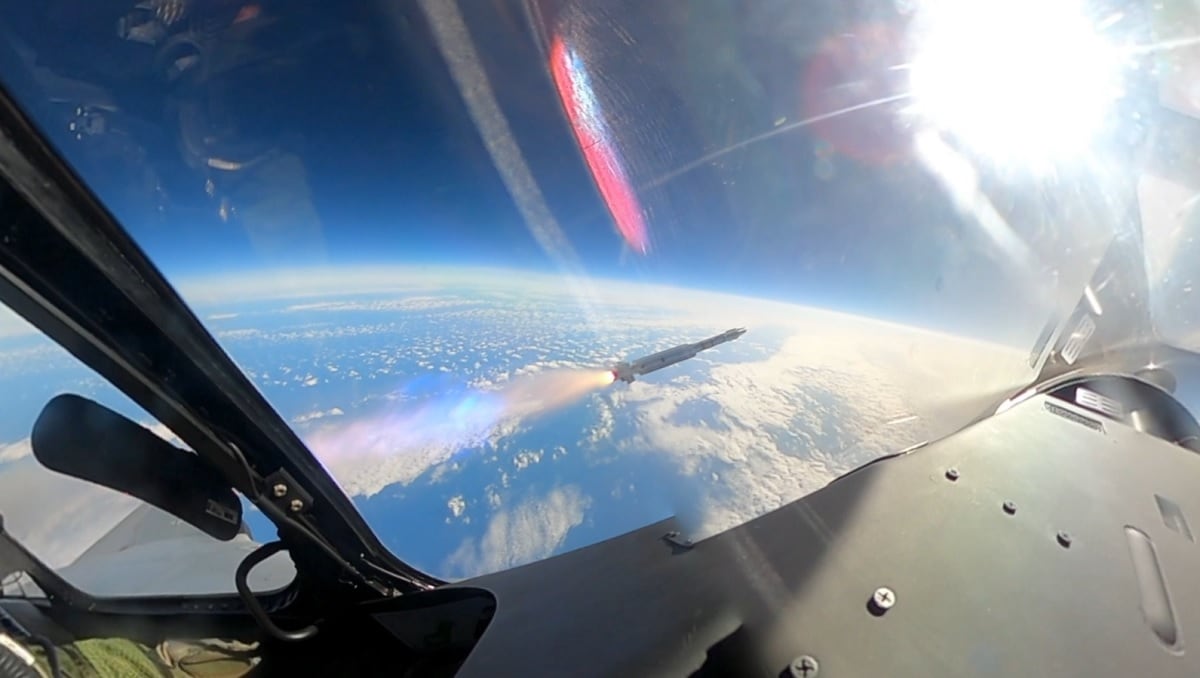
In the recent test, a Rafale and a Mirage aircraft successfully fired MBDA Mica missiles at balloons above 20 kilometers, marking a significant step in optimizing radar and missile guidance systems. Emmanuel Chiva, head of the DGA, shared insights from the test with a parliamentary defense committee.
France is advancing its radar capabilities, particularly the Thales GM400 and GM200, by incorporating artificial intelligence to detect complex near-space objects. For early missile detection, France is turning to Thales’ long-range UHF alerter and the Nostradamus over-the-horizon radar, which has been operational since the early 2000s and can detect stealth and hypersonic aircraft over vast distances.
Beyond radar technology, France is investing in the European Odin’s Eye satellite constellation for enhanced space-based detection. Koffi indicated that this system should be operational by 2030.
To intercept high-altitude threats, France is assessing the next-generation SAMP/T air-defense system and developing a 50-kilowatt laser capable of disabling optics on satellites and balloons by 2030.
In terms of operational capabilities in near-space, projects like the Stratobus airship are underway, focusing on surveillance and communication. Other projects include testing the BalMan maneuverable balloon by year-end and the Airbus Zephyr drone by the end of the summer.
The initial budget allocation for near-space projects, such as Nostradamus and BalMan, is approximately €10 million, with plans for significant increases as part of future defense budgets. Koffi noted that future weapons programs would need to integrate near-space considerations, including the Future Combat Air System.
Lecornu stressed the importance of avoiding a repeat of France’s past experiences with drones, where it lagged behind other nations. Emmanuel Chiva affirmed the commitment of the DGA to equip the armed forces with necessary capabilities in this domain, underscoring its importance for national sovereignty.
Furthermore, France has partnered with Dassault Aviation to develop a reusable space-plane demonstrator called Vortex, allocating €30 million of its €70 million budget. The demonstrator is expected to fly by late 2027 or early 2028, with potential missions including reconnaissance and strike operations.
Chiva underscored the necessity of a space plane, stating, “We want to be able to launch satellites reactively, for example, or carry out operations in orbit. A space plane is absolutely necessary.”